Vietnam itinerary: two weeks from Hanoi to Ho Chi Minh City, or 10 days
For a first two-week trip to Vietnam, this route works well: Hanoi, a night in Ha Long Bay or Ninh Binh, Hue, Hoi An, Da Lat or Nha Trang, then Ho Chi Minh City. Fly the long hops, take the train where it is short or scenic, and fly into one end and out of the other so you don’t have to backtrack. With 10 days, drop a stop rather than rushing all of them.
By Da Lat LoversPublished Updated

A northbound train on a cliffside stretch of the North-South railway on the central coast. Photo: Michael Quick / CC BY 2.0
The two-week route, day by day
Vietnam is long and thin: Hanoi to Ho Chi Minh City is about 1,150 km (700 miles) as the crow flies and more than 1,700 km (1,050 miles) by rail. Trying to see everything is how two weeks turn into ten travel days. The route below keeps it to six bases and gives the places worth slowing down for, like the bay and the old towns, enough time.
| Days | Where | How you get there |
|---|---|---|
| 1-3 | Hanoi, with a day trip to Ninh Binh | Fly in to Hanoi (Noi Bai, about 30 km from the Old Quarter) |
| 4-5 | Ha Long Bay, one night on a boat | Cruise shuttle from Hanoi, about 3-3.5 hours |
| 6-7 | Hue | On day 5, return to Hanoi after the Ha Long cruise, then take an evening flight or the night train to Hue. Pick your departure time once you know when the cruise shuttle drops you off. |
| 8-10 | Hoi An (Da Nang next door) | Heritage train or car over the Hai Van Pass |
| 11-12 | Da Lat or Nha Trang | Short direct flight from Da Nang |
| 13-14 | Ho Chi Minh City | Flight of about an hour on day 13; fly home from here on day 14 |
Add Phu Quoc at the end if you have three more days and the season suits a beach (December to March is the driest stretch). If you would rather do Ninh Binh as an overnight than a day trip, take a night off Hanoi, not off Hue or Hoi An.
Getting between stops: flight, train or sleeper bus
A simple rule: if a leg takes more than about eight daytime hours on the ground, fly, unless there is a night train and you can sleep on it. Domestic flights are short, but door to door, with the airport run, check-in and the ride into town, each one still takes about half a day. Trains are best on short or scenic legs, and a night train saves you a hotel night. Sleeper buses fill the gaps where there is no railway, mainly up to Da Lat.
| Leg | Best option | Time |
|---|---|---|
| Hanoi to Ha Long Bay | Cruise shuttle or private car | 2.5-3 hours by car; shuttles stop on the way, so allow 3-3.5 |
| Hanoi to Ninh Binh | Minivan or train | About 2 hours either way |
| Hanoi to Hue | Flight, or the night train | Flight about 1 hour 15 minutes; night train about 12.5-13 hours |
| Hue to Da Nang / Hoi An | Heritage train, or car through the Hai Van tunnel | Train 3-4 hours; car about 2 hours to Da Nang, then 30-50 minutes to Hoi An |
| Da Nang to Da Lat | Direct flight | About 1 hour; only a few flights a day |
| Da Nang to Nha Trang | Flight, or day train | Flight about 1 hour 10 minutes to Cam Ranh, 35 km from town; train 9-11 hours |
| Nha Trang to Da Lat | Bus or limousine van (no train, no flight) | About 145 km over Khanh Le Pass, 5-6 hours; travel in daylight |
| Da Lat to Ho Chi Minh City | Flight, or bus | Flight about 1 hour; bus 5-8 hours for roughly 300 km |
| Nha Trang to Ho Chi Minh City | Flight, or night train | Flight about 1 hour; train 7.5-10 hours |
| Ho Chi Minh City to Phu Quoc | Flight | About 1 hour, several flights a day |
The night train
The North-South trains (the Reunification Express) leave Hanoi for Hue every evening, and the faster ones get in around breakfast time: SE3 leaves at 7:20 pm and arrives about 7:50 am, and SE19 leaves at 7:45 pm and arrives about 8:45 am. Book a soft sleeper, a four-berth compartment with a door; the six-berth hard sleeper is cheaper and more cramped. The same evening trains stop at Ninh Binh about two hours after leaving Hanoi, so if Ninh Binh is your last night before Hue, you can board there instead of going back to the city. Check that your train stops there, and at what time.
Search and buy on dsvn.vn, the Vietnam Railways site, which has an English version. Around Tet, the Lunar New Year (February 6 in 2027), and over the April 30-May 1 and September 2 holidays and the summer break, Vietnamese families travel too, and both train tickets and flights sell out early. Book the long legs first.
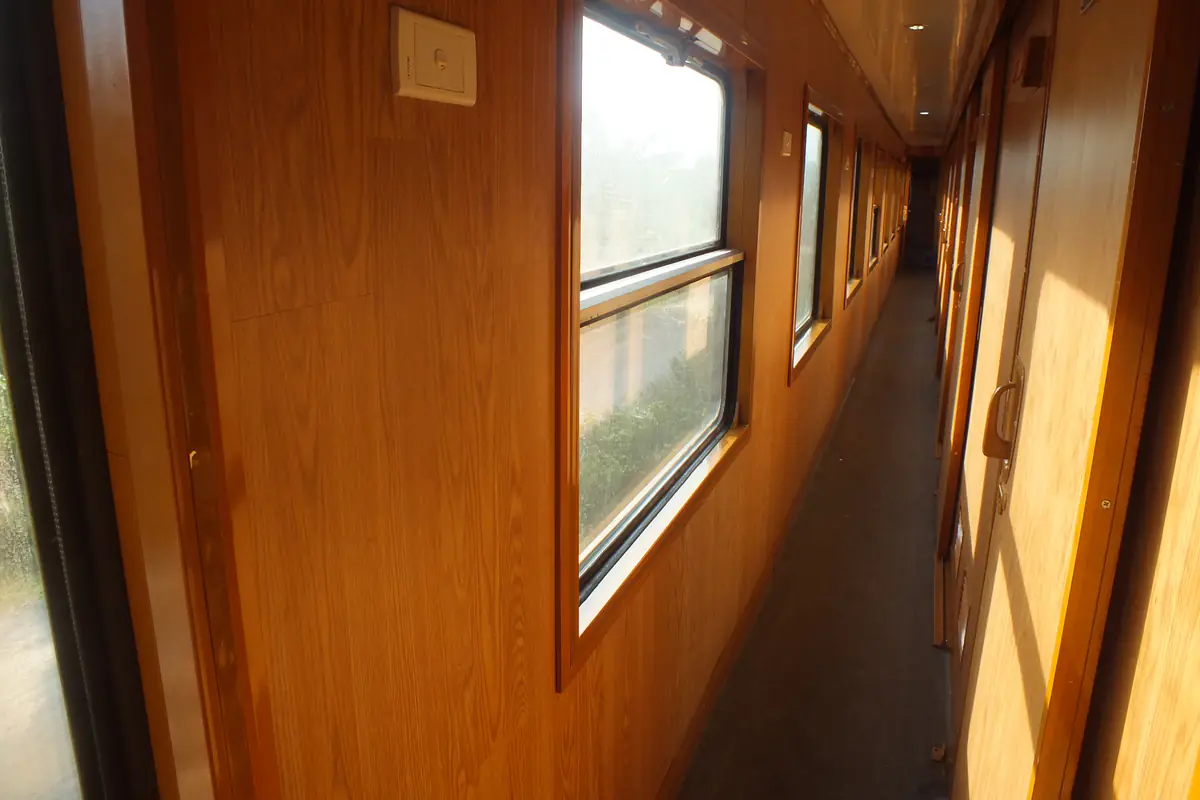
South of Da Nang, the train is less useful for this route: Da Nang to Nha Trang is a full day on the rails, against an hour in the air. The one southern leg where it still works well is Nha Trang to Ho Chi Minh City overnight. The upgraded SNT1 leaves Nha Trang at 8:20 pm and reaches Saigon station at 5 am.
Sleeper buses
You lie in a short, semi-reclined berth, two tiers high, with your shoes in a bag. They are cheap and run everywhere, but plenty of people sleep badly, and if you are over about 6 ft (1.8 m), you won’t be able to stretch out. On this route, the bus makes sense in two places: Nha Trang to Da Lat, where there is no train or direct flight, and Da Lat to Ho Chi Minh City if you would rather save the airfare.
Mountain roads to Da Lat

What each stop is for, and how long to give it
Hanoi: two or three nights
Hanoi is about eating and walking: the Old Quarter, Hoan Kiem Lake, the weekend walking street, coffee on a small plastic stool. Two nights is the minimum; three lets you fit in a day trip. If you are there in November or December, bring a proper jacket: Hanoi is cooler and grayer than many people expect, and it is the season for poor air quality. With extra days, the mountains around Sapa are a separate two- or three-day trip from here, not something to squeeze in.

Ha Long Bay or Ninh Binh: one of each, or pick one
These are the two big karst landscapes near Hanoi, and they feel different. Ha Long is limestone islands in the sea, seen from a boat; a Ha Long Bay cruise is worth an overnight if you want the bay in the evening and early morning, though winter wind can delay or cancel sailings. Ninh Binh is the same kind of limestone on land: a small rowboat takes you along rivers, through caves and past rice fields and temples, and it works as a day trip. With two weeks, do both. For a 10-day trip covering both northern and southern Vietnam, choose one: Ha Long if you want a night on the water, Ninh Binh if you would rather not spend six hours on a shuttle bus for one night.
Hue: two days
Hue, the old imperial capital, is quieter than Hanoi and Hoi An, and it rewards slow days. Allow one day for the Imperial City and Thien Mu Pagoda, and another for the royal tombs along the Perfume River.
To leave, the Hue to Da Nang train follows the coast over the Hai Van Pass and is one of the best short rides in the country. A car through the tunnel is faster, and a private car over the pass itself lets you stop at the top and at Lang Co beach.
Hoi An and Da Nang: three nights
Base yourself in Hoi An and use Da Nang for the airport and day trips. The Old Town is best early in the morning and after dark, when the lanterns are lit; if your dates include the 14th day of a lunar month, the Hoi An lantern festival is worth planning around. Three nights leave room for a beach afternoon, a cooking class or tailor fitting, and a day trip such as Ba Na Hills and the Golden Bridge, which is often wet and foggy at the top from October to December.

Da Lat or Nha Trang: two nights
This is the stop where you have to choose. Da Lat is the cool highland town: pine hills, coffee farms, flower gardens, nights around 15°C (59°F). Nha Trang is the beach city, with island boat trips and diving. If you have had your fill of heat, go up to Da Lat. If you want the sea, go to Nha Trang, but not in October and November, its wettest months.
You can do both by going Nha Trang, then road to Da Lat, then flying to Ho Chi Minh City. That adds two days; dropping the Ha Long overnight frees them. For a beach that is easy from Ho Chi Minh City instead, Mui Ne is four to five and a half hours by bus; its kitesurfing and sand dunes are at their best in the windy dry season.
Ho Chi Minh City, the Mekong Delta or Phu Quoc
Saigon is a good place to finish: big, fast, packed with street food, and with plenty of international flights home. With arrival and departure flights in these last two days, focus on Ho Chi Minh City. For a full Mekong Delta day, add a night or take one from an earlier stop. My Tho and Ben Tre are about 70-85 km away, which makes a comfortable day trip by boat-and-bus tour or car. Can Tho is about 170 km, so for its early-morning Cai Rang floating market, stay a night.

For an island finish, Phu Quoc is an hour's flight away, and its driest months are December to March. Phu Quoc’s own 30-day visa exemption is only for travelers who enter Vietnam at Phu Quoc and stay on the island, so on this route you need your normal visa or visa-free stay.
Only 10 days? Cut a stop, not the time per stop
Every move costs about half a day, so the trick with 10 days is fewer bases, not shorter visits. Two versions that work:
| North and center | North to south, faster |
|---|---|
| Days 1-3: Hanoi, with a Ninh Binh day trip | Days 1-3: Hanoi, with a Ninh Binh day trip or a night on Ha Long Bay |
| Days 4-5: Ha Long Bay overnight | Days 4-6: Hoi An (fly Hanoi to Da Nang, about 1 hour 20 minutes) |
| Days 6-7: Hue | Days 7-8: Da Lat (fly from Da Nang) |
| Days 8-10: Hoi An, then fly out of Da Nang | Days 9-10: Ho Chi Minh City, fly home |
The first suits a first trip and has only one long leg, Hanoi to Hue (fly or take the night train). Check that you can fly home from Da Nang on your airline, or allow for a domestic connection. The second covers the length of the country and skips Hue; if Hue matters more to you than Da Lat, swap them and fly Hue to Ho Chi Minh City instead.
Adjust the route by season
Vietnam never has good weather everywhere at once. September to December is the central coast's rain and flood season, worst in October and November, so keep Hue and Hoi An short and book rooms you can change or cancel: floods can close sites and cut roads and railways for a day or more. If there is a flood or landslide warning on your next leg, move that leg rather than pushing on to keep the schedule.
If you want beach days in those months, finish on Phu Quoc from December rather than Nha Trang. From May to August, it is the other way round: the central coast is hot and mostly dry, its beach season, while the north is humid with heavy showers, so give the center more nights and the north fewer.
Fly in to Hanoi, out of Ho Chi Minh City
Book a multi-city (open-jaw) ticket: arrive in Hanoi, leave from Ho Chi Minh City, or the other way round. A return ticket to one city means flying back up or down the country at the end, about two hours in the air plus half a day of transfers. Search the multi-city option on your airline or a comparison site, and compare it with a return ticket plus a domestic one-way. If you book separate tickets, leave at least three to four hours for any international connection, because a delay on one is not the other airline's problem.
Which way round? Late in the year, north to south works well: Hanoi is dry and mild in October and November, and the south turns dry as you arrive. From January to March, starting in the warm south and ending in a cool Hanoi is just as good.
Before you book
- Visa: UK, German and French passports get 45 days visa-free, Singapore 30 days and the Philippines 21 days. US, Australian and Indian travelers need a visa, usually the e-visa (up to 90 days). Before you book, look up your own passport in our Vietnam visa and entry guide and make sure your days cover the whole route, including the day you fly out.
- Data: drivers, hotels and cruise operators will message you about pickups, so get a Vietnam eSIM or SIM card sorted before your first transfer.
- Money: carry some Vietnamese dong in cash for street food, markets and small hotels, and use ATMs or cards for the bigger bills.
- Luggage: pack light enough to carry onto the train yourself and fit in the compartment, and leave space for coffee and cashews. Before you buy gifts to take home, check what your home country lets you bring in.
FAQ
Is two weeks enough for Vietnam?
Enough for one end-to-end trip with six bases, as long as you fly the long legs. It is not enough to add Sapa, Ha Giang or the far south as well without dropping something.
Is the night train from Hanoi to Hue worth it?
It is if you sleep reasonably on trains: you save a hotel night and arrive in the morning. Book a four-berth soft sleeper. If you sleep badly, the flight takes about 1 hour 15 minutes.
Can I skip Hanoi and start in Da Nang?
Yes, if the north is not a priority. Hoi An, Hue, then Da Lat or Nha Trang and Ho Chi Minh City makes a relaxed 10 days. Just check the central coast season first, since September to December is its rainy, flood-prone stretch.