Vietnam currency for travelers: cash, ATMs, cards and where to exchange
Vietnam uses the dong (VND), and day to day you pay in dong, in cash or by card, not in US dollars. For most trips the simplest setup is to withdraw dong from ATMs with a debit card from home and pay by card at hotels and larger shops. If you bring cash, change it only at a licensed place such as a bank, an airport counter or an authorized exchange agent; travelers who change money at unlicensed places can be penalized too.
By Da Lat LoversPublished Updated How we review
Exchange rates: what the dong is worth
When you hand over foreign cash for dong, you get the counter's cash buying rate, the rate at which it buys your cash. These are Vietcombank's rates at 1:24 a.m. on October 26, 2026, as a rough guide. Banks update rates several times a day and each counter posts its own, so check Vietcombank's rate page and the board at the counter before you hand over money.
| Currency | Cash buying | Transfer buying | 1,000,000 VND ≈ |
|---|---|---|---|
| US dollar | 25,610 | 25,640 | US$39 |
| British pound | 33,701 | 34,041 | £29 |
| Euro | 28,219 | 28,504 | €35 |
| Australian dollar | 17,668 | 17,847 | A$56 |
| Singapore dollar | 19,682 | 19,881 | S$50 |
At those cash rates, US$100 would have fetched about 2,561,000 dong at Vietcombank, £100 about 3,370,000 and A$100 about 1,767,000. For quick sums, knock three zeros off a dong price and divide by 25 to get US dollars: 100,000 dong is a little under US$4.
Not every currency is bought as cash. Vietcombank lists no cash rate for the Malaysian ringgit or the Indian rupee, and the Taiwan dollar isn't on its board at all; if yours is one of these, bring US dollars or rely on cards. The State Bank's central rate (25,627 dong per US dollar for October 24, 2026) is a reference for banks, not a rate you can get at a counter.
Vietnamese banknotes, and the pairs that get mixed up
Everyday money is six plastic (polymer) notes from 10,000 to 500,000 dong. Older paper 1,000, 2,000 and 5,000 notes still turn up in your change. Price tags and menus often drop the zeros: "50K" or just "50" means 50,000 dong.
| Note | Main color | Size | Reverse |
|---|---|---|---|
| 10,000 | Dark brown on a yellow-green background | 132 x 60 mm | Offshore oil rigs |
| 20,000 | Dark blue | 136 x 65 mm | Japanese Covered Bridge, Hoi An |
| 50,000 | Red and purplish brown | 140 x 65 mm | Nha Rong Wharf, Ho Chi Minh City |
| 100,000 | Dark green | 144 x 65 mm | Temple of Literature, Hanoi |
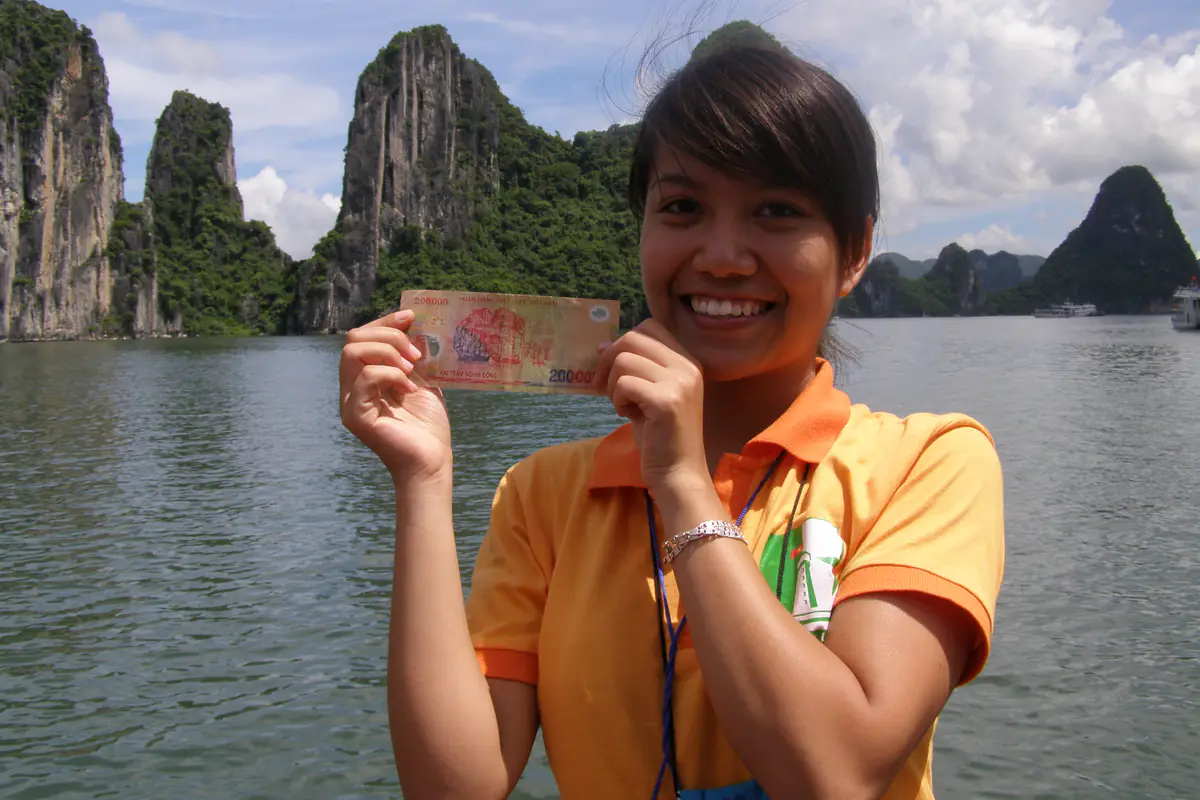
| 200,000 | Reddish brown | 148 x 65 mm | Ha Long Bay |
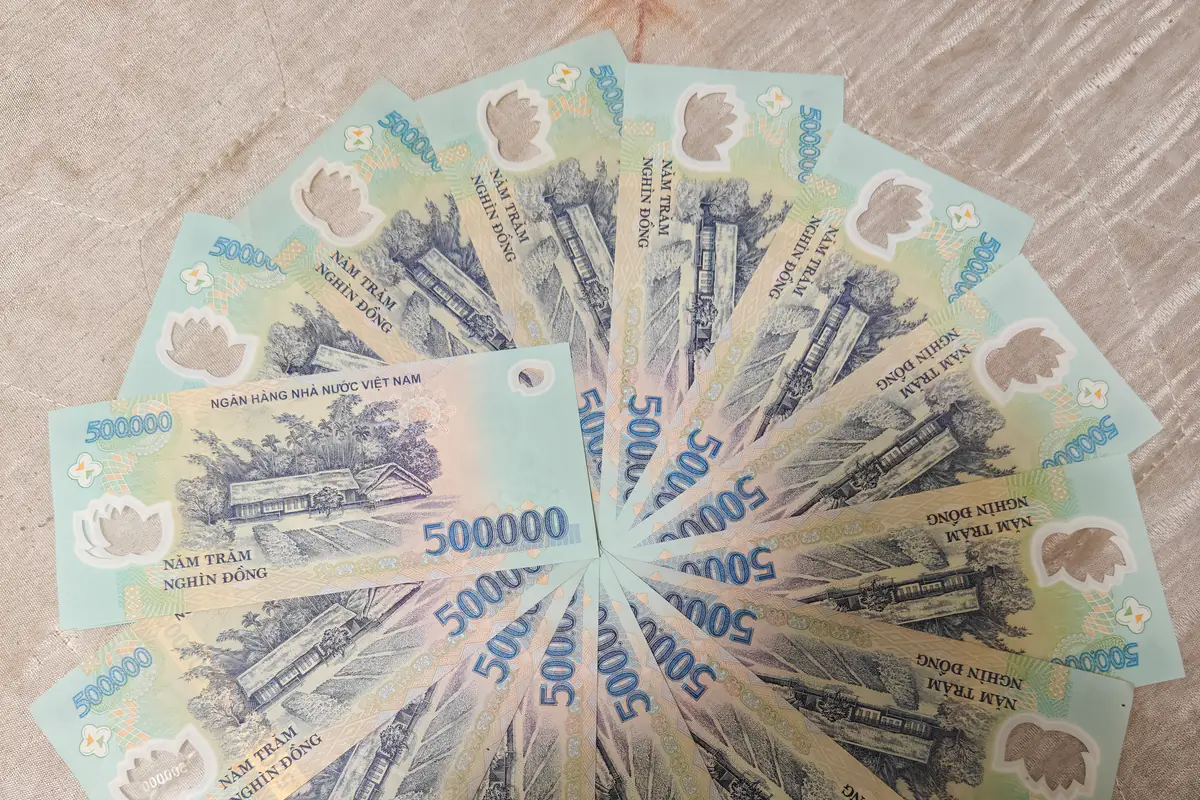
| 500,000 | Blue and bluish purple | 152 x 65 mm | Ho Chi Minh's childhood home, Kim Lien |
Three pairs to double-check
- 20,000 and 500,000. Both are blue. The 500,000 is 1.6 cm longer and shows a thatched house among trees; the 20,000 shows the covered bridge. This is the expensive mistake: handing over the wrong one costs you 480,000 dong, close to US$19.
- 10,000 and 100,000. Both start with "10" and both have a green tint. Count the zeros; the 10,000 is also noticeably shorter and narrower.
- 10,000 and 200,000. Both lean reddish brown, which is easy to miss in a dark taxi. This pair has been used in note swaps (see the scams section).
Keep notes sorted by value, put the 200,000s and 500,000s in their own pocket, and say the amount out loud as you pay.
Getting cash: ATM or exchange counter?
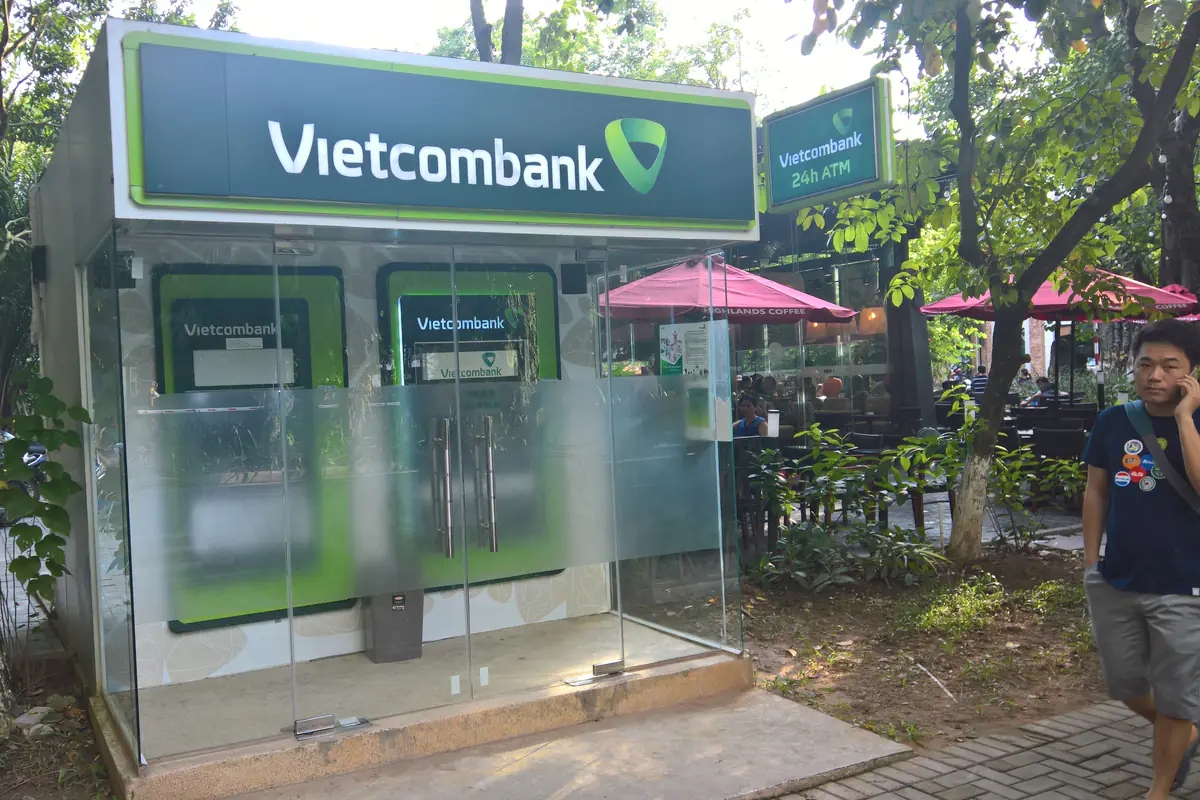
In cities and tourist towns, an ATM and a debit card from home is usually the easiest way to get dong. You can be charged twice:
- By your own bank: a foreign ATM fee and a foreign transaction fee. Taking cash on a credit card can also count as a cash advance, with its own fee and interest from the day you withdraw. Check your bank's fee page or app before you fly.
- By the Vietnamese bank that owns the ATM: some charge foreign-issued cards, and the amount varies by bank and card type. If the screen shows a fee you don't like, cancel and try another bank's machine.
The most you can take per withdrawal also varies by bank and by machine, and the screen shows the amounts on offer. Larger sums may take several withdrawals, each with its own fee. Online lists of "free ATMs in Vietnam" go out of date quickly, so trust what the screen says on the day.
If the machine offers to charge you in your home currency, decline and continue in dong (VND); the ATM's own conversion rate is usually worse than your card network's. Use machines inside bank branches or malls during banking hours, so there's someone to help if a machine keeps your card, and carry a second card in a different place.
Where you can legally exchange cash
| Where | Good for | Watch for |
|---|---|---|
| Airport exchange counters | Cash on arrival, especially late at night | Rates vary by counter and are usually weaker than in town. Ask how much dong you'll get before you hand over cash, and change only enough for the first day. |
| Banks | Larger amounts, a proper receipt | Bring your passport and go during opening hours. You get the bank's posted rate. |
| Licensed exchange agents (often gold shops or hotels) | Changing money in town after bank hours | Legal only if the shop is an authorized agent of a bank; see below. |
Is changing money at a gold shop legal?
Only if the shop is a licensed exchange agent. Under Decree 340/2025/ND-CP, in force since February 9, 2026, the person changing the money can be penalized too, which means the traveler, not just the shop:
- Under US$1,000 (or the equivalent): a warning. Repeat or multiple offenses: a fine of 10-20 million dong.
- US$1,000 to under US$10,000: a fine of 10-20 million dong (about US$390-780), plus confiscation of the currency and dong involved.
- Larger amounts carry higher fines, and a business that breaks the rule, such as an unlicensed gold shop, pays double.
The full scale is in the Vietnamese Government portal's summary of Article 27 (in Vietnamese). A licensed agent has to post its buying and selling rates and display a sign with the name of the authorizing bank and the agent. If you can't see both, go to a bank. Skip anyone offering a great rate on the street or in a market: on top of the fine, that's where short counts and fake notes happen.
Paying by card, Grab and QR codes
Visa and Mastercard work at hotels, supermarkets, malls, coffee chains and larger restaurants. Street food, markets and small family-run places mostly take cash or a bank transfer by QR code. Some places add a surcharge for cards, so ask before you tap.
The QR codes stuck on counters are for transfers from Vietnamese banking apps, so a visitor without a Vietnamese bank account usually can't use them. Some overseas payment apps are linked to Vietnam's QR network: China (Alipay, Weixin Pay, UnionPay), South Korea (Toss and Hana apps), Singapore (LiquidPay, Aleta Planet, DCS DeCard, Starryblu), Thailand, Laos and Cambodia. They work only at participating merchants that accept international QR payments (VIETQRGlobal, for the Korean link), not with every Vietnamese QR code, so confirm before you pay and keep cash as a backup. The lists published up to August 2026 include no US, UK, Australian or European apps, so plan on cards and cash.
Grab rides can be paid in cash or with an international card added in the app. Install the app and add your card before you leave home, when your bank's verification step is easier to complete, and keep small notes if you plan to pay cash.
Tipping in Vietnam
Tipping isn't expected. Nobody at a street stall, cafe or taxi is waiting for one, though leaving the small change is a nice gesture. Restaurants and hotels often add a service charge line to the bill alongside VAT; if it's there, you don't need to add a tip.
Guides, drivers on private tours and spa therapists are the people travelers most often tip. The amount is up to you; if you tip, hand it to the person who looked after you.
How much cash to carry
There's no single number, since costs depend on the city and how you travel. This split usually works:
- Change or withdraw enough for the first stretch: the ride to your hotel, a SIM or eSIM if you haven't sorted one out, your first meal. Check the fare in a ride-hailing app beforehand so you know roughly what you need.
- After that, withdraw a few days' worth at a time to keep the number of ATM fees down.
- Keep 10,000 to 50,000 notes for parking, water and street food; small vendors often can't break a 500,000.
- Pay hotels, flights and booked tours by card or online.
Bringing more than US$5,000 (or the equivalent) or more than 15 million dong in cash means you must declare it at customs on arrival.
Money scams and how to avoid them
- The note swap. Around early November 2025 in Nha Trang, a taxi driver was accused of taking a 200,000 note from two South Korean tourists, swapping it for a 10,000 and claiming they had underpaid; police in Khanh Hoa questioned him after the video spread. If someone says you paid too little, don't hand over more straight away. Look at the note in their hand and say its value.
- Vague prices. "Fifty" can mean 50,000 or 500,000. Ask again, or have the seller type the number on a phone.
- Short or strange change. Count your change before you leave the counter or get out of the car. In Hanoi, a taxi driver once gave tourists joss paper (fake "hell money" burned as offerings) as change.
- Street money changers. Besides being illegal, these deals are where fake notes and sleight of hand while counting happen.
Booking rides through an app with an upfront fare, and paying by card in the app, takes most change problems out of the car.
FAQ
Can I pay in US dollars in Vietnam?
Don’t plan on it. Vietnamese law bans paying for goods and services in foreign currency, apart from places allowed to take it such as duty-free shops, and the person paying can get a warning too. Pay in dong or by card.
Should I get Vietnamese dong before I leave home?
Only a little, and only if your bank sells dong at a fair rate. US dollars, pounds, euros and Australian dollars are bought as cash by Vietnamese banks, so changing them after you land, or using an ATM, is usually simpler.
What should I do with leftover dong?
Changing dong back means paying the spread a second time, and the counter may ask for paperwork, so withdraw close to what you need and spend the small notes before your flight. Taking more than 15 million dong in cash out of Vietnam also has to be declared.