Hue, Vietnam from October to December: what to see and how to plan for floods
Two full days cover Hue’s main sights: one for the Imperial City and Thien Mu Pagoda, one for the tombs of Tu Duc, Khai Dinh and Minh Mang. October to December is the flood season, and the monuments can close when they flood. Add a spare day if your schedule allows, and choose accommodation with flexible cancellation or date changes. The Imperial City costs VND 200,000 (about $8); a four-site combo with the three tombs is VND 530,000 (about $21) and lasts two days (prices on the official e-ticket system, October 26, 2026).
By Da Lat LoversPublished Updated How we review
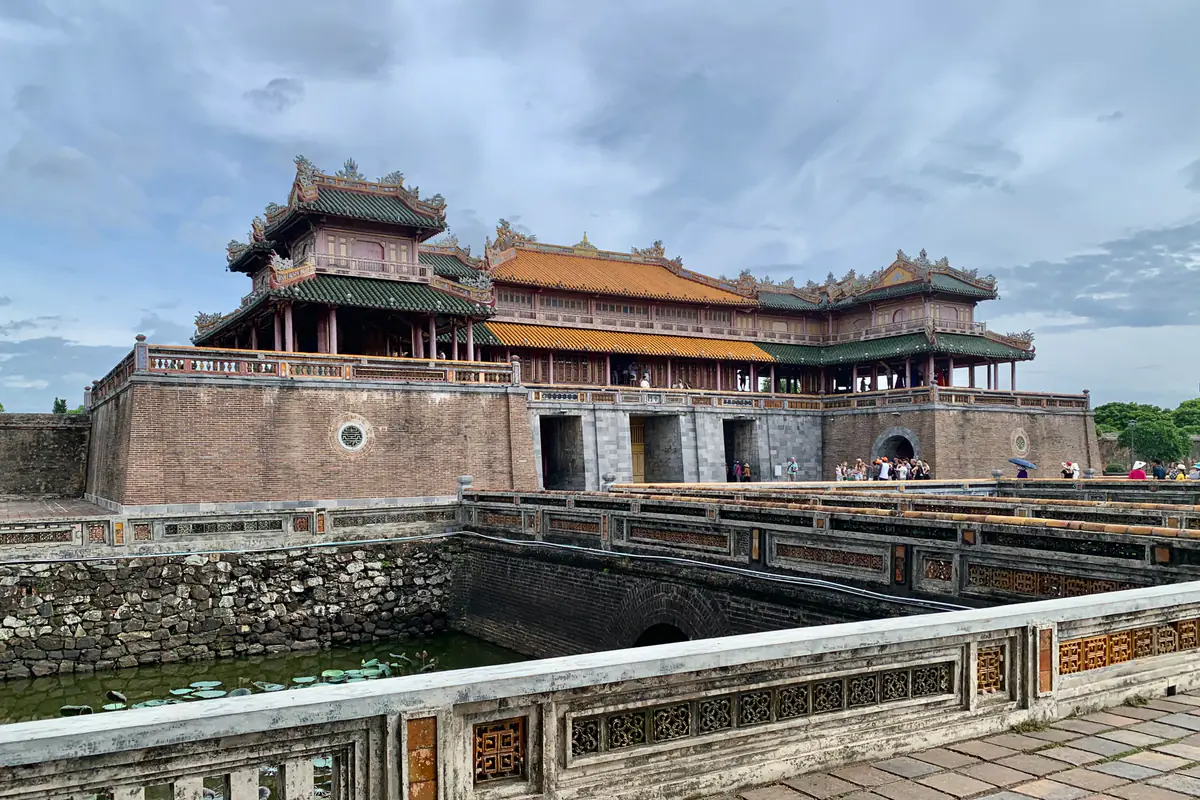
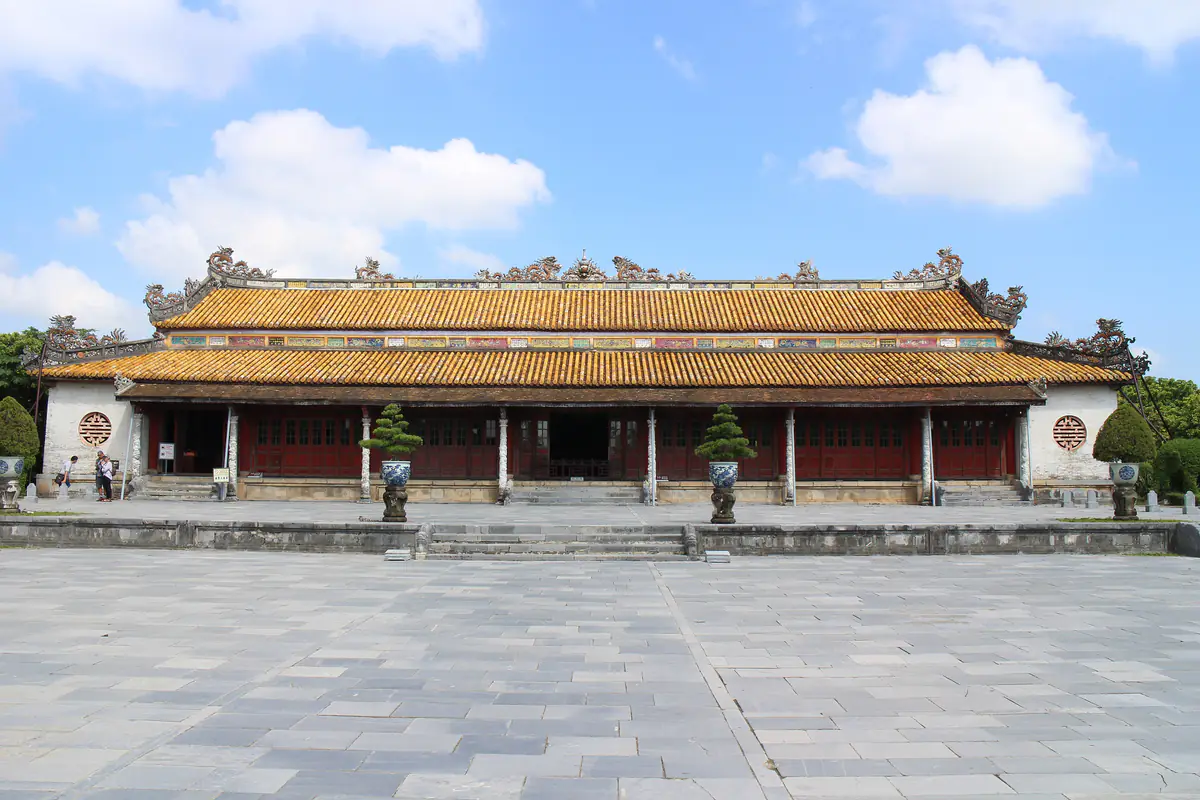
Ngo Mon, the main gate into Hue’s Imperial City, on a cloudy morning in July 2024. Photo: Chainwit. / CC BY 4.0
How many days in Hue, and how to plan in the rainy season
Hue’s big sights sit in two places. The Imperial City is inside the old citadel in the middle of town, and the three most visited royal tombs are spread over the hills to the south, about 6 to 14 km from its main gate. That shapes a simple plan:
- Day 1: the Imperial City in the morning, lunch in town, then Thien Mu Pagoda, about 4 km upriver, in the afternoon. Walk along the Perfume River in the evening.
- Day 2: the tombs by taxi or a car hired for the day, in the order Tu Duc, Khai Dinh, Minh Mang. With driving between them, the three usually fill most of a day.
- Day 3, if your schedule allows: a buffer. If day 2 is a downpour, move the tombs here. If the weather holds, add the Royal Antiquities Museum, Gia Long’s tomb or Dong Ba market.
If rain is manageable and the sites remain open, choose a shorter central itinerary, such as the Imperial City or the museum. Most of the Imperial City is open courtyards and paths, so you still need rain gear. Postpone sightseeing during flood warnings or when people are told to stay off the roads. The tombs are out in the hills on stone and brick paths that get slippery, and Khai Dinh involves a lot of steep steps.
Imperial City and tomb tickets: prices, combos, opening hours
Foreigners and Vietnamese pay the same. The prices below come from the Hue Monuments Conservation Centre’s e-ticket system, checked October 26, 2026, and match the Centre’s price notice in force since January 1, 2023. Recheck them on the Centre’s e-ticket site shortly before you go. Child prices are for ages 7 to 12; for other ages and concessions, ask at the ticket desk.
| Ticket | Adult | Child 7-12 | Valid |
|---|---|---|---|
| Imperial City | 200,000 (about $8) | 40,000 | - |
| Tu Duc, Khai Dinh or Minh Mang tomb (each) | 150,000 (about $6) | 30,000 | - |
| Gia Long tomb | 150,000 | Free | - |
| Dong Khanh tomb | 100,000 | Free | - |
| Thieu Tri and Duc Duc tombs, Royal Antiquities Museum, An Dinh Palace, Hon Chen Temple, Nam Giao Esplanade (each) | 50,000 (about $2) | Free | - |
| 3-site combo: Imperial City plus any two of Tu Duc, Khai Dinh, Minh Mang | 420,000 (about $16) | 80,000 | 2 days |
| 4-site combo: Imperial City plus all three tombs above | 530,000 (about $21) | 100,000 | 2 days |
| All 12 sites: Imperial City, seven tombs, the museum, An Dinh, Hon Chen, Nam Giao | 600,000 (about $23) | 120,000 | 5 days |
Which ticket makes sense?
- The two-day plan above: the 4-site combo. Bought one by one, the same four sites cost VND 650,000.
- Three days, adding the museum and Gia Long’s tomb: the all-sites pass. It costs only VND 70,000 more than the 4-site combo and lasts five days, while those two extra sites alone would be VND 200,000.
- A day trip covering the Imperial City and one tomb: two single tickets, VND 350,000 in total. The 3-site combo only pays off if you really get to a second tomb.
Buy at the desks (the Imperial City’s are at Ngo Mon gate) or on the same e-ticket site, which takes QR payment and emails your ticket code. If you buy online in advance, check the date of use shown before paying, since combos run for only two or five days. In the flood season, buying at the desk on the morning you visit means you haven’t paid ahead for a day you might need to move.
Opening hours
- October 16 to March 15: 7 am to 5:30 pm, tickets sold until 5 pm.
- March 16 to October 15: 6:30 am to 6 pm, tickets sold until 5:30 pm.
These hours apply to all the sites the Centre runs, as published by the Centre in March 2024; recheck them on its visiting time page or at the ticket desk before you go. Give the Imperial City two to three hours, which in winter means getting in by about 2:30 pm. It opens after dark only for events, such as Festival Hue on April 25 to 28, 2026, so don’t plan an evening visit unless the Centre has announced one.
What to see: the Imperial City and the three main tombs
The Imperial City
Ngo Mon gate leads to Thai Hoa Palace, the throne hall where the Nguyen emperors held court, and beyond it to the Forbidden Purple City, the royal family’s private quarter. Much of that inner area was destroyed in the war and is being rebuilt piece by piece, so expect open lawns between the surviving halls. Covering the main buildings on foot usually takes two to three hours; electric carts and guides are available for an extra fee.
Restoration is ongoing at Can Chanh Palace, and work on Dai Cung Mon, the inner gate, is due to start in November 2026, so some areas may be fenced off.
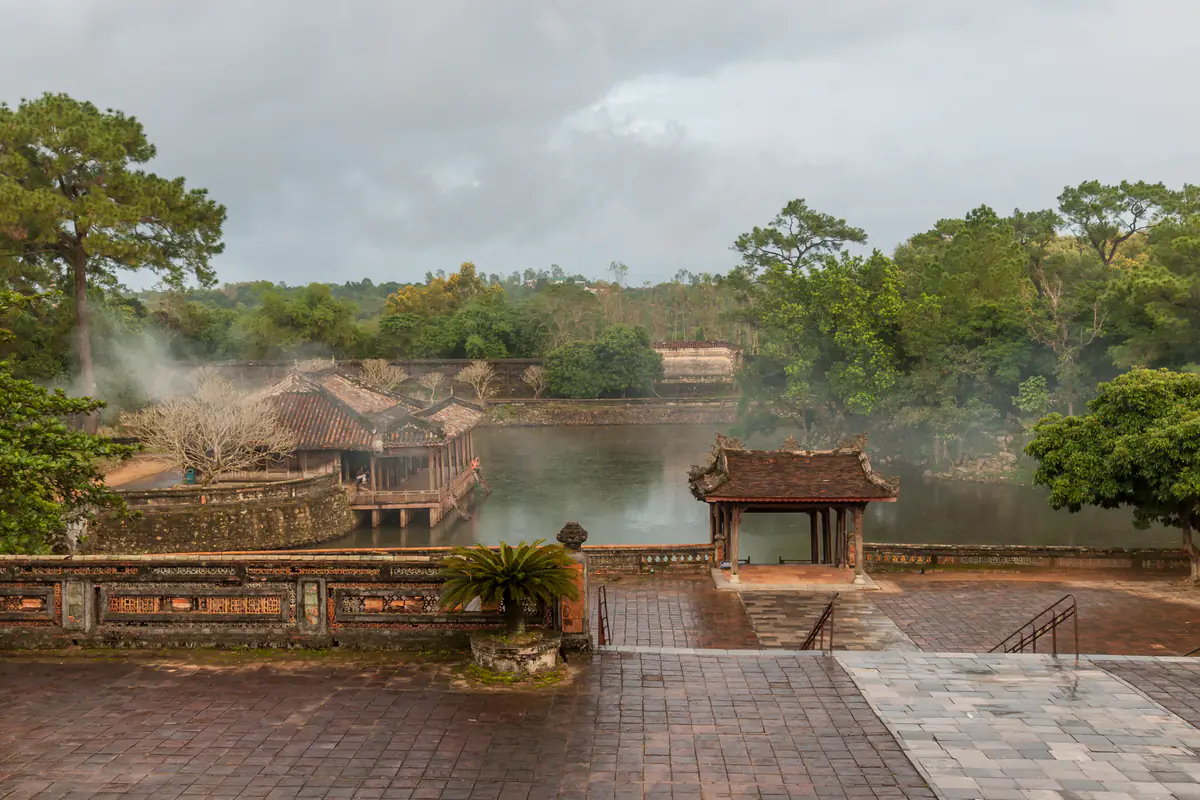
Tu Duc’s tomb
About 6 km from Ngo Mon. This one feels like a landscaped park: a lake with a wooden pavilion over the water, pine woods, and brick paths linking temples to the burial area. Allow 1 to 1.5 hours, mostly for the walking.
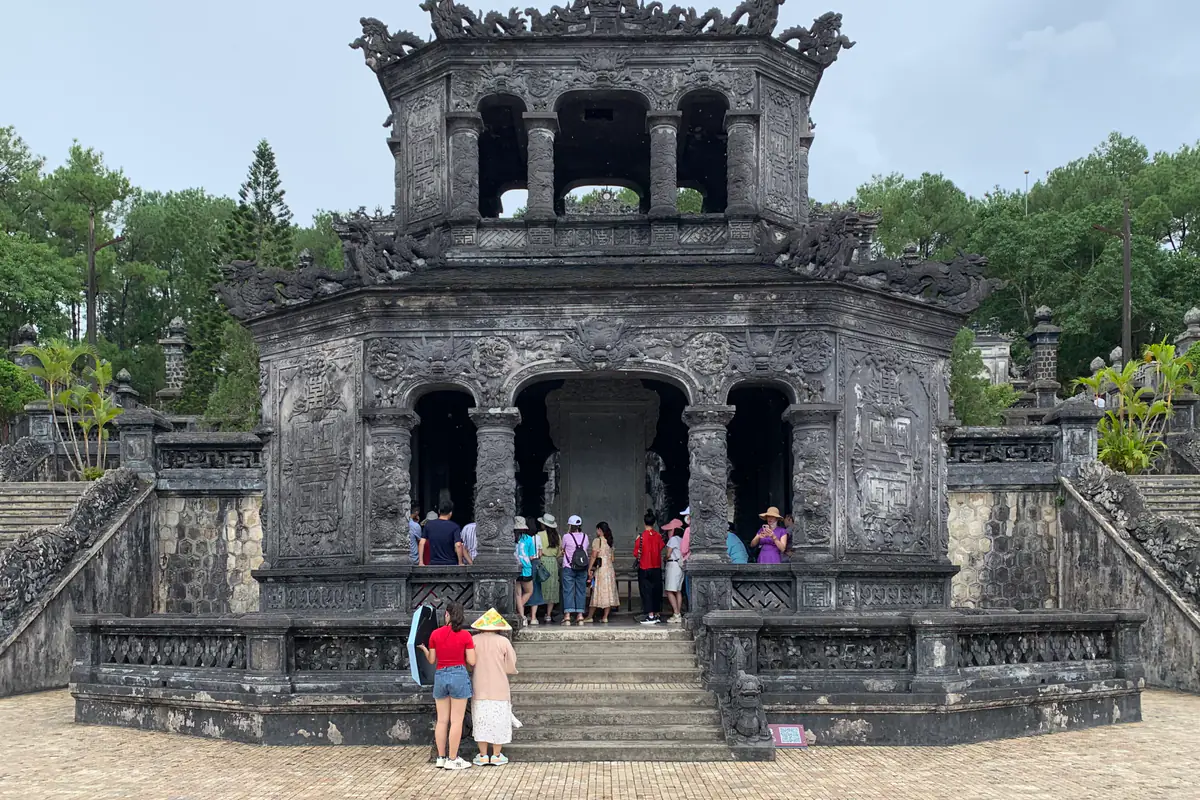
Khai Dinh’s tomb
About 10 km from Ngo Mon and 7 km from Tu Duc. The last of the big tombs is built of concrete on a hillside and mixes Vietnamese and European styles; the main hall inside is covered in mosaics made from broken porcelain and glass. Several flights of steep steps lead up from the gate, so wear shoes with grip in the rain. 45 minutes to an hour is enough.
Minh Mang’s tomb
About 14 km from Ngo Mon, on the west bank of the Perfume River. Gates, temples, stone bridges and lakes line up symmetrically along one long axis, so it’s a fair walk from the entrance to the burial mound. Allow 1 to 1.5 hours.
If you hire a car for the tombs, agree on the total price, how long the driver will wait at each stop and whether any extra stops are included. Riding a scooter works if you’re comfortable on hilly roads, but rain makes them slick and cuts visibility.
Thien Mu Pagoda
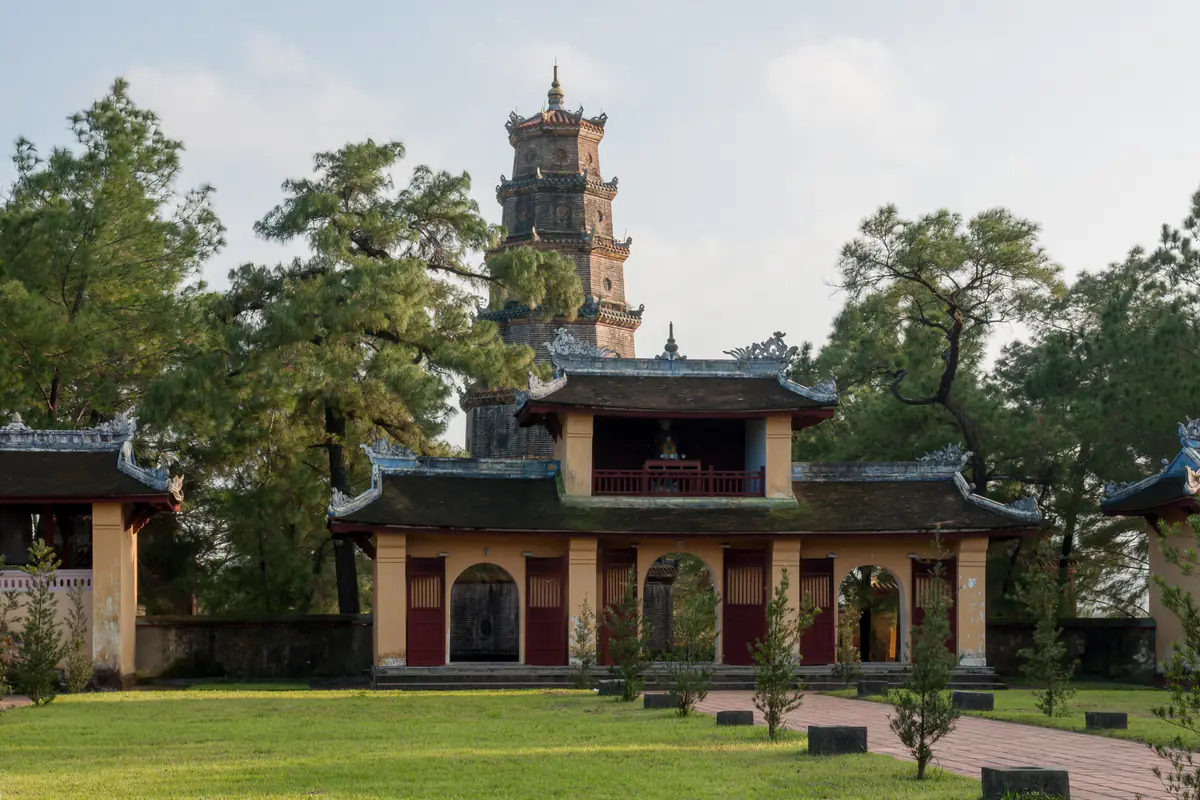
Thien Mu stands on a low hill on the north bank of the Perfume River, about 4 km upstream from Ngo Mon, and there’s no entry fee. The seven-story Phuoc Duyen tower faces the river. In the grounds you can see the Austin car that drove the monk Thich Quang Duc to the Saigon intersection where, in 1963, he burned himself to death in protest against the government’s treatment of Buddhists. Most people spend 30 minutes to an hour.
It is a working monastery, so cover shoulders and knees and keep your voice down near the main hall. You can get there by road or by boat from the city center; on days of heavy rain or high water, ask whether the boats are running.
What to eat in Hue
The prices below were recorded in April 2023 and are not current menu prices. Stalls next to the monuments tend to charge more than those in town, so ask at the stall before you order.
- Bun bo Hue: the city’s spicy beef noodle soup, with thick round rice noodles in a broth of lemongrass and fermented shrimp paste, often with pork knuckle and crab cake. About VND 30,000 to 50,000 a bowl.
- Com hen and bun hen: tiny stir-fried river clams tossed with room-temperature rice or noodles, herbs and crunchy bits, with hot clam broth on the side. Look around Con Hen islet and Han Mac Tu street; about VND 10,000 to 15,000 a bowl.
- Steamed cakes and dumplings: banh beo (small steamed cups topped with dried shrimp), banh nam and banh loc (wrapped in leaves), usually ordered as a few plates to share, about VND 15,000 to 50,000 a plate.
- Che: sweet soups and puddings, with a long menu at any dessert stall, including one oddity: tapioca dumplings stuffed with roast pork.
Dong Ba market on the riverbank has food stalls by day and a night market.

Getting to Hue: from Da Nang and Hoi An, by train, by air
From Da Nang and Hoi An
- Car or taxi: about 97 km by road from Da Nang airport to Ngo Mon, and about 123 km from Hoi An’s old town. Cars use the Hai Van tunnel and take about two hours from Da Nang.
- Heritage train: a daytime tourist train that takes three to four hours and runs along the coast over the Hai Van Pass. Times, fares and which side to sit on for sea views are in our Hue to Da Nang train guide. Regular Reunification Express trains also cover the route, at times set by the north-south timetable.
- Motorbike: you can’t ride through the tunnel yourself. Take the pass, or ask ahead whether the shuttle that carries bikes through the tunnel is running and when. If you stop at the Hai Van Gate ruins at the top, entry has been VND 70,000 (about $3) since June 2, 2026, with children under 13 free.
The pass has been closed by landslides during past rainy seasons. If heavy rain is forecast, check road conditions and train status before you set off. Take the tunnel or the train only while the route is operating safely; postpone if there are landslide warnings or disruptions, and don’t ride a motorbike over the pass on those days.
By train from Hanoi or the south
Reunification Express trains stop at Hue station, about 2.5 km from Ngo Mon. From Hanoi it’s 688 km by rail, usually more than 12 hours. Check times and fares on dsvn.vn, which has an English version, and give a phone number that can receive texts, since that’s how the railway tells passengers about flood cancellations.
By air
Phu Bai airport is about 18 km from Ngo Mon by road, with domestic flights from Hanoi and Ho Chi Minh City. From abroad, you would normally connect through one of those cities or fly into Da Nang instead. A four-seat taxi or ride-hailing car into town is typically about VND 150,000 to 200,000 ($6 to $8; a guide price as of October 2026), so check the fare in the app or agree on it before you get in.
Weather to pack for
| Month | Rainfall | Rainy days | Average temperature |
|---|---|---|---|
| September | 411 mm (16 in) | 16 | 27°C (81°F) |
| October | 773 mm (30 in), the wettest month | 21 | 25°C (78°F) |
| November | 642 mm (25 in) | 21 | 23°C (74°F) |
| December | 350 mm (14 in) | 20 | 21°C (69°F) |
| January | 129 mm (5 in) | 16 | 20°C (68°F) |
These averages tell you the season is wet, not which week will flood, so check the forecast a few days out. Pack a light rain jacket, shoes with grip for the stone paths at the tombs, and an extra warm layer in December, when wet, windy days can feel quite cool.
Flood season: what changes and where to check warnings
What can change
- Monuments close. In late October 2025, water flooded parts of the Imperial City and every site closed for several days.
- Streets flood. Roads inside the citadel and along the river can go under, and taxis become hard to find.
- Trains, flights and the pass. Trains can be suspended, flights delayed and the Hai Van Pass closed.

Where to check warnings
- Heavy rain and flood bulletins from Vietnam’s National Center for Hydro-Meteorological Forecasting, and its flash-flood and landslide warning map, updated hourly.
- The city’s Hue-S app, which shows a flood map, river levels and cameras at spots that flood deeply, plus an emergency rescue button. If you can’t use it, ask your hotel to check it for you.
- Closure notices on the Hue Monuments Conservation Centre’s website.
- Messages from your airline and the railway, and the front desk, who can tell you which nearby streets are under water.
Before you book
- Choose accommodation with flexible cancellation or date changes.
- Ask the hotel whether its street floods, whether you can have an upper-floor room, and whether it has a generator.
- If you’re connecting to Da Nang or Hoi An, travel early in the day so you have time to adjust if a train or car is canceled.
If a flood hits while you’re in Hue
Follow local instructions
- Stay put when people are told to keep off the roads. Don’t walk, ride or drive through fast-moving water or water where you can’t see the road surface: there may be holes, open drains or power lines underneath.
- Charge your phone and power bank, keep drinking water, snacks and a flashlight handy, and put your passport in a waterproof bag.
- If you’ve rented a bike or car, ask the hotel where to park on higher ground and move it early.
- Contact your airline or the railway to change or refund tickets; if a trip is canceled because of the weather, ask exactly what refund you’re entitled to.
- Don’t push on to Da Nang over the pass while landslide warnings are out; another night in Hue is the safer choice.
FAQ
Is Hue worth visiting in the rainy season?
Yes, if your plans can bend. The monuments normally stay open in ordinary rain, though most of the Imperial City is outdoors, so bring rain gear. The risk is a flood that closes the monuments or cuts roads for a few days, so keep a spare day if you can, choose accommodation with flexible cancellation or date changes, and watch the forecast.
What should I pack for Hue in November?
Average temperatures from October to December run about 21 to 25°C (69 to 78°F), cooler on windy, wet days. Bring a light rain jacket, shoes with grip for the stone paths at the tombs, and clothes that cover shoulders and knees for the pagodas.
Can I do Hue as a day trip from Hoi An?
It’s possible but long: Hoi An is about 123 km away, roughly 2.5 hours or more each way by car through the Hai Van tunnel. You’d realistically see the Imperial City and one tomb, so staying a night in Hue is easier. If heavy rain is forecast, check road and train status before setting out, and postpone if the route is disrupted.