Da Lat or Sapa: which suits your dates, starting point and travel style?
Da Lat or Sapa? Look at both your travel month and your starting point. From December to February, Da Lat is usually drier and sunnier than Sa Pa, which is cold and often foggy; in September, Sa Pa’s rice turns gold just as Da Lat has the most rainy days of its year.
By Da Lat LoversPublished Updated How we review
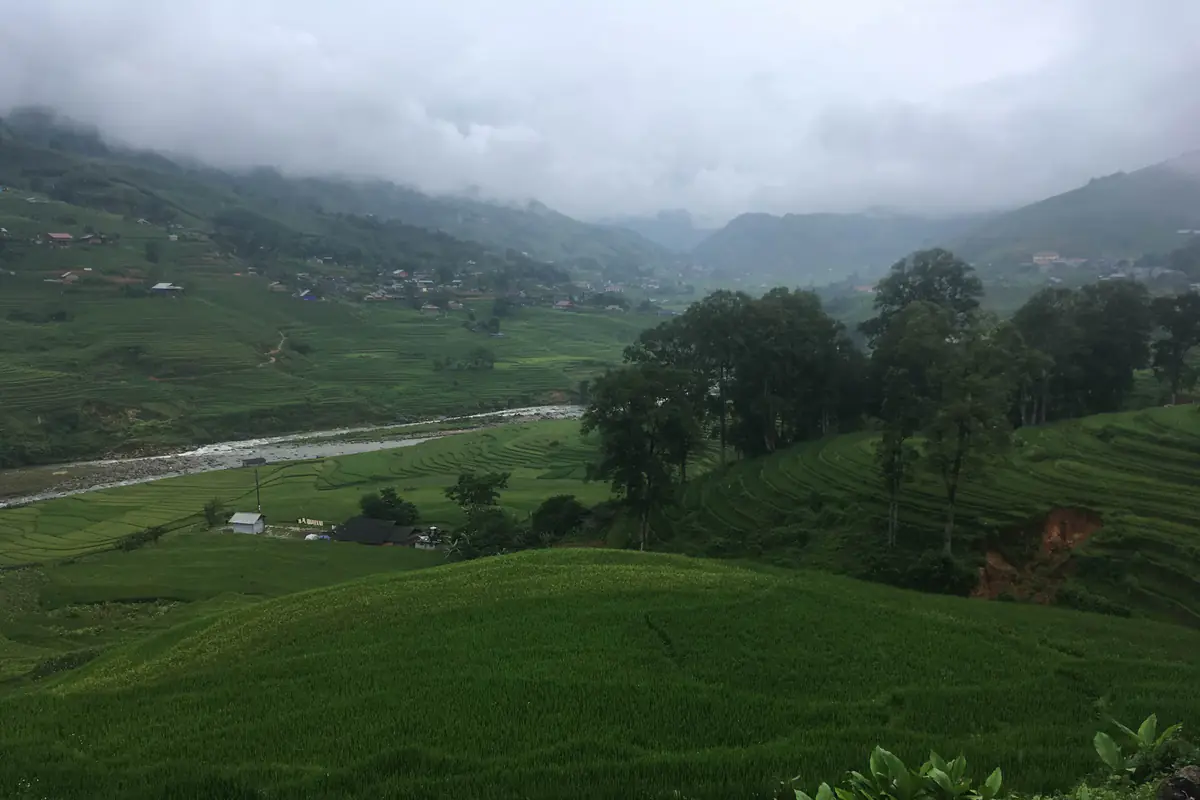
Green rice terraces in the Muong Hoa Valley near Sa Pa, between Ta Van and Hau Thao, in early August 2018. Photo: Christophe95 / CC BY-SA 4.0
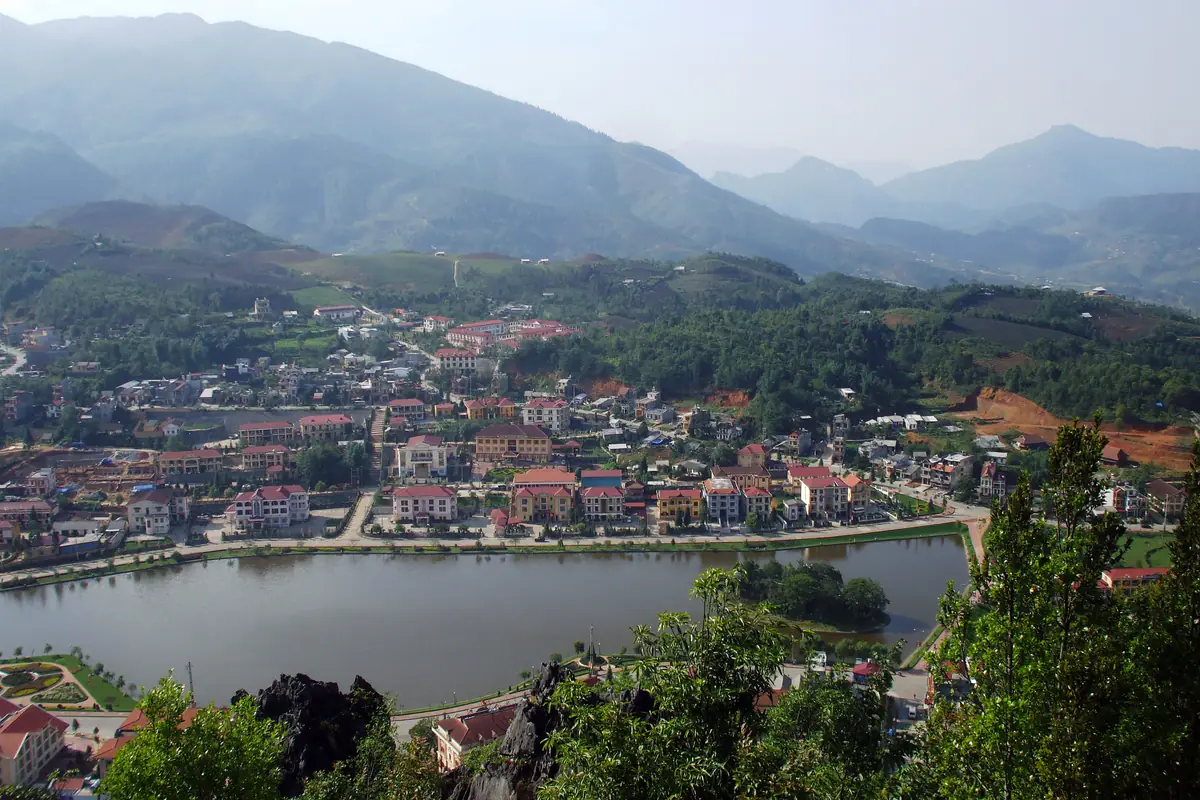
Both towns sit at around 1,500 meters: Da Lat on the Lam Vien plateau in the southern Central Highlands, Sa Pa (often written Sapa) in the Hoang Lien Son range of the northwest. If you only have three or four days, work out the travel time first, then choose by season and by what you want to spend most of your time doing.
Which destination suits your starting point and travel style?
From Ho Chi Minh City, Da Lat is one short flight or a single bus ride, while Sa Pa means flying to Hanoi and continuing by road. From Hanoi, both can be reached within a day. The travel time section breaks down each leg and how to compare them.
- Families with young children and older travelers: from the south, Da Lat is usually easier, with a short trip and winter nights that are cool rather than cold. If you choose Sa Pa, consider March to May or September to October rather than midwinter. Both places allow an itinerary with little walking.
- Trekkers and rice-terrace photographers: Sa Pa, in the terrace-flooding season or at harvest time.
- Couples and friends after cafes, cloud hunting and strolling: Da Lat, especially in the dry season.
- Travelers who want real cold, fog and a chance of frost: Sa Pa from about December to February, accepting little sunshine.
- Tight budgets: start by pricing the one you can reach by bus (Da Lat from southern Vietnam, Sa Pa from Hanoi and the north), then add rooms and the tickets you plan to buy.
Da Lat or Sapa: which is better in which month?
The table puts two weather stations side by side from a single source, Vietnam’s QCVN 02:2022/BXD standard on natural conditions for construction, so the figures are directly comparable. Sa Pa’s station sits at 1,570 meters and Da Lat’s at about 1,500 meters. These are long-term averages, not forecasts.
| Month | Da Lat: high / low | Da Lat: rainy days | Sa Pa: high / low | Sa Pa: rainy days | Suggested choice |
|---|---|---|---|---|---|
| Jan | 22.3 / 11.7 | 2.2 | 12.3 / 6.2 | 16.3 | Da Lat for dry weather; Sa Pa for real cold |
| Feb | 23.9 / 11.9 | 2.5 | 14.3 / 7.8 | 16.3 | As January; both busy over Lunar New Year (Tet) |
| Mar | 25.1 / 13.0 | 5.8 | 18.2 / 10.8 | 15.7 | Da Lat drier; Sa Pa warming up |
| Apr | 25.3 / 14.7 | 12.8 | 21.3 / 14.0 | 17.9 | Either; afternoon rain returns to Da Lat |
| May | 24.7 / 16.2 | 20.5 | 22.4 / 16.3 | 22.2 | Sa Pa, terrace-flooding season in the first half of the month |
| Jun | 23.6 / 16.4 | 21.2 | 22.9 / 17.6 | 24.4 | Both wet |
| Jul | 23.0 / 16.2 | 23.8 | 23.0 / 17.7 | 25.6 | Both wet; Sa Pa’s rainiest month |
| Aug | 22.7 / 16.2 | 23.1 | 23.0 / 17.4 | 23.4 | As July; Sa Pa’s rice starts to turn late in the month |
| Sep | 22.9 / 16.0 | 24.1 | 21.7 / 15.9 | 19.8 | Sa Pa, for the rice harvest |
| Oct | 22.8 / 15.3 | 20.0 | 19.0 / 13.7 | 18.6 | Similar rain; Sa Pa getting colder |
| Nov | 21.9 / 14.6 | 11.5 | 16.1 / 10.2 | 13.8 | Da Lat drying out; Sa Pa cold and misty |
| Dec | 21.4 / 13.2 | 5.9 | 13.2 / 7.0 | 13.5 | Da Lat, dry with the Flower Festival; Sa Pa for real cold |
Winter is when the two really part ways. In January, Sa Pa’s average low is 6.2°C, 5.5°C below Da Lat’s, and its average high is only 12.3°C, 10°C below Da Lat’s. Sa Pa’s station has recorded sub-zero temperatures in December, January, February and March. From June to August the two are almost level.
Their rainy seasons differ too. Da Lat’s rain sets in from May to October and eases sharply from December. Sa Pa has rainy days every month, but the heavy rain falls from May to September; it gets about 2,780 mm a year against roughly 1,800 mm in Da Lat.
For Da Lat month by month, with flower seasons and public holidays, see the best time to visit Da Lat. To compare temperatures with your home city on your travel dates, try the Da Lat temperature tool.
November to February: Da Lat or Sapa?
Beyond temperature, sunshine differs too. In December and January, Da Lat averages 199-237 hours of sun a month; Sa Pa gets 113-121.
Da Lat: drying out, flowers and year-end crowds
November is the changeover month, with rain tapering off. Wild sunflowers peak in November, pink grass lasts until the end of December, and cherry blossoms bloom from about late December to early February. The Da Lat flower season calendar has the timing for each.
The catch is crowds. The 11th Da Lat Flower Festival is scheduled for December 19-31, 2026; if your trip falls in those two weeks, book a room as soon as your dates are fixed (see the Da Lat Flower Festival guide). For the weather in detail, see Da Lat in November and in December.

Sa Pa: cold, fog and cloud seas on Fansipan
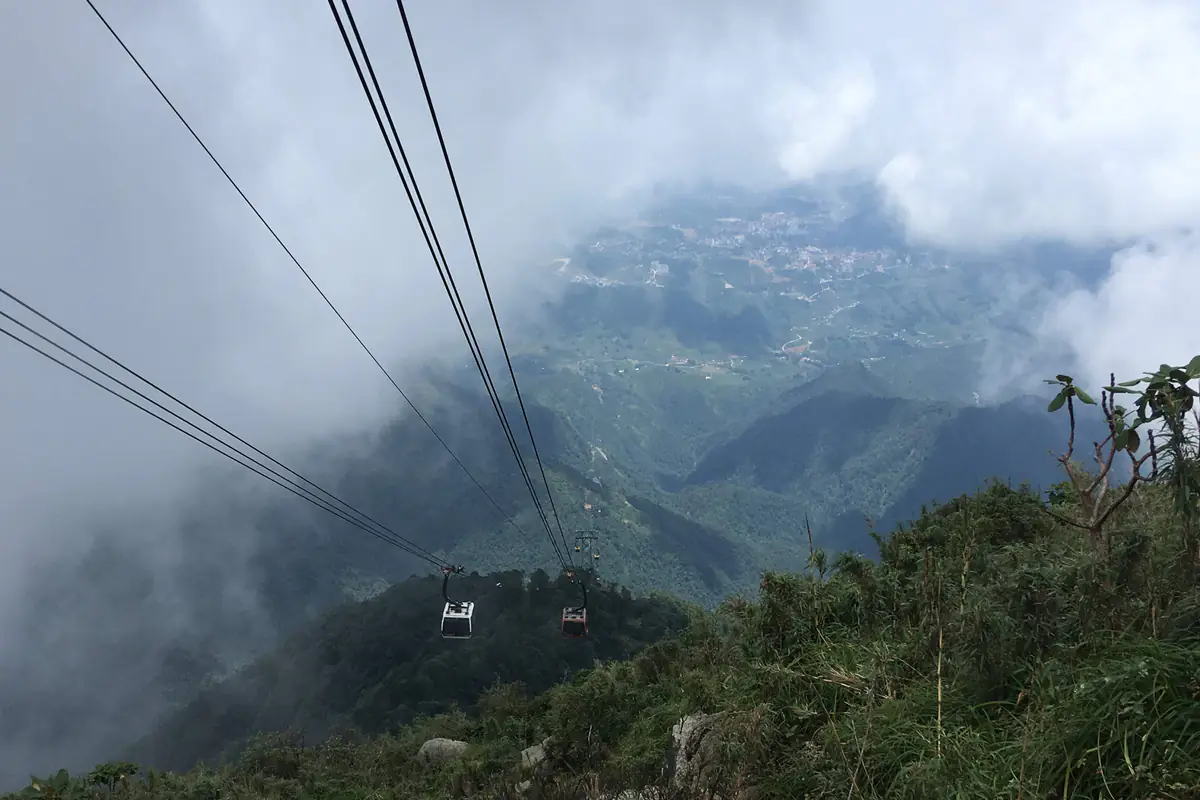
Sa Pa’s winter is damp and misty rather than stormy. January averages 14.1 days of drizzle and 17.4 foggy days, yet only about 70 mm of rain for the whole month. The Fansipan cable car operator promotes October as the start of cloud-watching season at the summit; whether you get a sea of clouds still depends on the day.
Snow is a matter of luck. It fell in Sa Pa town itself on the morning of January 24, 2016, and on Fansipan, from about 3,000 meters up, on the afternoon of January 26, 2025. It comes only with very strong cold spells and melts fast, so don’t build a trip around it.
You can borrow the layering approach from what to wear in Da Lat, but for Fansipan, prepare separately for the temperature, wind and rain forecast at the summit.
Rice terraces and the rainy season: what to plan for
Sa Pa’s terraces usually grow a single rice crop a year, which gives you two seasons to plan around. The terrace-flooding season, when the paddies are freshly flooded for planting, usually runs from about late April to mid-May. Rice ripens here earlier than in much of the northwest: fields in Ta Van start turning gold in late August, and early September is the peak.
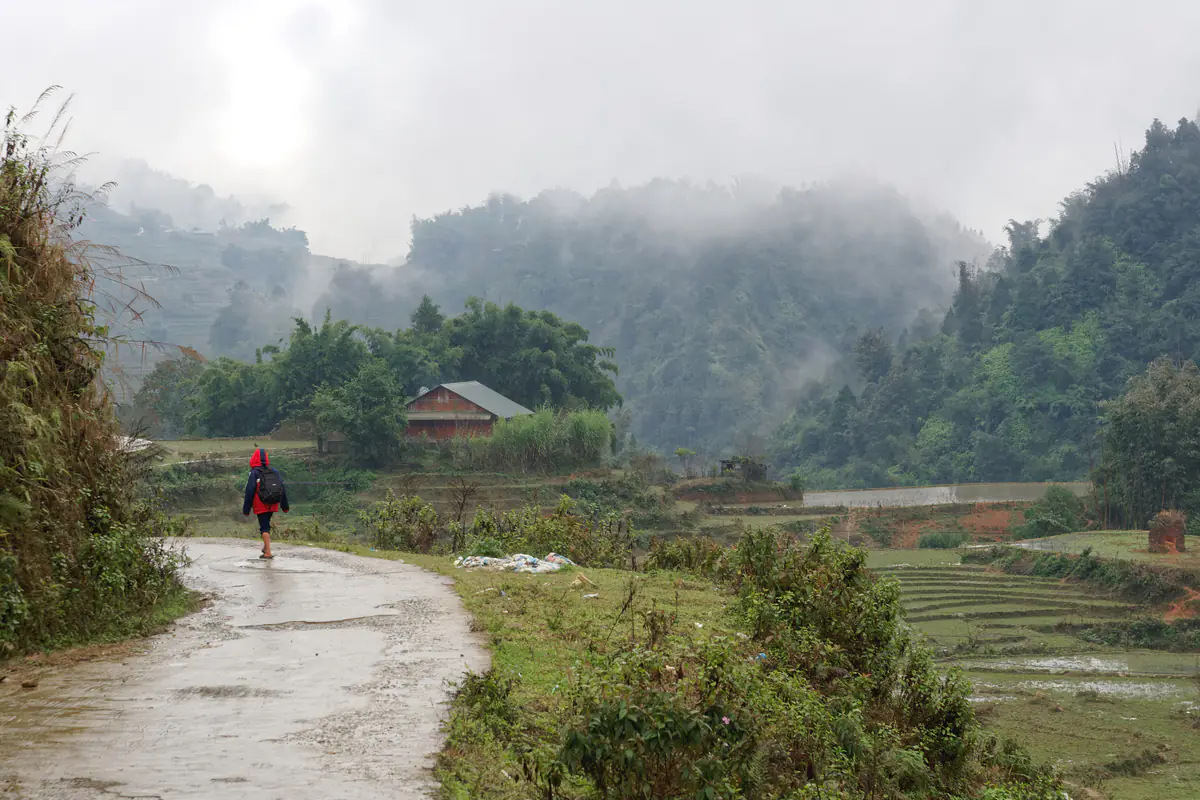
Between the two lies the green season, which overlaps with the heavy rain: July and August each get about 450-460 mm. The road up to Sa Pa has stretches prone to landslides in downpours; before dawn on May 4, 2026, rocks blocked National Route 4D in Ta Phin commune until around 9 a.m.
The rice harvest can overlap with the National Day holiday, when Sa Pa gets busy. On the afternoon of August 31, 2026, at the start of the break, roads around Sa Pa Lake were jammed, and local authorities expected 400,000-500,000 visitors over the holiday. To avoid crowds, aim for ordinary weekdays outside public holidays and ask your accommodation how busy the village you plan to visit is.
In Da Lat, rainy-season showers usually come in the afternoon, so plan outdoor sights for the morning (see Da Lat weather in October). Conditions on the mountain passes into Da Lat are tracked in our guide to getting from Ho Chi Minh City to Da Lat.
How long does it take from Ho Chi Minh City and Hanoi?
| Starting from | To Da Lat | To Sa Pa |
|---|---|---|
| Ho Chi Minh City | About a 1-hour flight to Lien Khuong Airport; or about 300 km by bus, 5-8 hours | About a 2-hour 5-minute flight to Noi Bai (Hanoi), then 5-6 hours by bus from Hanoi, or about 8 hours by night train to Lao Cai |
| Hanoi | Direct flight of about 1 hour 55 minutes to Lien Khuong Airport | 5-6 hours by bus or limousine van; or about 8 hours by night train to Lao Cai |
From Ho Chi Minh City, the difference is the number of legs. Da Lat is one short flight; Lien Khuong Airport has been back in operation since August 19, 2026, and lies about 28-30 km from the center, 35-45 minutes by car. Sa Pa adds a long road leg after landing at Noi Bai; with airport time, each direction takes most of a day.
From Hanoi, Sa Pa has direct buses and Da Lat has direct flights. Compare the total door-to-door time, including getting to the airport, waiting and the final transfer. If you take the night train, check departure and arrival times at Lao Cai for your travel date, and add the transfer from the station up to Sa Pa. For flights into Da Lat, see flights to Da Lat.
Costs: which prices are published?
The table lists published prices with their dates. Room rates swing with the season and the day of the week, so treat them as a rough guide.
| Item | Price | Date, source |
|---|---|---|
| Sa Pa | ||
| Bus or limousine van, Hanoi - Sa Pa | VND250,000-400,000 per person | September 2025, VnExpress |
| Train, Hanoi - Lao Cai | VND450,000-1,000,000 per person, by seat or berth class | September 2025, VnExpress |
| Fansipan cable car, return | Adults VND850,000; children 1-1.4 m tall about VND550,000 | March 2026, Sun Paradise Land (Sun Group) |
| Muong Hoa train / summit funicular | VND200,000 / VND150,000 | March 2026, same source |
| Cat Cat village entry | VND90,000 | September 2025, VnExpress |
| Rooms in central Sa Pa | VND300,000-3 million a night | September 2025, VnExpress |
| Da Lat | ||
| Bus, Ho Chi Minh City - Da Lat | Sleeper berth VND325,000; private cabin VND500,000 | September 2026, Thanh Buoi website |
| Three days, two nights from Ho Chi Minh City, weekdays | About VND2.4 million per person (backpacker), nearly VND4 million per person (couple) | Review Da Lat trip cost calculator, rechecked October 1, 2026 |
The three prices listed by the March 2026 source add up to about VND1.2 million per adult. Before booking, check which direction each ticket covers and the price that applies on your travel date.
The cost of getting there can change the choice, especially on a short trip. Compare transport fares, rooms of the same standard and the activities you actually plan to pay for. To work out a Da Lat budget by group size, transport and room type, use the Da Lat trip cost calculator.
What is there to do: villages and Fansipan, or lakes, pine hills and cafes?
Sa Pa: walking between villages, riding up Fansipan
Sa Pa suits travelers who like walking between villages. Cat Cat village is about 2 km from the center; Ta Van and Ta Phin are about 12 km away; Lao Chai and Y Linh Ho lie toward the Muong Hoa Valley. Village life among the Hmong, Dao, Tay, Giay and Xa Pho communities is a large part of the trip.
The Fansipan cable car carries visitors close to the 3,143-meter summit in about 15 minutes. The Muong Hoa train links the town center with the cable car station, and a funicular replaces roughly 600 stone steps on the final stretch.
Da Lat: lakes, pine hills, coffee and old streets
Da Lat suits a slower trip around town and its outskirts: lakes, pine-covered hills, cafes, the night market and French-era buildings such as the railway station and the cathedral. Our guide to places to visit in Da Lat sorts sights by area, and where to eat in Da Lat covers food.
For exercise there is the Langbiang hike; for an early start among the clouds, see Da Lat cloud hunting. In both places you can plan an itinerary with little walking. Check the steps, slopes and walking distances at each sight separately.

Is it worth combining Da Lat and Sa Pa in one trip?
Yes, if you have about a week or more. A convenient link is a direct flight from Da Lat to Hanoi, then a bus or night train up to Sa Pa, flying home from Noi Bai. Set aside a full day for the transfer between the two.
Weather-wise, March and November are the two windows when neither place is in its heaviest rain: Sa Pa gets about 105 mm in each of those months, while Da Lat is already dry in March and drying out in November. Pack light layers for Da Lat afternoons and a proper warm coat for Sa Pa nights.
FAQ
Is Da Lat or Sapa better in December?
If you want dry, sunny and not-too-cold weather, Da Lat usually suits better: December averages 5.9 rainy days and about 13-21°C, though the last two weeks can be busy with the Flower Festival, scheduled for December 19-31, 2026. For real cold and fog, choose Sa Pa: December averages about 7-13°C, with many misty days and little sun.
Does it snow in Sa Pa, and when?
Occasionally, and only during very strong cold spells, mostly on the summit of Fansipan. Snow fell on the summit on the afternoon of January 26, 2025, for example; the much-cited snowfall in Sa Pa town itself was on January 24, 2016. It can’t be planned for, so watch the forecasts if you travel between December and February.
How long does it take to get from Ho Chi Minh City to Sa Pa?
About 2 hours 5 minutes to fly to Hanoi, then 5-6 hours by bus or limousine van to Sa Pa, or about 8 hours by night train to Lao Cai followed by a road transfer up the mountain. Those are times for each leg; with getting to the airport, waiting and connections, it usually takes most of a day.
How much is the Fansipan cable car?
According to Sun Group’s Sun Paradise Land page dated March 10, 2026, a return cable car ticket costs VND850,000 for adults and about VND550,000 for children 1-1.4 m tall; the Muong Hoa train is VND200,000 and the summit funicular VND150,000. Before booking, check which direction each ticket covers and the price for your travel date.
Which is better with young children or older relatives?
From the south, Da Lat is usually easier: the trip is short and the average low in December and January is around 12-13°C. If you go to Sa Pa, avoid midwinter, when the average low in January is 6.2°C. Both places allow an itinerary with little walking; check the steps and slopes at each sight.
Which provinces are Sa Pa and Da Lat in now?
Since July 1, 2025, Sa Pa has been a ward of Lao Cai Province, which absorbed neighboring Yen Bai; the trekking areas around Ta Van and Ta Phin belong to communes of the same names. Da Lat is part of an enlarged Lam Dong Province that now includes the former Dak Nong and Binh Thuan.
Sources
These are the sources used for this article. It was last updated on Oct 18, 2026; prices and opening hours may have changed since, so please double-check before you go.
- Ministry of Construction: QCVN 02:2022/BXD, natural condition data for construction, Appendix A, Sa Pa and Da Lat stations (tables A.1-A.4, A.6, A.22, A.25, A.28, A.31, A.32; downloaded October 18, 2026)
- VnExpress International: Sa Pa offers autumn, winter escapes as Vietnam makes Lonely Planet travel list (October 15, 2026)
- VnExpress: Snow falls on Sa Pa at minus 3°C (in Vietnamese, January 24, 2016)
- Nhan Dan: Snow unexpectedly falls on the roof of Indochina (in Vietnamese, January 26, 2025)
- Bao Lao Cai: Fansipan summit forecast to see snow and ice this weekend (in Vietnamese, February 7, 2025)
- Sun World Fansipan Legend: Fansipan enters its best cloud-hunting season (in Vietnamese, October 16, 2026)
- Sun World Fansipan Legend: about the resort, Muong Hoa train and funicular (in Vietnamese, checked October 18, 2026)
- Sun Paradise Land (Sun Group): Fansipan cable car prices for 2026 (in Vietnamese, March 10, 2026)
- VnExpress: 48 hours of golden rice season in Sa Pa (in Vietnamese, September 5, 2025)
- Bao Lao Cai: Sa Pa glistens in water season (in Vietnamese, April 27, 2023)
- Bao Lao Cai: National Route 4D largely reopens from 9 a.m. after overnight rockfall (in Vietnamese, May 4, 2026)
- Bao Lao Cai: Legal outreach for ethnic minority communities in Sa Pa, with population shares (in Vietnamese, December 25, 2023)
- Kenh14 (via Phu Nu Moi): Sa Pa over the September 2 holiday (in Vietnamese, August 31, 2026)
- Vietnam Airlines: Ho Chi Minh City - Hanoi route page, flight time and Noi Bai airport (checked October 18, 2026)
- Vietnam Airlines: Flights to Da Lat (checked October 4, 2026)
- Vietnam Airlines: Ho Chi Minh City - Da Lat route page (in Vietnamese, checked October 4, 2026)
- Vietnam Airlines: Hanoi - Da Lat route page (in Vietnamese, checked October 4, 2026)
- Government News: Lien Khuong airport reopens from August 19 (in Vietnamese, June 15, 2026)
- Tuoi Tre: Lien Khuong airport reopens August 19, Da Lat airfares by airline (in Vietnamese, July 28, 2026)
- VnExpress: Five roads to Da Lat while Lien Khuong airport is closed (in Vietnamese, March 6, 2026)
- Tuoi Tre News: How to get to Da Lat if Lien Khuong airport temporarily closes (May 24, 2025)
- Thanh Buoi official website: Ho Chi Minh City - Da Lat fares (checked September 25, 2026)
- Thanh Nien: What is new at the 2026 Da Lat Flower Festival (in Vietnamese, October 8, 2026)
- Resolution 202/2025/QH15 on merging provincial-level administrative units (LuatVietnam, in Vietnamese)
- Resolution 1673/NQ-UBTVQH15 on commune-level units in Lao Cai Province, 2025 (in Vietnamese, June 20, 2025)
- Bao Lam Dong: The new Lam Dong Province (in Vietnamese, June 30, 2025)