Da Lat night market: hours, layout, what to buy, paying and bargaining without getting overcharged
The Da Lat night market is where almost every visitor ends up after dark. This honest guide covers hours, layout, what to buy and take home, cash versus QR payments, bargaining, safety and the city’s 2026 clean-up, based on local news reports (updated September 27, 2026).
By Da Lat LoversPublished Updated How we reviewĐọc bản tiếng Việt
How we put this guide together
The Da Lat night market is the one evening stop nearly every visitor makes: a walk from the hotel, a sweater bought on the spot because the hills turned out colder than expected, something hot to eat, then a stroll around the lake. It is also the most crowded, most confusing and most price-flexible corner of the city. This guide explains where it runs, when to go, what each zone sells, what is worth taking home through customs, how to pay, how to bargain politely and what the city changed in 2026.
Where is the Da Lat night market, and why is it called the “Hell Market”?
The Da Lat night market sets up directly in front of the Da Lat Market building (Chợ Đà Lạt), running along Nguyen Thi Minh Khai Street and climbing the stairs to the Hoa Binh area. Until July 1, 2025, this was Ward 1 of Da Lat city. After Vietnam’s administrative reshuffle it falls under Xuan Huong - Da Lat ward, which is the body provincial departments now instruct on market issues.
Dan Tri (in Vietnamese) put the market strip along Nguyen Thi Minh Khai at more than 1 km in April 2024. Tuoi Tre News located the market on the same street in 2023. From Xuan Huong Lake it is about a five-minute walk. If you stay on Nguyen Chi Thanh, Phan Boi Chau or Bui Thi Xuan, walking is usually faster than a ride at peak time.
The nickname chợ Âm Phủ, often translated as “Hell Market” or “Underworld Market,” goes back to the 1970s. VnExpress (in Vietnamese) explains that farmers held an unofficial vegetable market here from around 11pm until dawn. With almost no street lighting, buyers and sellers checked produce by oil lamp in thick fog, and locals compared the scene to the afterlife. Today the market starts much earlier and is brightly lit, but the old name stuck.
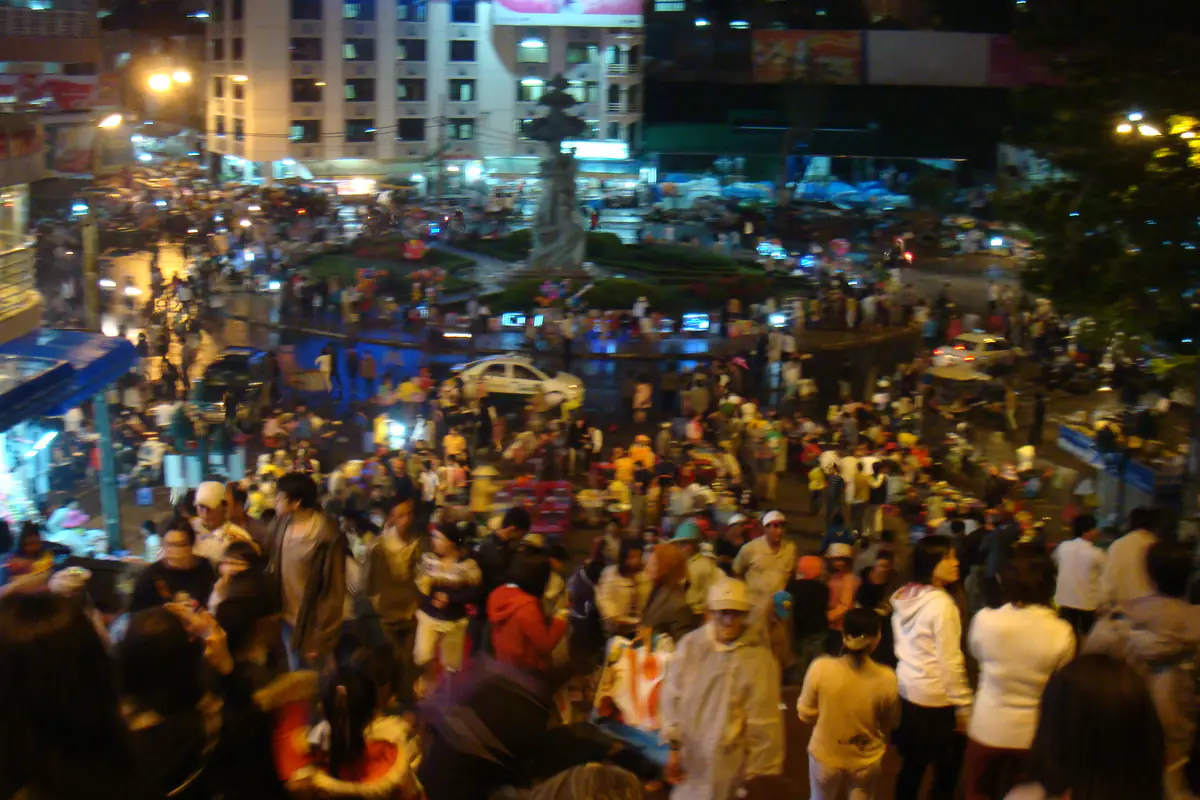
The key thing to understand: the Da Lat night market is not a building with a gate. It is the streets around the day market switching to evening trade. When the indoor halls close, the outside area turns into the night market, as Tuoi Tre (in Vietnamese) described on September 19, 2026.
Opening hours and the busiest nights
There are no official hours. Use these press-reported markers to plan, not as a fixed timetable:
- Around 4pm: vendors start laying out goods (Dan Tri, April 29, 2024).
- 6pm-7pm: crowds build. Lam Dong newspaper (in Vietnamese) wrote on May 12, 2026 that the center around the night market comes alive from about 6pm.
- 11pm-midnight: things wind down. A vendor told Tuoi Tre that young visitors eat and take photos until 11pm or midnight.
- Peak nights: on holidays the area can stay busy past midnight (Lam Dong newspaper).
VnExpress International gave the hours as 6pm until midnight in its April 2025 roundup of Vietnam’s best-known markets. Saturday nights and Vietnamese public holidays are the most crowded. Over the April 30-May 1 holiday in 2026 the city received about 620,000 visitors, according to Lam Dong newspaper, and on the September 2 national holiday of 2026 parking lots around the market were close to full (Kenh14 (in Vietnamese)).
Traffic jams at holiday time are not new. Saigoneer quoted a local in 2018 who needed 70 minutes to drive 2 km into the center on the third evening of Tet. If your dates overlap with Tet, April 30, September 2 or the Flower Festival, plan to walk.
Layout: the Da Lat night market zone by zone
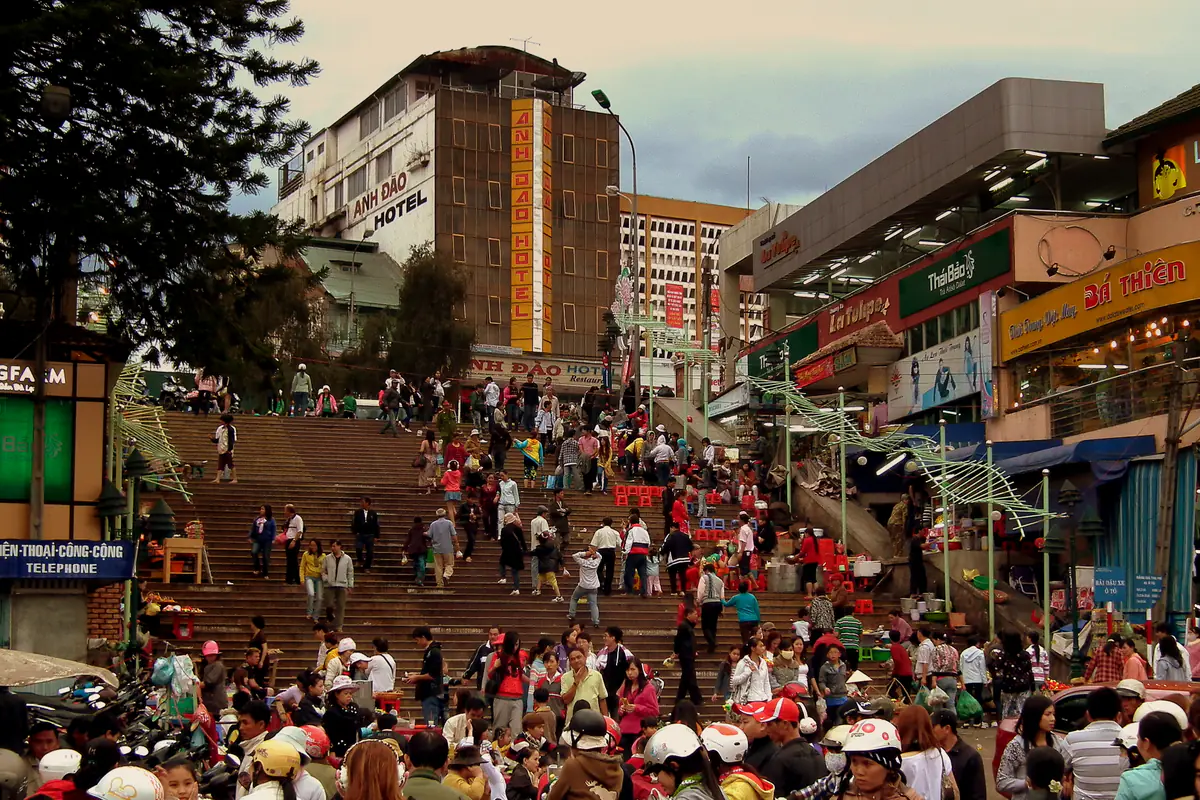
There is no official map, and in 2026 the ward is regrouping stalls by product type (see the section on the clean-up below). So instead of naming individual stalls, here are the zones that reports have described consistently over the years.
The plaza in front of the market and the roundabout
This open space in front of the market facade, next to the central roundabout, is where people pose for photos and where balloon sellers and hawkers gather. VnExpress (in Vietnamese) reported gridlock at this roundabout on holiday evenings in 2024. It is also the easiest meeting point if your group gets separated.
The stairs up to Hoa Binh
The stairways linking the market to the Hoa Binh area fill with low tables and plastic stools. They are steep and packed at peak time, so take it slowly with children or older relatives. The Hoa Binh area at the top hosts the weekend walking street.
Nguyen Thi Minh Khai: wool, souvenirs, specialties
Both sides of the main strip are lined with sweaters, scarves, hats, souvenirs and dried specialties. Tuoi Tre (September 19, 2026) describes souvenir, woolen and dried fruit stalls along the walkway, open late. VnExpress International mentions separate sections for clothing, fruit and specialty goods, along with live music.
The edges: farmers’ produce
Around the outer edge, residents sell farm produce and local specialties on the spot (Tuoi Tre). This is where you find seasonal fruit and vegetables sold by weight, which is easier to price-check than boxed gifts.
The rented food court
Beyond the street vendors there is a small food court of 12 counters rented out by the market management board. According to PLO (in Vietnamese) (March 12, 2026), 10 of those 12 counters had not signed new contracts for 2025 after the old ones expired on December 31, 2024.
What to buy at the Da Lat night market
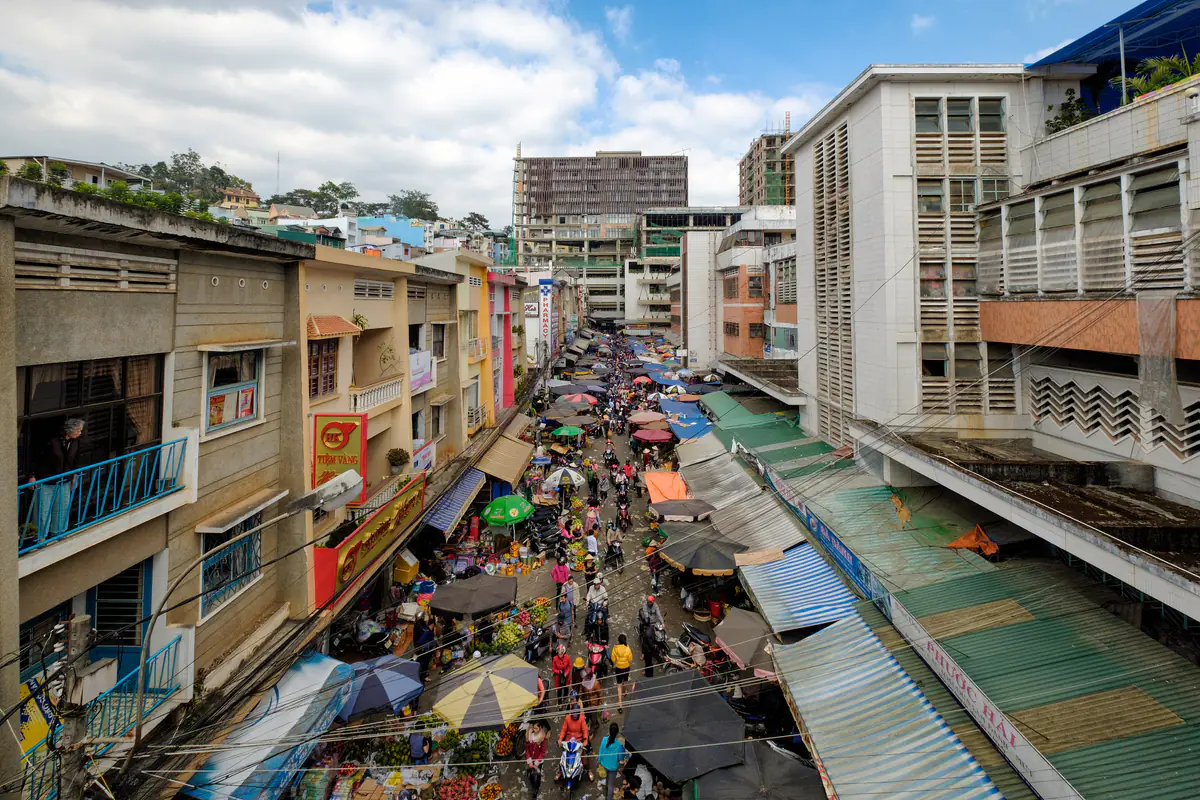
The Da Lat night market is best for three things: warm clothes to wear right away, small souvenirs, and dried specialties to take home. Thanh Nien (in Vietnamese) (May 9, 2024) suggests five gift groups: strawberries, dried fruit, artichoke tea, fruit syrups and woolens.
Wool sweaters, scarves and gloves
Plenty of visitors arrive underdressed and buy a sweater here to wear straight away. Thanh Nien says woolens at the night market and downtown shops sell at reasonable prices, and Tuoi Tre notes that Da Lat Market is also a wholesale hub for fabric and knitwear for surrounding districts, so the choice is wide.
We could not find a recent major news report quoting sweater prices, so we do not give numbers. Travel blogs quote very different figures depending on the yarn and the markup. The safe approach is to ask at two or three stalls before you commit.
- Check the color under a bright light; market lamps change how yarn looks.
- Look at the seams at the hem, armpits and cuffs, and skip anything with stains.
- Check the fabric label if you need real warmth for colder trips later, such as a winter back home.
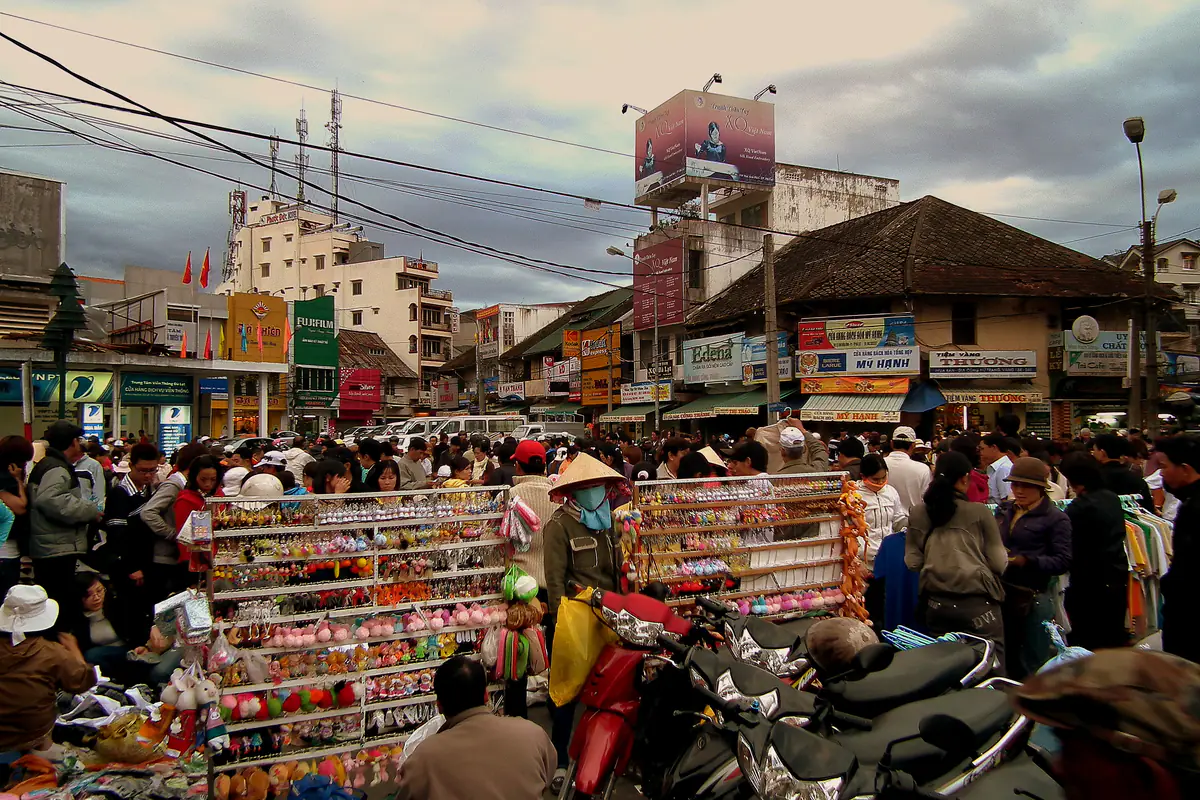
Souvenirs
Keyrings, soft toys, small knitted items, cloth bags and on-the-spot portrait sketches are easy to find. VnExpress mentions clothing, souvenirs and portrait drawing as things to do at the market. Souvenirs rarely carry price tags, so always ask first.
Dried specialties: candied fruit, dried fruit, artichoke tea
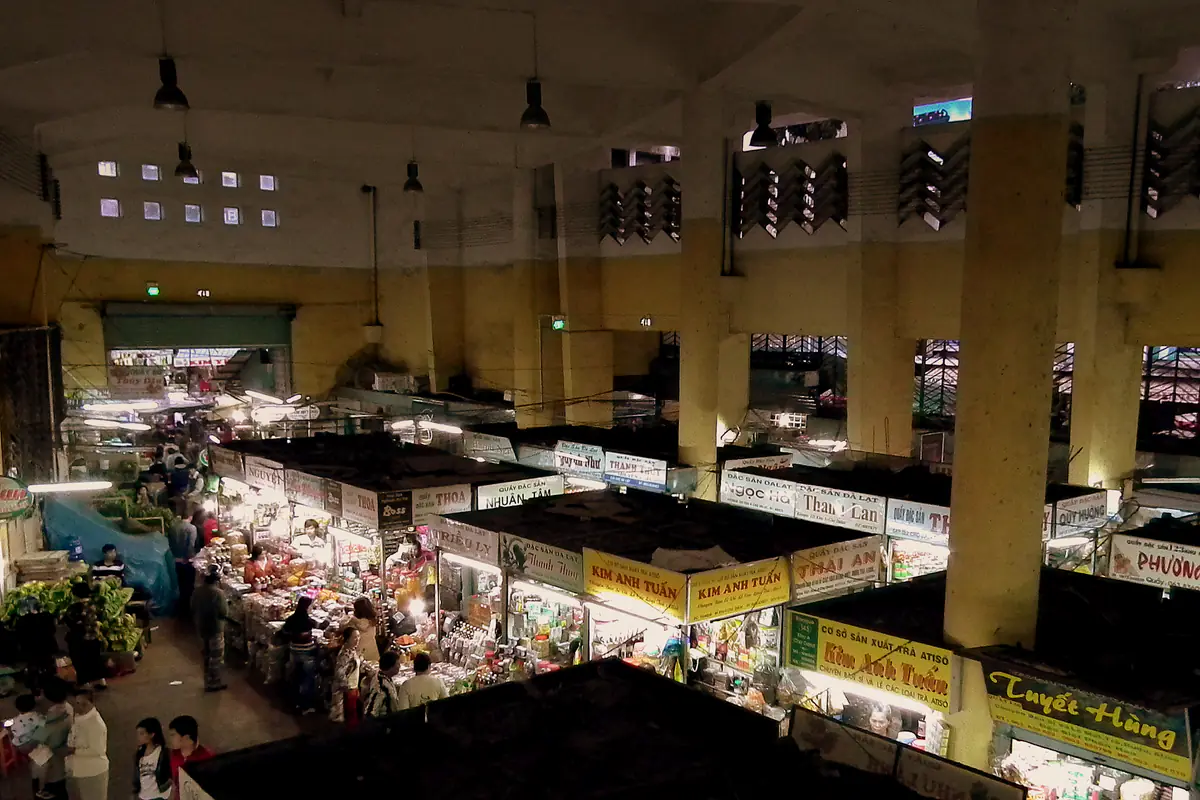
Candied fruit (mứt) is the backbone of Da Lat Market: strawberry, persimmon, kiwi and plum, plus air-dried persimmons, dried fruit and artichoke. But the same Tuoi Tre report notes that some candied fruit and sweets are “gathered from other places.” Not everything sold at the Da Lat night market is made in Da Lat. Pick packs with a label, producer name, address and expiry date.
The problem is old. In 2012, Tuoi Tre (in Vietnamese) found 37 so-called candied fruit “workshops” on two tourist roads with no production license, relabeling bought-in goods and charging three to five times the price of the same products inside Da Lat Market. The data is dated, but the lesson holds: buy in the market, compare stalls, read labels.
For air-dried persimmons and this season’s prices, see our guide to Da Lat dried persimmons. For coffee as a gift, our Da Lat coffee guide explains what to look for.
What travels well, and what customs may stop
Fresh Da Lat strawberries and avocados look tempting at the Da Lat night market, but they bruise fast and most countries restrict fresh produce. Sealed, labeled, shelf-stable items are the easiest to carry home. Customs rules change, so check your own country’s official page before you fly.
- Korea: according to the Korea Tourism Organization’s VisitKorea page on animal and plant quarantine (viewed September 27, 2026), almost all fresh fruit and vegetables are prohibited, and meat products, including processed ones like jerky or sausage, need a quarantine certificate. Declare anything you are unsure about on arrival.
- Singapore: the Singapore Food Agency allows food for private consumption only in small quantities, with limits on weight and value per traveler. Check its “bringing food for personal use” page for the current caps.
- Malaysia: plant and food items can be inspected on arrival. Check the Malaysian quarantine rules before packing fresh fruit or plants.
Items that generally travel well: sealed artichoke tea bags, vacuum-packed dried fruit, commercially packed candied fruit and roasted coffee in factory packaging. Items to think twice about: fresh strawberries, avocados, flowers with soil, homemade jars without labels and anything containing meat.
Paying: cash, VietQR and cross-border QR
Carry Vietnamese dong in small notes (VND10,000, VND20,000, VND50,000). Many street vendors do not keep much change early in the evening, and a network outage can stop a QR payment. Do not count on card terminals at street stalls; cards are more realistic in hotels and larger shops.
Many vendors display a VietQR code, which Vietnamese customers scan with their banking apps. Visitors from some countries can now scan those codes from home:
- South Korea: since April 23, 2026, users of banking apps and e-wallets in the GLN International network can scan VIETQRGlobal codes at merchants across Vietnam, with direct won-dong settlement through Hana Bank and BIDV (Nhan Dan).
- Singapore: since July 2, 2026, a NAPAS, Liquid Group and VietinBank link lets Singapore users pay VIETQRGlobal codes with automatic dollar-dong conversion, starting with about five million users in Liquid Group’s partner network (VOV).
- Malaysia: we could not confirm a live link that lets Malaysian apps pay Vietnamese QR codes, so plan on cash.
Before you scan
Bargaining and avoiding overcharging
The Da Lat night market has a reputation for inflated first prices, especially on woolens and unpriced souvenirs. In 2017 two foreign visitors were charged VND460,000 at a food stall, and police made the owner refund VND200,000 (VietnamPlus (in Vietnamese)). The details of food-stall disputes are in the where to eat in Da Lat guide.
In early 2026 the province still listed “not displaying prices” and “aggressively soliciting tourists” among the violations to tackle at the night market (PLO, March 12, 2026). In other words, the problem has not gone away. Our rules of thumb:
- Ask the price before you pick something up, and ask whether it is per piece or per set.
- Prefer stalls with a price board, and photograph it if there is one.
- Ask at two or three stalls for the same kind of item. There are dozens of sweater stalls; you never need to buy at the first.
- Bargain with a smile. Once the vendor agrees to your price, it is rude to walk away.
- For packaged specialties, compare the printed price with what you are quoted.
- Count your change at the stall; for QR, check the recipient name and amount before approving.
- If you feel cheated or pressured, note the stall and report it to the market management board or ward police.
Two phrases help: “Bao nhiêu tiền?” (how much?) and “Mắc quá” (too expensive, in southern Vietnamese). A calculator app on your phone avoids confusion over zeros, which is the most common mix-up for visitors dealing in hundreds of thousands of dong.
The 2026 clean-up at the Da Lat night market
This part rarely appears in travel guides, but it shapes what you will see. On March 3, 2026, the Lam Dong provincial government issued instructions to tighten management of Da Lat Market and the night market. On March 12, the provincial Department of Industry and Trade told Xuan Huong - Da Lat ward to fix the problems, according to PLO. The list included:
- Ending unlicensed trading, sidewalk and roadway encroachment and food safety violations in the night market area.
- More night patrols against unpriced goods, goods of unclear origin, illegal parking fees and aggressive touting.
- Upgrading the night market into a night-time economy highlight linked to the walking street.
- Having the ward study options to reorganize or relocate the night market in line with city planning.
On March 31, 2026, Lam Dong newspaper (in Vietnamese) quoted ward vice chairman Nguyen Ngoc Hau as saying vendors would be regrouped by product type, with uniform, tidy stalls, and that some outdoor trade would move into the market building. The deadline was April 30, 2026.
As of September 27, 2026, we have not seen a major news report assessing the results. If you find stalls neatly grouped with consistent price boards, that is the clean-up at work; if not, the bargaining tips above matter even more.
Is the night market moving?
The idea has circulated for years. VnExpress International reported in August 2022 on a planned VND1.6 trillion night market and walking street near Cam Ly Stream. In February 2023, Tuoi Tre News and Viet Nam News reported plans for a modern night market in the Anh Sang (Light) park, about 100 meters away, to replace the current one. As of September 2026 the Da Lat night market still runs on Nguyen Thi Minh Khai Street (Tuoi Tre), so just head to Da Lat Market.
A telling detail: in December 2024 the then provincial chairman said he never spent more than VND200,000 on his visits, just a bowl of porridge and a few beers (Thanh Nien (in Vietnamese)). Big crowds, low spending: that gap is a big reason the province wants to upgrade the market.
Food: the short version
Food is the other half of the market: charcoal skewers, grilled rice paper, hot soups, soy milk and sweet soups. We map the food stalls, list dated prices and explain how to avoid billing mistakes in our where to eat in Da Lat guide. What each dish actually is appears in the Da Lat specialties section of our homepage. For a first-person taste of the stalls, VietNamNet’s 2018 feature Tastes of Da Lat night market is still a nice read.
One tip only: eat first, shop second. Juggling shopping bags on a low stool on the stairs is hard, and hungry shoppers agree to prices too quickly.
Getting there and parking
Walking from a central hotel is easiest. If you have not booked yet, our guide to cheap hotels in Da Lat city center lists streets within walking distance. A ride-hailing car is fine on weeknights; on Saturday nights, ask to be dropped a few blocks away and walk the rest.
The weekend walking street
According to Nhan Dan (in Vietnamese) (April 28, 2024), the Hoa Binh walking street covers about 1 km around the 3/4 cinema, including the Le Dai Hanh slope, the La Tulip stairs, Truong Cong Dinh, Nguyen Chi Thanh and Nguyen Thi Minh Khai streets. It runs from 7pm to 10pm on Saturdays and Sundays, and vehicles cannot enter. A second walking street along Xuan Huong Lake on Tran Quoc Toan closed on October 23, 2025 because of low turnout and traffic problems (Tuoi Tre (in Vietnamese)).
Tour coaches and parking
Since August 1, 2026, coaches with more than 29 seats (city buses excepted) are restricted on several central streets, including Bui Thi Xuan between 7pm and 9pm (Bao Tin Tuc (in Vietnamese), July 28, 2026). If you travel with a tour, ask where the driver will drop you.
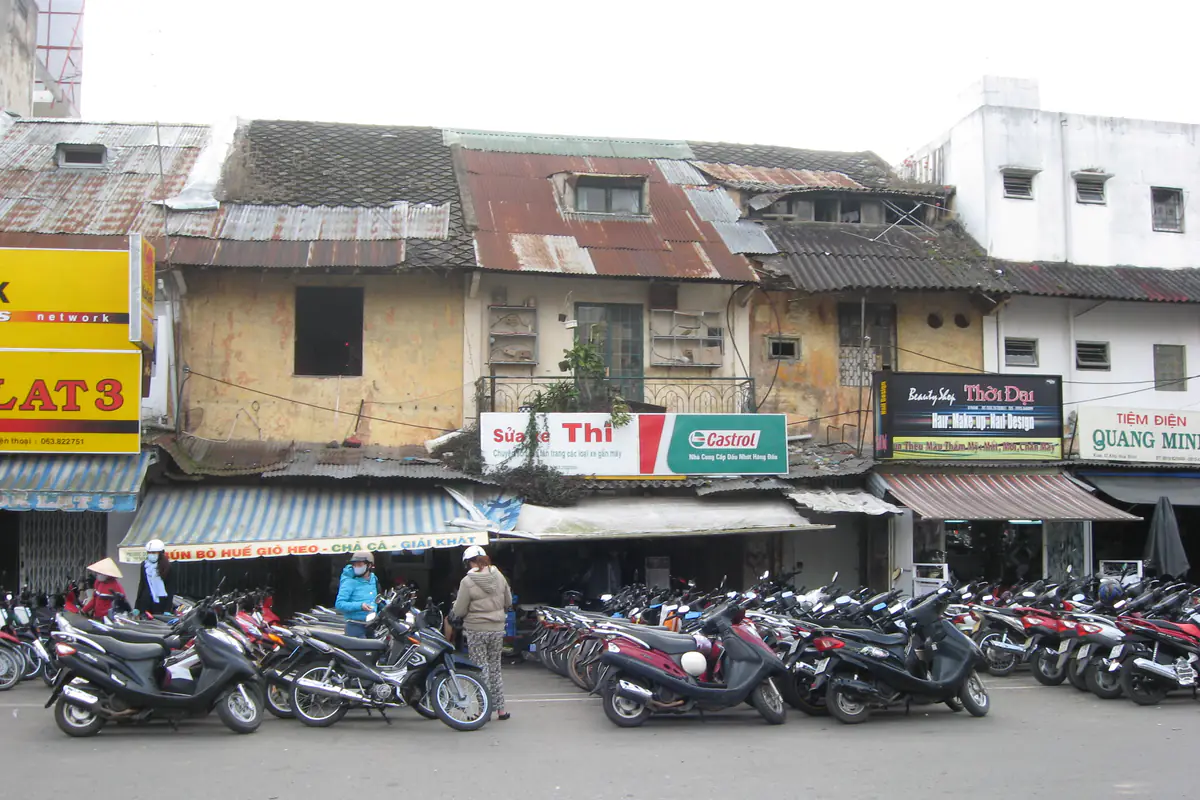
In 2023, newly auctioned car parks near the Hoa Binh cinema and the market charged VND30,000 per 30-minute slot at night for cars under 12 seats; the authorities ruled the 30-minute slot illegal, noting the provincial night rate of VND25,000 per turn (Tuoi Tre (in Vietnamese), February 15, 2023). Illegal parking fees were still on the 2026 list of problems. Always ask the price first, keep the ticket and avoid lots with no price board.
Pickpockets and crowd safety
Crowds attract thieves. On the evening of April 30, 2021, a four-person gang stole nine phones at the Da Lat night market; the next night they struck three more times in an hour before police caught them in the act (VnExpress (in Vietnamese)). In 2022, police arrested a group from Dong Nai province who rented a car to work tourist sites and the night market (Thanh Nien (in Vietnamese)).
Police told Thanh Nien that such gangs create a crush, shield each other and strike while visitors are on the phone or paying. Over the April 30 holiday in 2024, market staff kept broadcasting theft warnings over loudspeakers (Dan Tri).
- Wear a crossbody bag in front of you; never keep your phone or wallet in a back pocket.
- When paying, stand close to the stall and put your phone away before taking out your wallet.
- Agree on a fixed meeting point, such as the front of Da Lat Market, in case you get separated or your phone dies.
- Hold small children’s hands and write a parent’s phone number on a wristband or card.
- If something is stolen, tell the market management board and the Xuan Huong - Da Lat ward police; dial 113 in an emergency.
General safety advice for Da Lat, from mountain passes to motorbike rental, is in our Da Lat travel tips.
Evening weather and what to wear
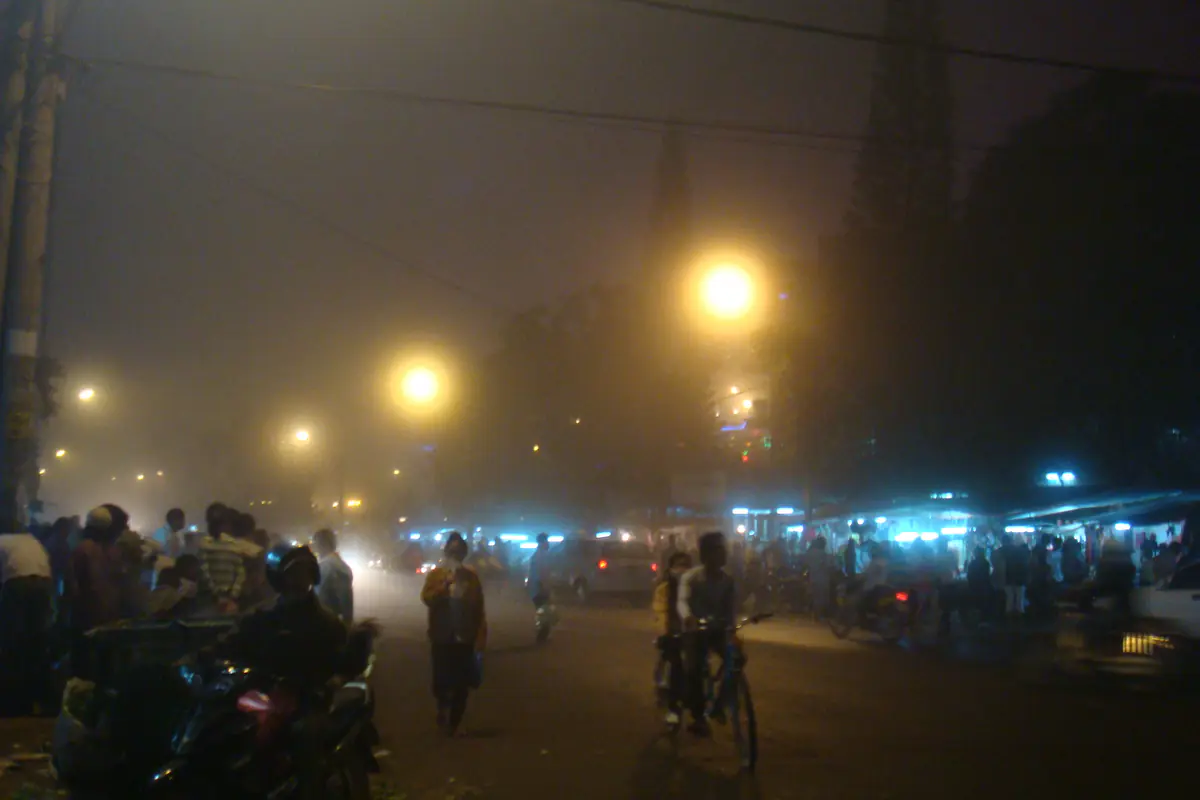
Evenings at the Da Lat night market are noticeably cooler than the daytime. Dan Tri measured 20-21°C around the market at 8pm on April 28, 2024, dropping to 19°C by 10pm, when many people started buying scarves and sweaters. That was dry season; rainy months and the end of the year feel colder, which surprises visitors used to tropical Singapore or Kuala Lumpur nights.
- A light jacket or sweater, plus a scarf after 9pm.
- Sneakers with grip; stairs and pavement get slippery in rain or fog.
- A compact rain poncho in the rainy season (roughly May to October); umbrellas snag on others in crowds.
Traveling in the rainy season? Our Da Lat weather in October guide has hourly rain patterns and wet-day plans. The 12-month weather calendar is on the Review Da Lat homepage.
Best time to visit the Da Lat night market
| Time | Best for | Keep in mind |
|---|---|---|
| 5pm-6:30pm | Families with small children, older travelers, photos as the lights come on | Some stalls are still setting up |
| 6:30pm-9pm | Peak atmosphere | Crushes, hard to find a seat, highest pickpocket risk |
| 9pm-11pm | Shopping for wool and gifts after dinner | Colder; the weekend walking street ends at 10pm |
| After 11pm | Night owls | Many stalls packed up, only some food vendors left |
If you can, go Monday to Thursday. Friday and Saturday nights and Vietnamese holidays are the busiest, with the worst traffic around the roundabout. Many first-timers go on their first evening because it is close to the hotel; we think the second evening works better, once you know which warm layer you are missing and which gifts you want.
Walk it off at Xuan Huong Lake
Xuan Huong Lake is about five minutes on foot from the market. In the evening the lakeshore is much calmer than the market and good for photos of the lights on the water. Lam Vien Square often hosts holiday events, but it is also a traffic bottleneck on those nights.

The lake and other central sights are covered in our list of places to visit in Da Lat, including a Da Lat Market entry for your daytime route.
Pros and cons of the Da Lat night market
What we like
- Right in the center, walkable from many hotels and from Xuan Huong Lake
- Free to enter; stay as long as you like
- Warm clothes to wear on the spot and plenty of dry, packable gifts
- Lively atmosphere, with a walking street on weekend nights
- A chance to buy produce straight from residents at the market edges
Watch out for
- Very crowded on Saturdays, holidays and Tet; easy to get separated
- Many woolen and souvenir stalls show no prices, and first quotes can be inflated
- Some specialties are brought in from elsewhere; read labels
- Hard to park a car; some lots have charged illegal fees
- Pickpocketing cases have been reported repeatedly
- Stalls are being regrouped in 2026, so older descriptions may be off
The bottom line
The Da Lat night market is worth an evening, as long as you treat it as a lively stroll with some shopping rather than a bargain hunt. Go early or on a weeknight, eat before you shop, compare prices at a few stalls, keep your phone in front of you, carry small notes and dress warmly. That avoids most of the hassles reported in the press.
Because the market is being reorganized in 2026, you may find a different layout, prices or hours. If you do, tell us through our contact page so we can update this guide for the next traveler.
FAQ
What time does the Da Lat night market open?
There are no official hours. Vendors set up around 4pm, crowds build from 6pm and things wind down around 11pm to midnight (Dan Tri 2024; Tuoi Tre, September 19, 2026). VnExpress International lists 6pm to midnight. On holidays it can stay busy past midnight.
Where exactly is the Da Lat night market?
On Nguyen Thi Minh Khai Street in front of Da Lat Market (Chợ Đà Lạt) and on the stairs up to the Hoa Binh area, in Xuan Huong - Da Lat ward. It is about a five-minute walk from Xuan Huong Lake.
Can I pay by card or QR at the Da Lat night market?
Carry cash in small dong notes. Many vendors show a VietQR code. Korean users of GLN-network apps (since April 23, 2026) and Singapore users in Liquid Group’s network (since July 2, 2026) can scan VIETQRGlobal codes. Do not rely on card terminals at street stalls.
What should I buy at the Da Lat night market to take home?
Sealed artichoke tea, vacuum-packed dried fruit, labeled candied fruit and factory-packed coffee travel best. Buy sweaters and scarves to wear on the trip. Skip fresh strawberries and avocados if you are flying to Korea, and check Singapore or Malaysia food rules before packing produce.
Is bargaining expected at the Da Lat night market?
Yes for woolens and unpriced souvenirs, less so for packaged goods with printed prices. Ask the price before picking items up, compare two or three stalls and bargain politely. In 2026 the province was still targeting unpriced goods and touting at the market (PLO, March 12, 2026).
Is the Da Lat night market safe?
Generally yes, but pickpocketing has been reported repeatedly on crowded holiday nights (VnExpress 2021, Thanh Nien 2022). Keep your bag in front, put your phone away before paying and agree on a meeting point. Dial 113 for police in an emergency.
Sources
Facts in this article were checked against the sources below, accessed on Sep 27, 2026. Prices and opening hours change, so please double-check before you go.
- VnExpress International: 7 markets that represent Vietnam’s trade and culture (April 26, 2025)
- Nhan Dan: Viet Nam and Korea launch cross-border QR payment service (April 2026)
- VOV: Singapore visitors can now pay in Vietnam using VietQRGlobal (July 2026)
- VnExpress International: Da Lat eyes new night market (August 5, 2022)
- Tuoi Tre News: Vietnam’s Da Lat announces plans for new night market, casino (February 9, 2023)
- Viet Nam News: Đà Lạt plans to open casinos, new night market at tourist destinations (2023)
- VietNamNet: Tastes of Da Lat night market (April 29, 2018)
- Saigoneer: Every holiday season, Da Lat chokes under tourism pressures (February 28, 2018)
- VisitKorea (Korea Tourism Organization): Animal/Plant Quarantines (viewed September 27, 2026)
- Singapore Food Agency: Bringing food for personal use from overseas (viewed September 27, 2026)
- Lam Dong newspaper: Bringing Da Lat’s central market and night market into order and transparency (March 31, 2026) (in Vietnamese)
- PLO: 1,164 business spots at Da Lat Market leased at non-compliant rates (March 12, 2026) (in Vietnamese)
- Tuoi Tre: Why Da Lat Market thrives while other traditional markets struggle (September 19, 2026) (in Vietnamese)
- Kenh14 (via Tien Phong): Traffic inches through central Da Lat over the September 2 holiday (September 1, 2026) (in Vietnamese)
- Bao Tin Tuc: From August 1, Da Lat restricts coaches over 29 seats in the center (July 28, 2026) (in Vietnamese)
- Lam Dong newspaper: Da Lat’s night economy, busy but not strong (May 12, 2026) (in Vietnamese)
- Tuoi Tre: Walking street along Xuan Huong Lake closed over low turnout and congestion (October 23, 2025) (in Vietnamese)
- Thanh Nien: Lam Dong chairman says night market visitors only eat porridge and drink beer (December 10, 2024) (in Vietnamese)
- Dan Tri: Da Lat night market packed over the holiday (April 29, 2024) (in Vietnamese)
- Nhan Dan: Walking street in central Da Lat reopens (April 28, 2024) (in Vietnamese)
- Thanh Nien: Which specialties to buy as gifts in Da Lat (May 9, 2024) (in Vietnamese)
- Tuoi Tre: Da Lat car parks charge VND500 per minute (February 15, 2023) (in Vietnamese)
- Thanh Nien: Avoiding pickpockets in crowded places in Da Lat (July 5, 2022) (in Vietnamese)
- VnExpress: Tourists pickpocketed at Da Lat night market (May 2, 2021) (in Vietnamese)
- VnExpress: Why Da Lat night market is called Âm Phủ (December 12, 2020) (in Vietnamese)
- VietnamPlus: Da Lat restaurant owner forced to refund overcharged foreign tourists (August 7, 2017) (in Vietnamese)
- Tuoi Tre: The murky world of Da Lat specialties (July 1, 2012) (in Vietnamese)