Da Lat Clay Tunnel: who built it, what is inside, 2026 tickets and directions
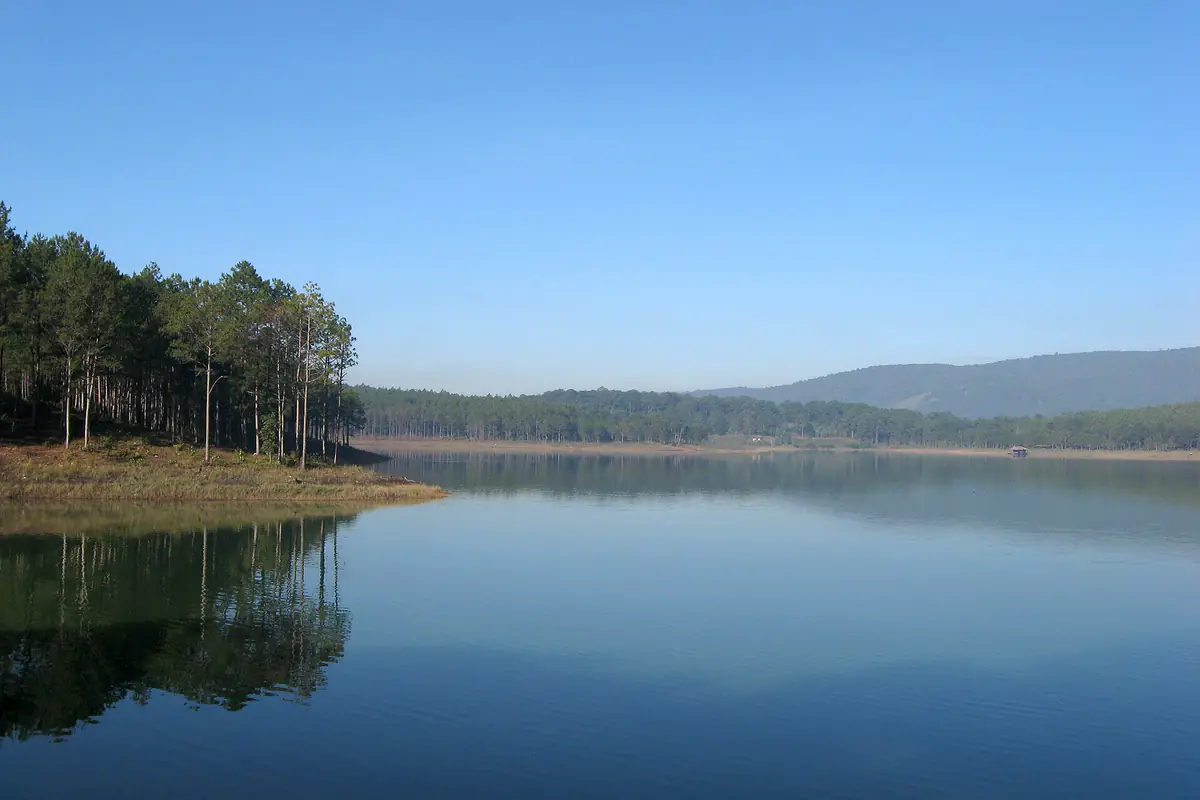
The Da Lat clay tunnel is an open-air trench of red basalt clay sculptures beside Tuyen Lam Lake. This honest guide draws on Vietnamese press from 2014 to 2026: who built it, what is inside, current tickets and hours, photo spots, weather and directions.
By Da Lat LoversPublished Updated How we reviewĐọc bản tiếng Việt
How we put this guide together
The Da Lat clay tunnel, known in Vietnamese as Đường hầm điêu khắc (Sculpture Tunnel) or Đường hầm đất sét (Clay Tunnel), is not really a tunnel. It is a long, open-air trench cut into a pine-covered hillside next to Tuyen Lam Lake, its walls carved into red-clay models that tell the story of the city. Our list of places to visit in Da Lat gives it one short paragraph. This guide goes further: who made it and how, what you see inside, what tickets cost, when to go and how to get there.
What is the Da Lat clay tunnel?
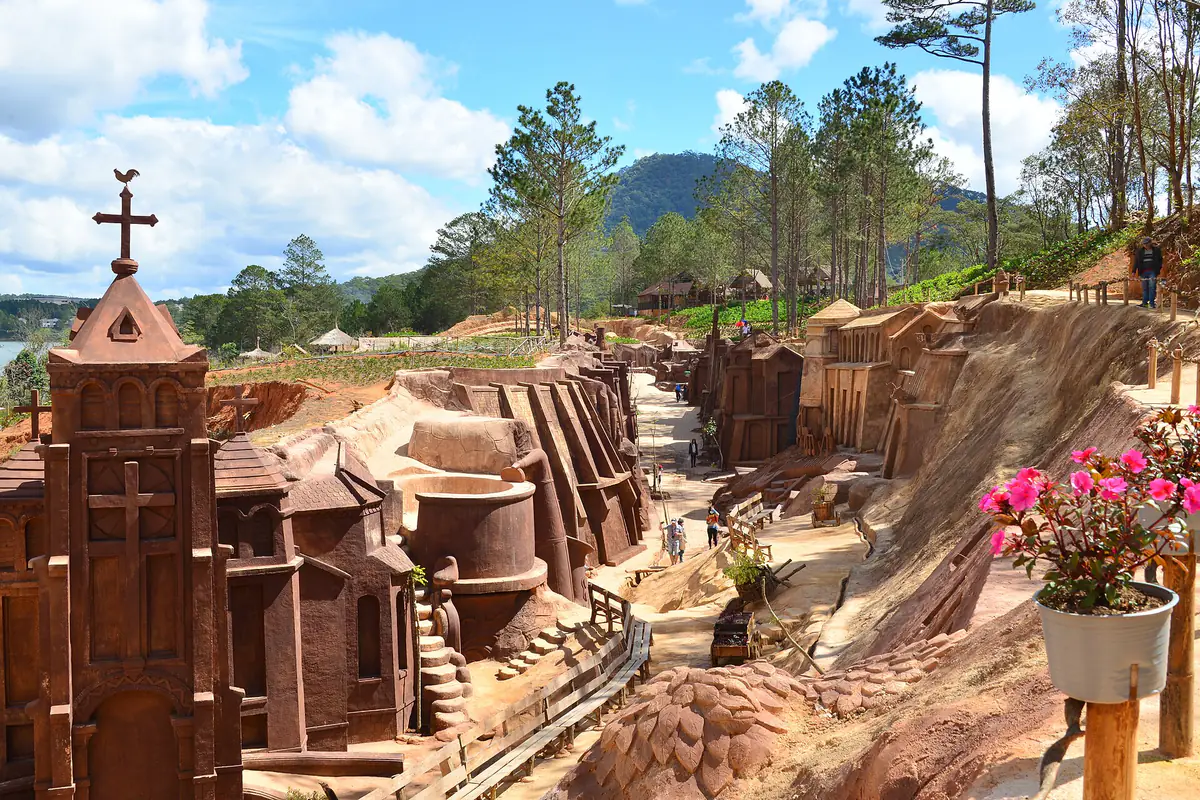
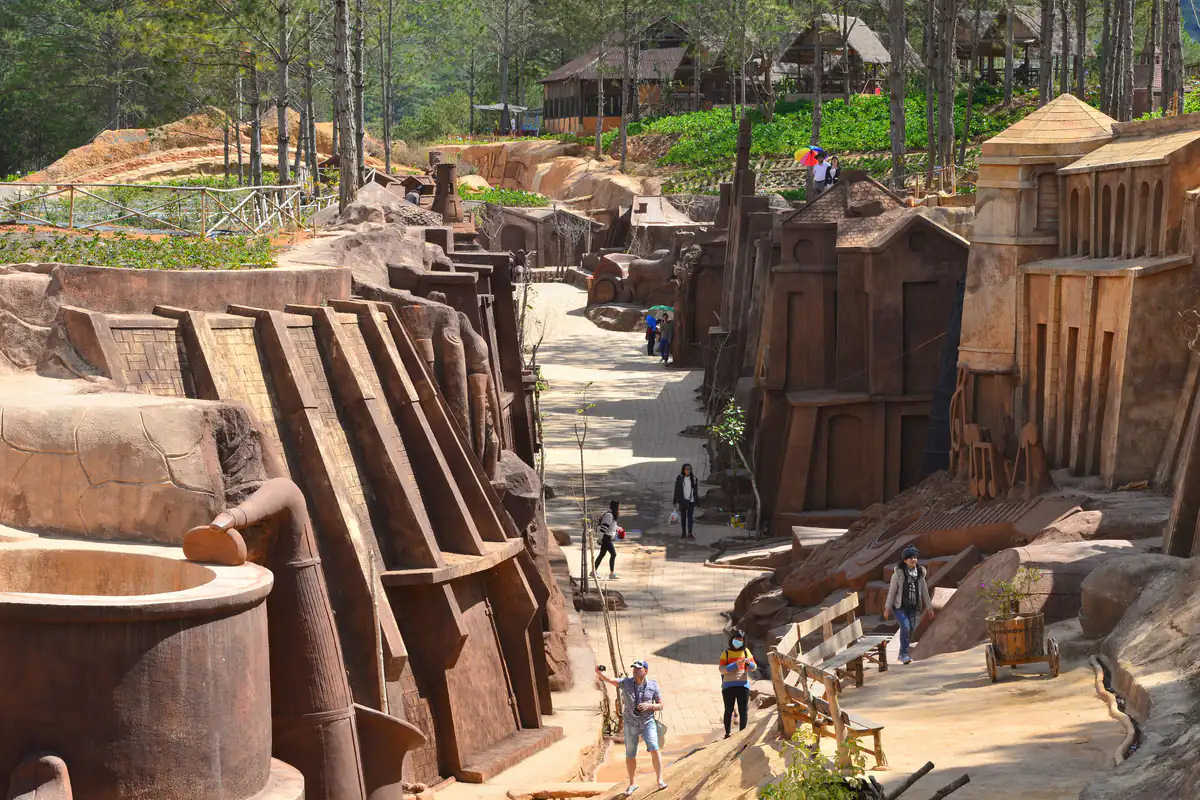
According to Thanh Nien (in Vietnamese) (June 15, 2014), the trench is 1.2 km long, 1 to 9 meters deep and 2 to 10 meters wide. There is no roof. You walk along a winding path at the bottom while buildings, trees, animals and people rise from the walls on either side, all shaped from the hillside itself.
The material of the Da Lat clay tunnel is local red basalt soil that has been hardened without firing. VietnamPlus (January 31, 2026) calls it a distinctive tourism symbol of the city, and its Vietnamese edition describes it as “Da Lat in miniature,” covering about 130 years of history through landmarks such as the railway station, the Chicken Church and the Pasteur Institute. Everything is outdoors, so the weather shapes your visit more than at most attractions in town.
You will see three names used for the same place: Sculpture Tunnel (the name on the gate), Clay Tunnel and Clay Village. On Grab or Google Maps, “Đường hầm điêu khắc” finds the right pin most reliably.
Who built it, and when?
The man behind the Da Lat clay tunnel is Trịnh Bá Dũng. A 2014 profile by VnExpress (in Vietnamese) says he was born in 1972 in Thanh Hoa province, trained as a marine engineer, studied economics in Germany and spent nearly 10 years in the customs service before moving to Da Lat to go into tourism.
In 2007 he and four friends leased land in the Tuyen Lam Lake area, planning 100 holiday villas on 15 hectares. The access road was still red dirt, the project stalled and three partners pulled out. Getting his car stuck in that mud is what gave him the idea of hardening soil without firing it. In early 2012 he built two test villas from earth mortar, then switched to a new plan: a sculpted trench retelling how Da Lat came to be.
The start date depends on which paper you read
Dan Tri (in Vietnamese) (May 14, 2015), VietNamNet (December 11, 2015) and CafeF (2024) all put the start of construction in 2010. Thanh Nien (2014) says ground was broken on the trench in 2013, while VnExpress (2014) reports he planned 1.3 km and finished 1 km in under two years. We give both dates rather than pick one.
VnExpress also reported that after seven years he had put almost VND200 billion into the wider Sao Da Lat project. Even unfinished, the site was drawing 500 to 700 visitors a day in 2014 on a trial ticket of VND50,000. The operator today is Sao Da Lat JSC, according to VietNamNet’s 2018 report.
How do you sculpt with unfired clay?
This is the part most guides skip. Thanh Nien (2014) says Dung spent four years testing a mix of red basalt soil and additives before he found one that set hard. VnExpress (2014) describes the process step by step:
- At night, painters and sculptors designed the shapes on a computer.
- An excavator dug out a rough block; workers sitting in the bucket marked with paint where soil should come off.
- The bucket was swapped for blade- and chisel-like tools to shave the block; machines did about 60% of each piece.
- Artisans were lifted by the excavator to finish details, with no scaffolding needed.
- A final “locking” layer of fine soil, water, stone powder and chemicals was applied and hardened overnight.
The reddish-brown finish is a paint made from local soil powder, another of Dung’s experiments. Once you know this, the Da Lat clay tunnel looks different: most figures are the original hillside carved in place, not statues cast elsewhere and brought in.
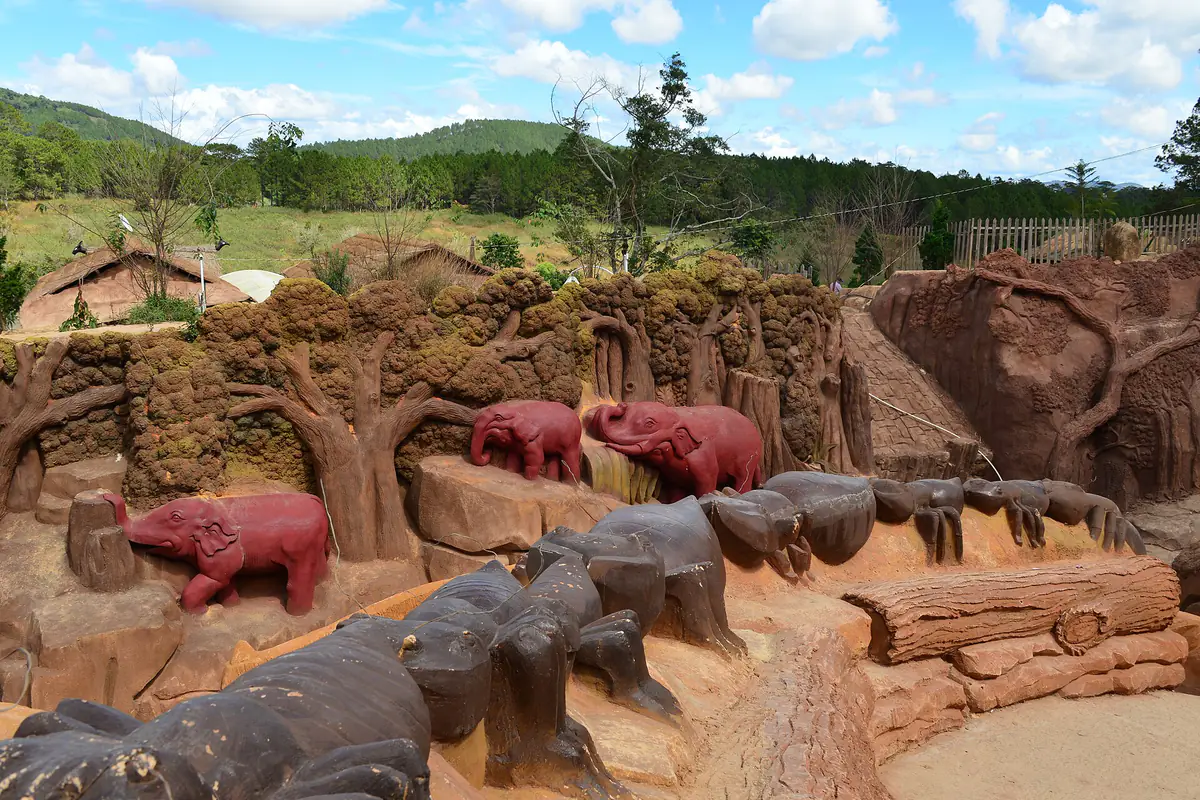
Walking the Da Lat clay tunnel: the zones in historical order
We could not find an official map from the operator. The order below follows how Dan Tri (2015), VietNamNet (2015), CafeF (2024) and Thanh Nien (2026) describe the walk: from the wild plateau to the modern city. The path does branch, so follow the signs on the day.
1. The wild Lang Biang plateau
The walk starts with forest scenes: ancient trees, streams, waterfalls, herds of elephants and troops of monkeys. Dan Tri (2015) calls it Lang Biang in its primordial state, and VietNamNet’s English report mentions apes going about prehistoric life. Kids tend to like this stretch best because the animals are huge.
2. Indigenous villages
Next come stilt houses, banana gardens and red gourds of the K’Ho and Chu Ru peoples (Dan Tri, 2015). Thanh Nien (June 17, 2026) describes the same area as old Lach villages at the foot of Lang Biang Mountain, and its 2014 report mentions symbols of the local matrilineal society.
3. The French arrive and a town takes shape
According to CafeF (2024), the first theme runs from Dr. Alexandre Yersin’s exploration of the Lang Biang plateau to the arrival of the French. VietNamNet (2015) lists a statue of Yersin, horse carriages, an old train and station, and a steam locomotive relief that fills an entire wall.
4. Modern Da Lat in miniature
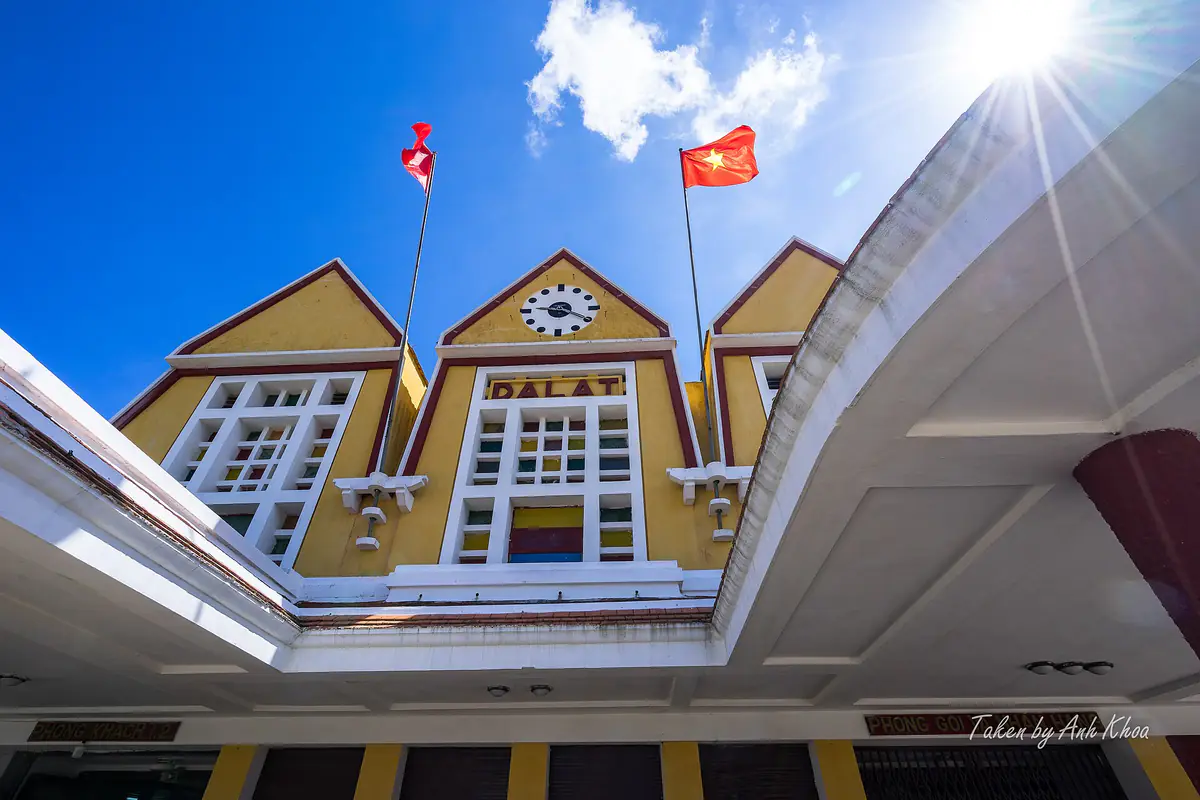
This is the longest and busiest stretch for photos. The press names the Da Lat railway station, the Chicken Church, Bao Dai’s Summer Palace, the Pasteur Institute, the Palace Hotel, the Pedagogy College, Da Lat University, Linh Son Pagoda, Truc Lam Zen Monastery, Xuan Huong Lake, Da Lat Market and Lien Khuong airport. VOV (March 19, 2018) adds a giant dragon head, and Thanh Nien (2026) mentions musical notes from the song “Ai lên xứ hoa đào” carved into the wall.
If you have already visited the real landmarks, such as the Crazy House or the railway station, this stretch becomes a fun game of “name that building.” Everyday details are here too: a vintage Vespa, old cars and farm tools.
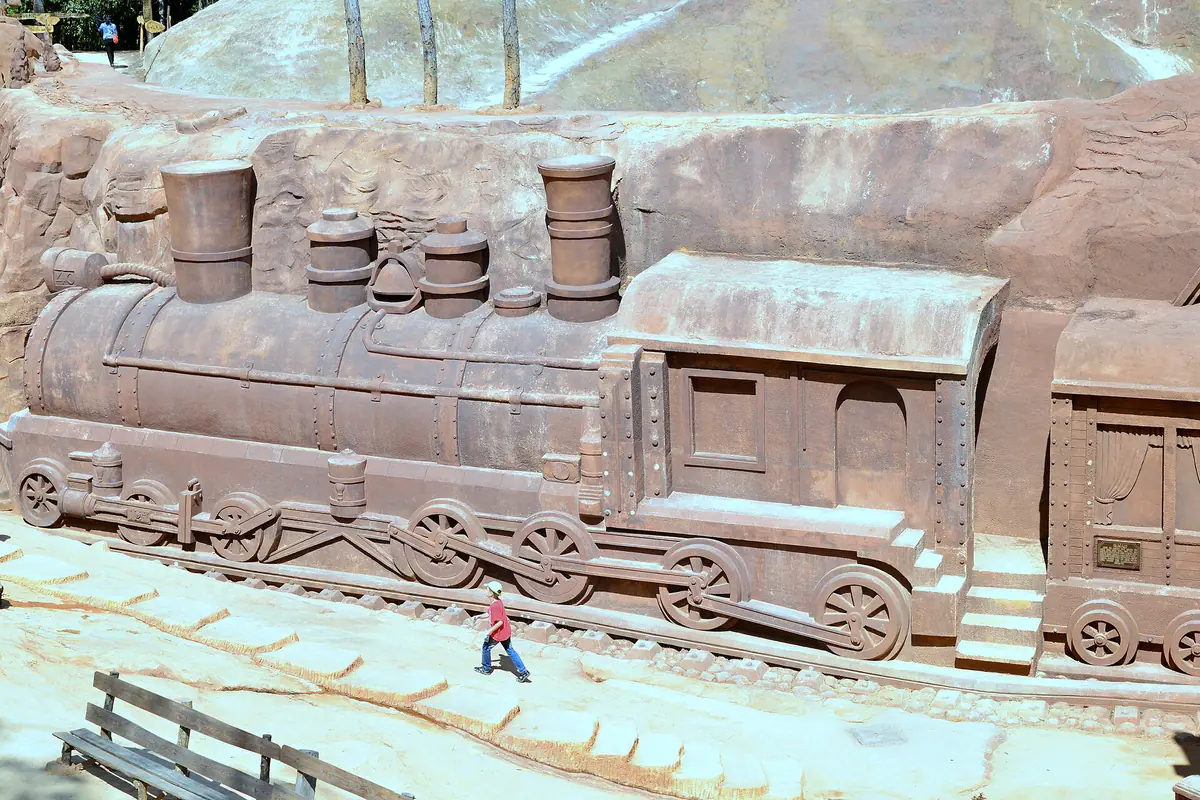
The clay house, Infinity Lake and those record claims
The basalt house with a map of Vietnam on its roof
Beside the trench stands a house of about 90 square meters, furniture included, built from unfired red basalt soil. According to Thanh Nien (2014), the Vietnam Book of Records confirmed two national records for it: the first and largest unfired basalt house with a raised map of Vietnam on its roof, and the first and most uniquely designed unfired basalt house. Dan Tri (2015) gives the roof map as 2.75 by 11 meters, including the Hoang Sa (Paracel) and Truong Sa (Spratly) islands.
The same 2014 Thanh Nien report says the house and trench won a 2014 Green Architecture award from the Vietnam Association of Architects.
Is it a Guinness World Record?
Many blogs and tour sellers call it “the longest clay tunnel in the world” or say it holds a Guinness record. We could not find any major news outlet or record body confirming that. The only sourced fact is an intention: in 2014, Dung told VnExpress he would apply to Guinness. The two confirmed records are Vietnamese records, and they are for the house, not the length of the Da Lat clay tunnel.
Infinity Lake (Hồ Vô Cực)
This is the newest scene and now the most photographed. According to Thanh Nien (in Vietnamese) (June 17, 2026), two giant stone-look faces gaze at each other across clear water ringed by pines, a symbol of lasting love. Several blogs link the faces to the Lang Biang legend of K’Lang and H’Biang, but we have not seen a major outlet confirm that.
We have also left out the “wine cellar” and a “Clay Tunnel 2” area that some ticket resellers mention, because no major outlet describes them. If you see them advertised, ask at the counter whether they cost extra.

Da Lat clay tunnel tickets and opening hours in 2026
The most recent prices from a major outlet come from the promotional Thanh Nien feature of June 17, 2026. Here they are next to older figures so you can see how prices have moved:
| Ticket | Price (Thanh Nien, June 17, 2026) | Earlier |
|---|---|---|
| Adult | VND120,000 | VND120,000 (Thanh Nien, June 20, 2024); VND50,000 trial ticket (VnExpress, 2014) |
| Child 1.1-1.3 m | VND50,000 | VND50,000 (2024, for 1.3 m and under) |
| Child under 1.1 m | Free | — |
| Couple (2 people) | VND230,000 | — |
| Family (4 people) | VND450,000 | — |
Opening hours are 7:30am to 5pm, according to both Thanh Nien (2026) and CafeF (in Vietnamese) (2024). CafeF notes that the site can close about 30 minutes early in the rainy season. Thanh Nien suggests calling the hotline for group and family deals.
Quick cost check
- Two adults: the couple ticket is VND230,000, which saves VND10,000.
- Family of four: VND450,000. With two kids under 1.1 m, two single adult tickets (VND240,000) work out cheaper.
- Half-day combo: add the cable car or the Datanla alpine coaster; prices are in our separate guides below.
Best photo spots and light
We have not photographed the Da Lat clay tunnel ourselves, so this section is based on press photos and Commons images. The shots that come up again and again:
- Looking down the trench: from the upper walkway, frame the Chicken Church model in front with the trench and pines behind, like the photo at the top of this guide.
- Infinity Lake: the two giant faces reflected in the water, best on a still, windless morning.
- The Vespa and the steam locomotive: they are big enough to sit on or stand beside for scale.
- The Lang Biang model and the map-roof house: Tuyen Lam Lake shows in the distance on a clear day.
CafeF (2024) says visitors recommend roughly 8-9:30am and 4-5pm. At midday the sun hits the bottom of the trench directly, the red clay washes out in photos and it gets surprisingly warm even in cool Da Lat.
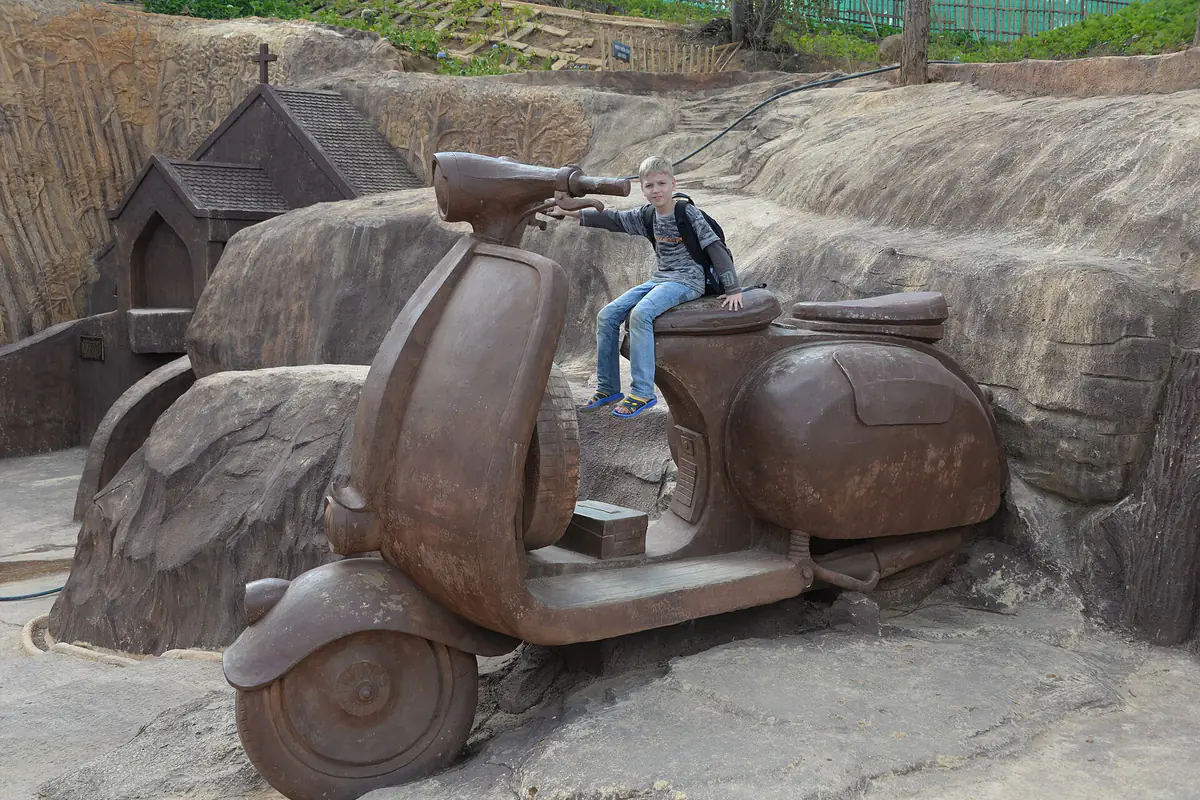
Weather: when to visit the Da Lat clay tunnel
The whole site is outdoors, with only a few small shelters. Da Lat’s rainy season runs roughly from May to October, and showers usually arrive in the afternoon. Wet red clay is slippery and sticks to your shoes, and the path has steps. In the rainy months, arrive at opening time and check the forecast, as we explain in our guide to Da Lat weather in October.
November to April is the dry season: blue skies and better photos, but strong midday sun. A hat and sunscreen on sunny days, and a raincoat or umbrella when it is overcast, is the advice printed in the Thanh Nien feature itself.
Pine trees and a 2018 accident
How to get to the Da Lat clay tunnel
According to CafeF (citing VTC News, October 27, 2024), the site is about 13 km from Da Lat Market, a 30-minute drive, at the far end of the Tuyen Lam tourist area. There are two main routes:
- Via the Prenn Pass: from the center take 3 Thang 4 Street onto the pass. Near Datanla Waterfall, turn right at the sign for Truc Lam Zen Monastery. After about 1 km uphill you reach Tuyen Lam Lake; turn right along the shore for about 400 meters to the entrance sign.
- Through town: many visitors go this way to stop at the Chicken Church, the Crazy House and Bao Dai’s Summer Palace en route.
On rainy days a taxi or Grab car is the safest choice. The Prenn Pass has an active landslide point: on September 22, 2026, Lam Dong province declared an emergency at Km225+250, with the pass still open under traffic control (Thanh Nien (in Vietnamese)). On the evening of September 25, 2026, a motorbike carrying two tourists skidded on a bend near Datanla in heavy rain and one person died (Tuoi Tre (in Vietnamese)). We track pass conditions weekly in the getting-to-Da-Lat section of our travel tips. Still on your way to the highlands? See our guide to getting from Ho Chi Minh City to Da Lat.
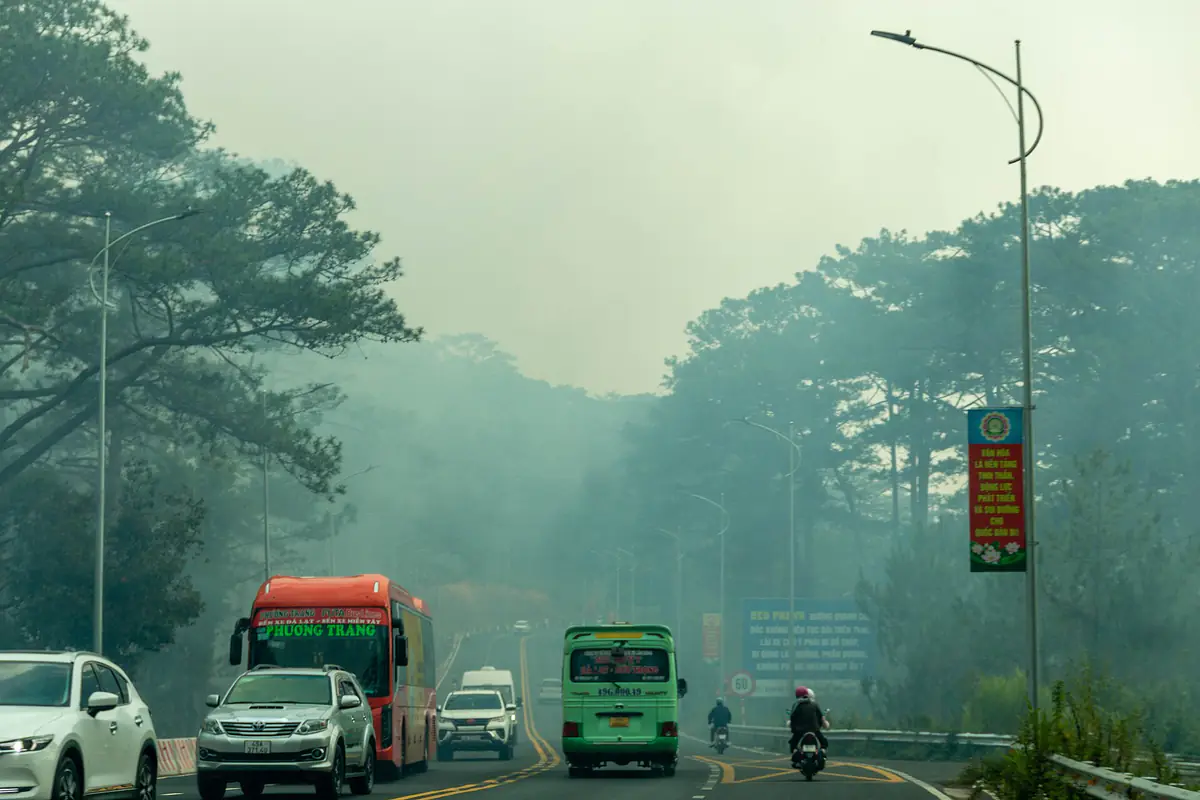
Combine it with the cable car, Truc Lam and Datanla
The Da Lat clay tunnel sits in the same southern cluster as Tuyen Lam Lake, Truc Lam Zen Monastery and Datanla Waterfall, so a half-day loop is easy:
- 7:30am: enter the tunnel while it is cool and quiet; allow about an hour.
- 9am: drive around the lake to Truc Lam. To ride the cable car back to Robin Hill, check tickets and hours in our Da Lat cable car guide.
- 10:30am: head out to Highway 20 for the Datanla Waterfall alpine coaster, then back to town for lunch.
If it rains from the morning, swap the order and save the tunnel for another dry morning; wet clay and a wet coaster are both far less fun.
Etiquette and practical tips
- Do not carve or draw on the sculptures. Kenh14 (in Vietnamese) (December 10, 2019) published photos of graffiti left by visitors here.
- Do not climb on models unless there is a path; the hardened clay is tough, but small details break.
- Wear shoes with grip, and skip white sneakers after rain; red clay stains are hard to wash out.
- Bring water and a hat; there is little shade in the trench at midday.
- For a seasonal packing list for the whole trip, see our Da Lat travel tips.
Is the Da Lat clay tunnel worth it?
What we like
- An original idea: Da Lat’s history told in red clay, easy for kids to follow
- Lots of oversized sculptures to pose with; Infinity Lake is a new photo favorite
- VND120,000 adult ticket, with couple and family tickets and free entry under 1.1 m
- Same cluster as Tuyen Lam Lake, Truc Lam, the cable car and Datanla
- About an hour on foot, no real fitness needed
Watch out for
- Fully outdoors: slippery when wet, hot at midday
- About 13 km from the center, via a pass with rainy-season landslides
- Online “world’s longest” claims have no official confirmation
- No dedicated official website to check prices; you need to call
- Some sculptures have been vandalized, and upkeep varies
Final thoughts
If you like places with a story, the Da Lat clay tunnel deserves a morning. It is an open-air history museum of the city and the life project of a man who bet most of what he had on red earth. Go early, pick a dry day, confirm prices by phone and pair it with Tuyen Lam Lake or Datanla for a tidy southern loop.
For the big picture on Da Lat, start at our Review Da Lat homepage. If you visit and find different prices or hours, let us know through the contact page so we can update this guide for the next traveler.
FAQ
How much is the Da Lat clay tunnel ticket in 2026?
According to Thanh Nien (June 17, 2026): VND120,000 per adult; VND50,000 for children 1.1-1.3 m tall, free under 1.1 m; VND230,000 for a couple and VND450,000 for a family of four. Prices can change over holidays, so call ahead.
What are the Da Lat clay tunnel opening hours?
7:30am to 5pm every day, weekends included. CafeF (2024) notes it may close about 30 minutes early in the rainy season. A full walk takes about an hour.
Where is the Da Lat clay tunnel and how far is it from the center?
It is in the Tuyen Lam Lake tourist area, Xuan Huong - Da Lat ward, about 13 km from Da Lat Market. The drive takes around 30 minutes via the Prenn Pass and the road to Truc Lam Zen Monastery.
Who built the Da Lat clay tunnel?
Trinh Ba Dung, born in 1972 in Thanh Hoa, a former marine engineer and customs officer who moved into tourism in Da Lat in 2007. Sao Da Lat JSC runs the site. Press reports give the start of construction as either 2010 or 2013.
Does the clay tunnel hold a Guinness World Record?
We found no official confirmation. The sourced records are two Vietnamese records for the unfired red basalt house with a map of Vietnam on its roof, confirmed by the Vietnam Book of Records (Thanh Nien, 2014).
Is it worth visiting the clay tunnel in the rain?
Not ideally. The site is fully outdoors, wet red clay is slippery and sticks to shoes, and the Prenn Pass has landslide points in the rainy season. Go on a dry morning in shoes with good grip.
Sources
Facts in this article were checked against the sources below, accessed on Sep 27, 2026. Prices and opening hours change, so please double-check before you go.
- VietnamPlus: Unique red-earth sculpture tunnel offers miniature Da Lat experience (January 31, 2026)
- Thanh Nien (promotional feature, in Vietnamese): Sculpture Tunnel, basalt memories in the forest (June 17, 2026)
- Thanh Nien (in Vietnamese): Lam Dong declares landslide emergency on the Prenn Pass (September 22, 2026)
- Tuoi Tre (in Vietnamese): Two Indian tourists crash on the Prenn Pass, one dies (September 25, 2026)
- CafeF, citing VTC News (in Vietnamese): The unusual clay tunnel in Da Lat (October 27, 2024)
- Thanh Nien (in Vietnamese): Sculpture Tunnel, an art paradise in the mountain city (June 20, 2024)
- Tuoi Tre News: Da Lat, perfect picnic spot and sports destination for holidays (April 29, 2023)
- Kenh14 (in Vietnamese): Famous Da Lat spots defaced by graffiti (December 10, 2019)
- VietNamNet: Tourist killed by falling tree at Da Lat clay tunnel (June 20, 2018)
- VOV: Clay tunnel, Da Lat’s model village (March 19, 2018)
- VietNamNet: Unique clay architecture and sculpture in Da Lat (December 11, 2015)
- Dan Tri (in Vietnamese): Da Lat in miniature in a unique sculpture tunnel (May 14, 2015)
- Thanh Nien (in Vietnamese): Da Lat inside the sculpture tunnel (June 15, 2014)
- VnExpress (in Vietnamese): The tourism gamble of a marine engineer (June 13, 2014)
- dalat.vn directory listing for the Sculpture Tunnel, Sao Da Lat JSC (checked September 27, 2026; outdated, prices not used)