Da Lat railway station: tickets, the Trai Mat train and a 1930s landmark
Da Lat railway station is a 1930s landmark and the start of the tourist train to Trai Mat. We pulled together news reports and official notices (checked September 27, 2026): history, architecture, entry fees, train times, fares, photo spots and how to get there.
By Da Lat LoversPublished Updated How we reviewĐọc bản tiếng Việt
How we put this guide together
Da Lat railway station (Ga Đà Lạt) is one of the town’s three classic landmarks, alongside the Chicken Church and Yersin High School, according to Tuoi Tre (July 11, 2024). Our Da Lat overview and our list of 30 places to visit in Da Lat give it only a short entry.
This guide goes deeper: when the station was built and why it has three pointed roofs, what the entry fee is and who gets in free, when the train to Trai Mat leaves and what it costs, whether the old cog railway to the coast will ever return, and where to stand for the best photos.
History of Da Lat railway station and the Thap Cham cog line
To understand why Da Lat railway station is so carefully kept, start with the railway behind it. The French built the Thap Cham to Da Lat line over 24 years, from 1908 to 1932. It ran about 84 km from the coastal plain near Phan Rang up to the Lang Biang plateau, reports VnExpress International (August 20, 2023).
What made it special was the rack section. VietnamPlus (May 8, 2026) reports (in Vietnamese) about 16 km of rack rail with an average gradient of 12% over the Ngoan Muc Pass. A cogwheel under the locomotive gripped a toothed rail between the running rails, so trains could climb without slipping.
Dan Tri (in Vietnamese) called it Vietnam’s one and only rack railway; at the time, only Switzerland had anything similar. Saigoneer’s photo history describes the line carrying produce and holidaymakers between the coast and the hills, a lifeline for colonial-era Da Lat.
French architects Moncet and Reveron designed Da Lat railway station in 1932. The Vietnamese Wikipedia article says it was finished in 1938 by contractor Vo Dinh Dung for about 200,000 francs. Tuoi Tre (2024) and VnExpress (2024) give 1936 instead; we list both because we could not find the original records.
The line closes, then 7 km come back
War stopped the trains. VnExpress (January 3, 2023) and Phap Luat TP.HCM (in Vietnamese) (July 20, 2025) both date the end of service to 1968; the Vietnamese Wikipedia says 1972. After 1975 most of the track was pulled up, leaving bridges and tunnels to the forest.
In 1991, the 7 km stretch between Da Lat railway station and Trai Mat station was restored for tourist trains (VietnamPlus, May 8, 2026). That short section is all that runs of the old cog line today, and it is the reason most visitors come.
Da Lat railway station was listed as a national historic relic in 2001 (VietnamPlus; Wikipedia). Lam Dong province recognized it as an official tourist site on June 21, 2024, announced on July 11, 2024 (Tuoi Tre (in Vietnamese)). That decision is what allowed the new entry fee.
Architecture: three roofs and the details to look for
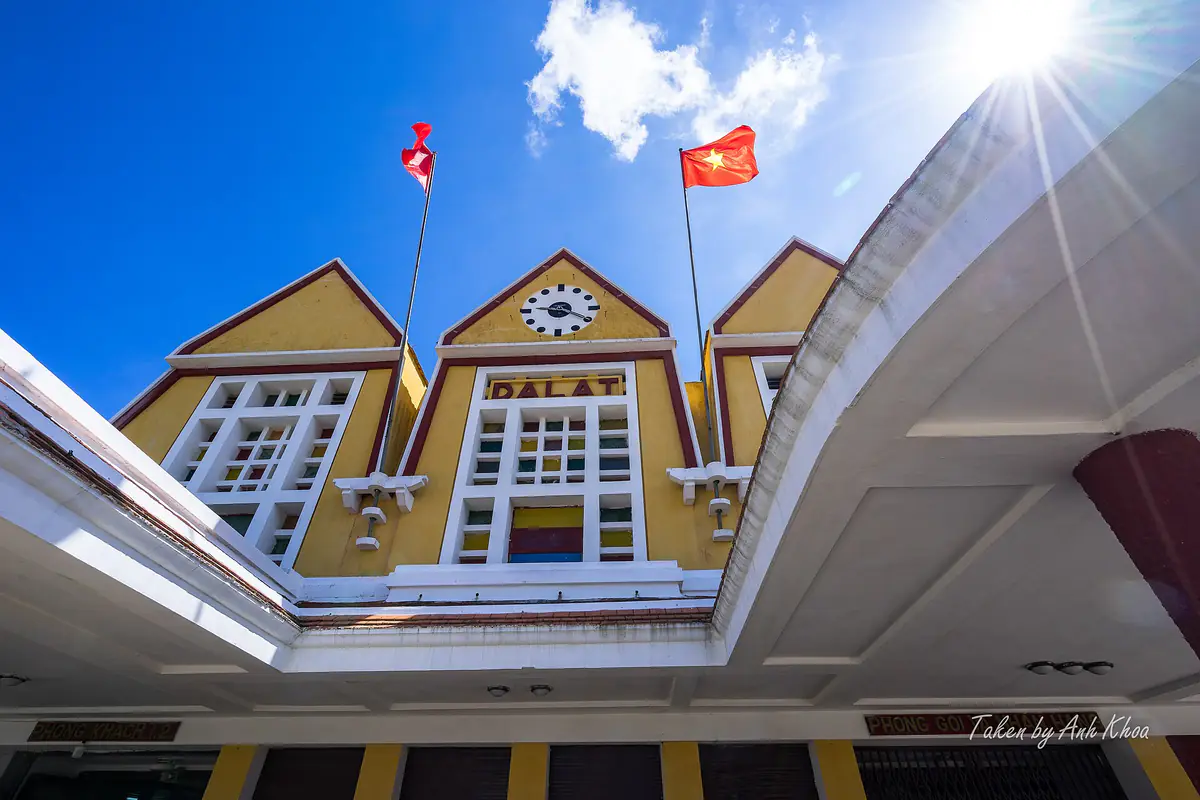
From the square out front, the building is all about its three steep yellow gables. Dan Tri and Kenh14 (July 28, 2025) say they echo the three peaks of Lang Biang mountain and the tall roofs of Central Highlands communal houses. English Wikipedia describes the style as Art Deco with highland touches.
Da Lat railway station is 66.5 m long, 11.4 m wide and 11 m high (VietnamPlus). The facade has colored glass windows and a large restored clock on the central gable, and the carriage porch rests on 24 columns (Wikipedia). The Vietnamese Wikipedia says the design took cues from stations in southern France.
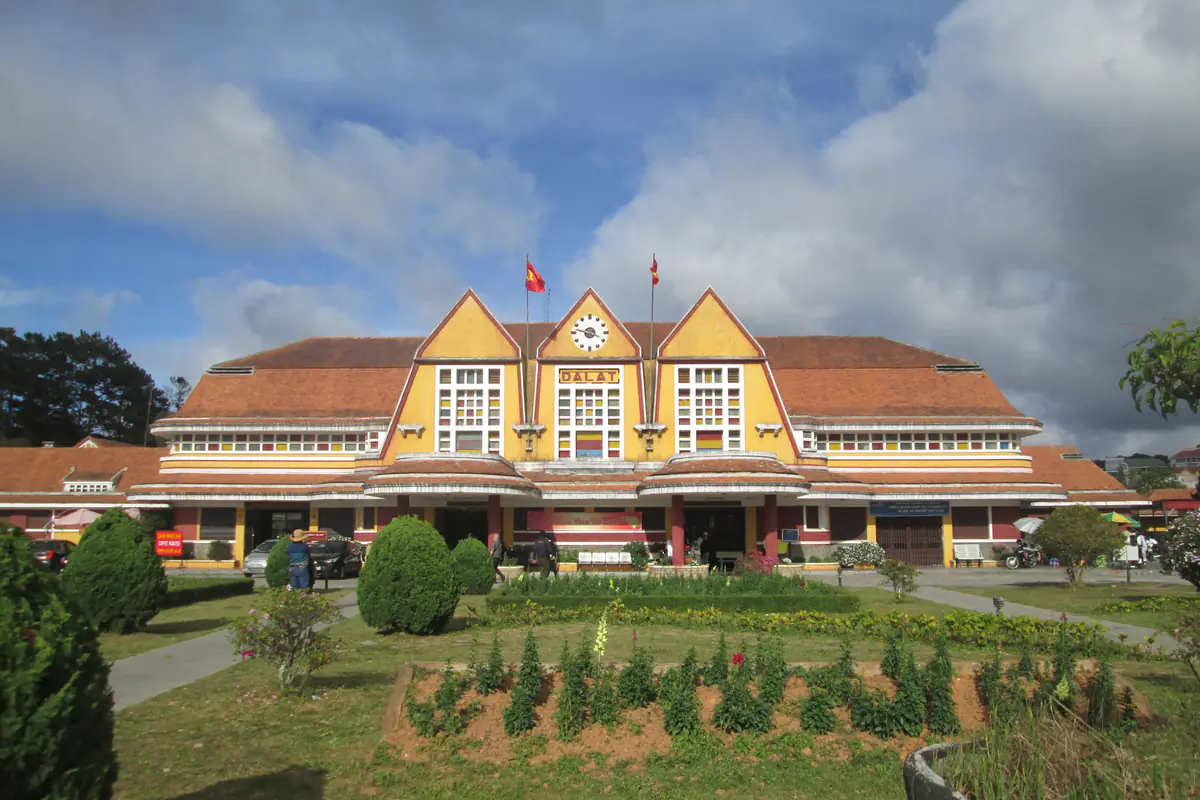
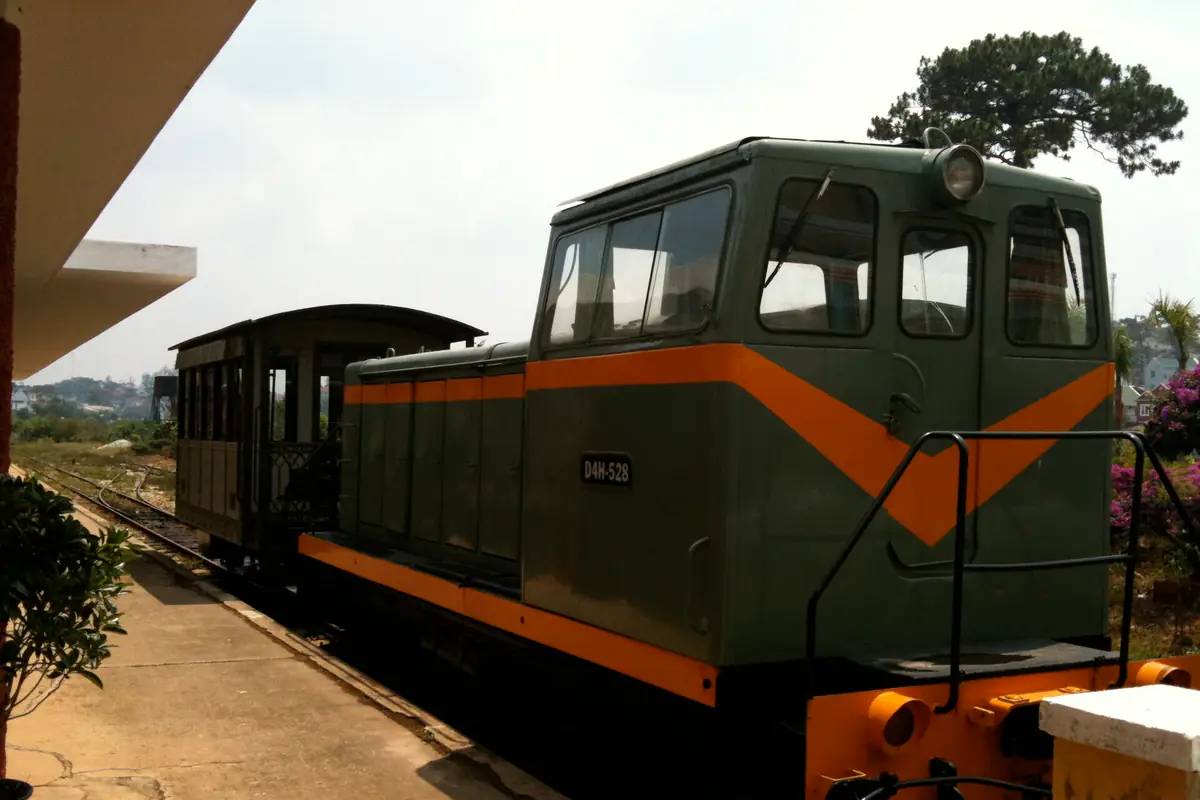
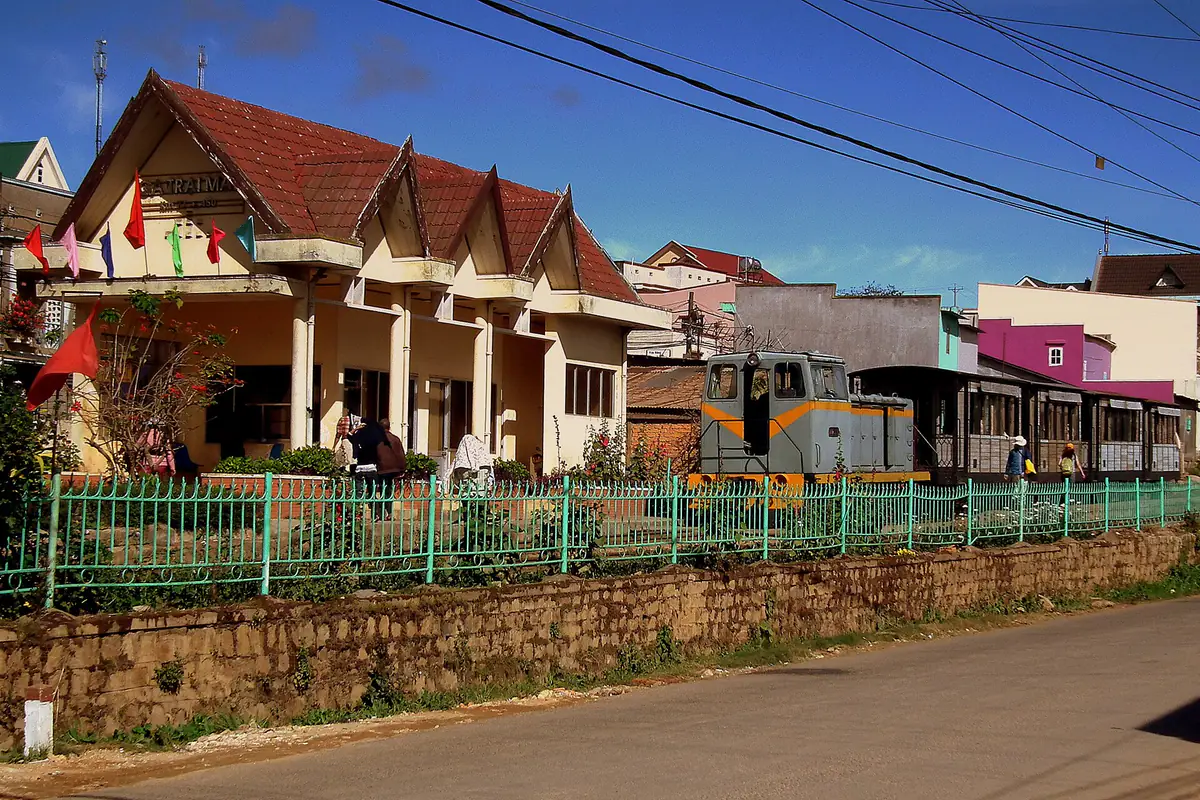
Inside, the waiting hall has a high ceiling and tall windows onto the platform. Behind it sit the tracks, the locomotives and the vintage carriages. English Wikipedia mentions a Japanese-built JNR Class C12 steam locomotive on display; the Vietnamese edition lists two steam engines, D4H-462 and D4H-866. Dan Tri says today’s tourist train is one regular locomotive pulling three carriages.
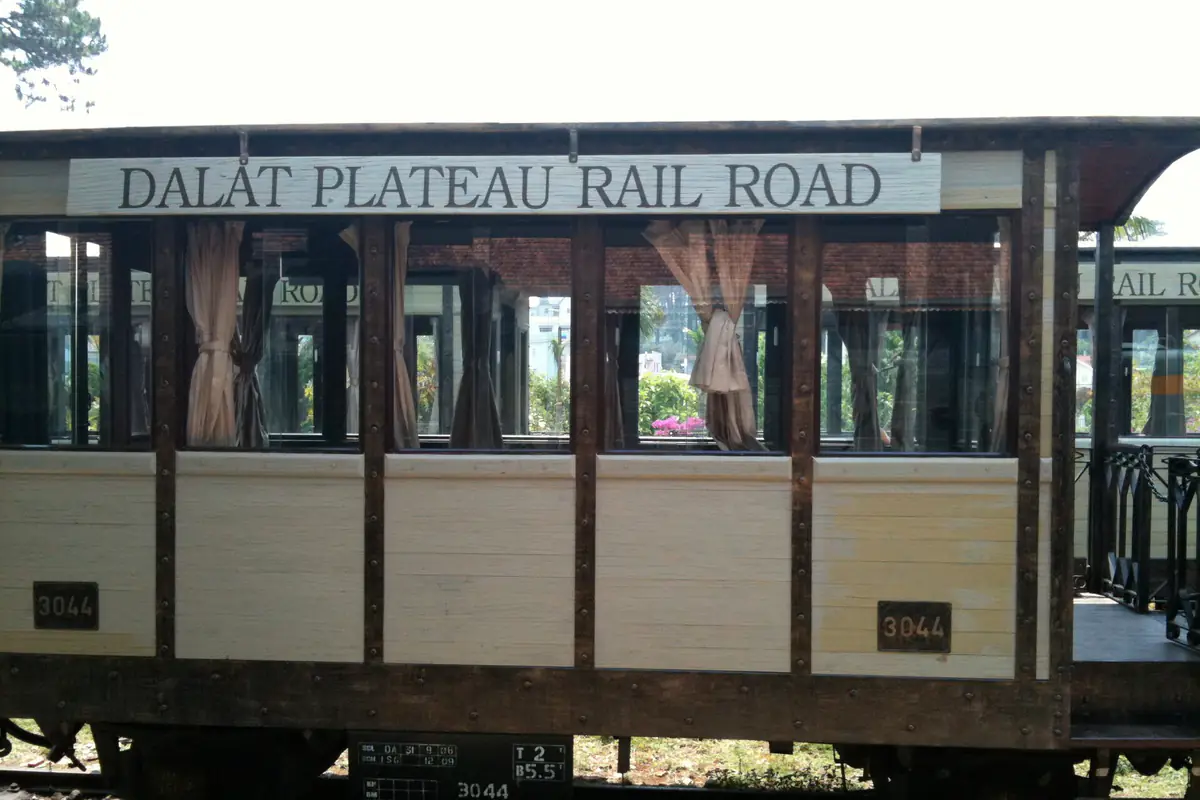
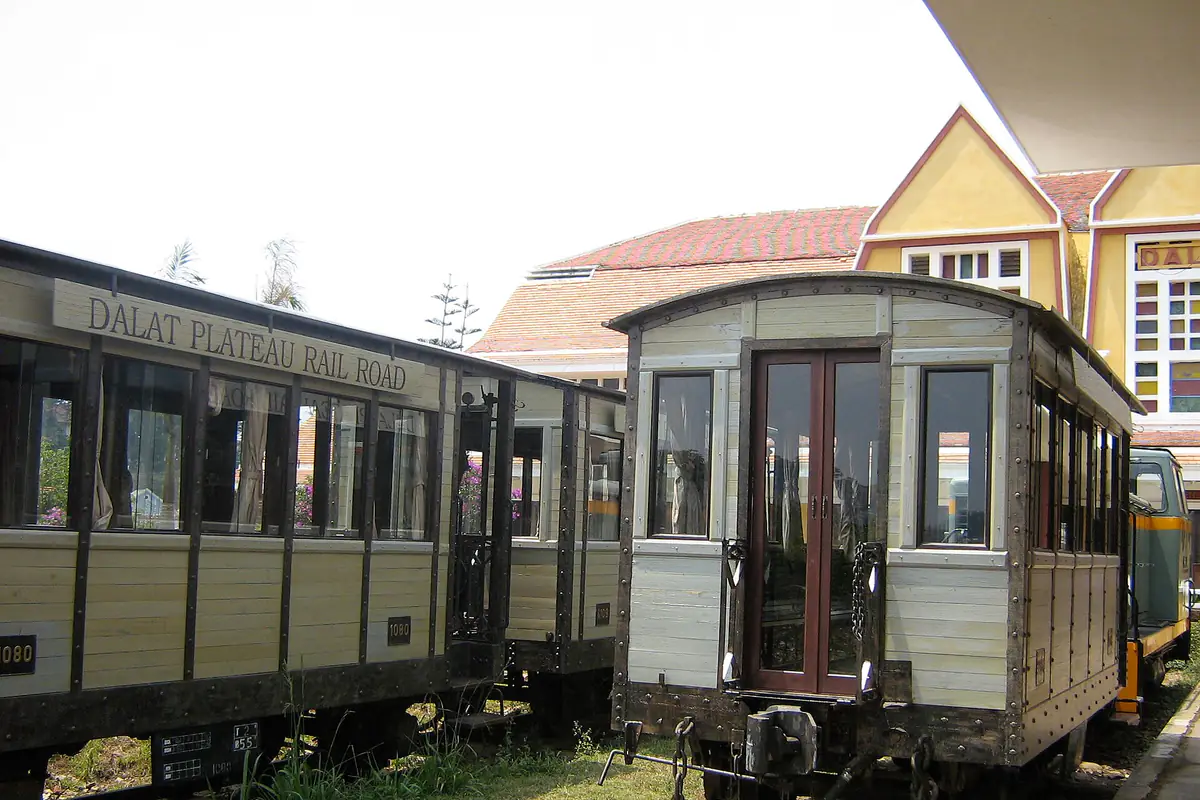
Small details worth a look around Da Lat railway station: the name boards, wooden benches, an old post box and the wooden cars painted “Dalat Plateau Rail Road,” introduced in 2009 (Wikipedia). VietNamNet (April 17, 2024) also mentions a café set inside an old railway carriage on the grounds.
Da Lat railway station entry fee in 2026
For years, walking into Da Lat railway station cost just VND5,000. From October 1, 2024, the fee rose tenfold to VND50,000 (about US$2), once the station became an official tourist site, reported Tuoi Tre News (September 12, 2024).
The Saigon railway branch set the price with approval from the Lam Dong finance department. After public pushback, it widened the exemptions on September 17, 2024, according to Nguoi Lao Dong (in Vietnamese). The stated reason: VND5,000 did not cover maintenance of a protected building.
| Who | What you pay |
|---|---|
| Regular visitor | VND50,000 per visit |
| Passengers on the Trai Mat train | No entry fee |
| Children under 11 (under 1.35 m), people 80 and over, people with severe disabilities | Free |
| People aged 65 to 79, Da Lat residents, officials and armed forces based in Da Lat | 50% off |
| Groups of 20 to 49 / 50 or more | 30% off / 45% off |
| Multi-visit card (since April 30, 2026) | VND2.5 million for 100 visits (VND25,000 each), valid six months |
The multi-visit card, reported by Nguoi Lao Dong (in Vietnamese) (April 29, 2026), is really for tour companies and big groups. The same report says VND25,000 per visit is about 50% below the listed price, which suggests the single ticket was still around VND50,000 at that point.
Money-saving tip: buy a train ticket instead
The Da Lat to Trai Mat train: times, fares and carriages
The line runs about 7 km east through vegetable plots, greenhouses and pine-covered hills. Trains crawl along at roughly 15 km/h (Tuoi Tre, 2024). According to VietnamPlus (May 8, 2026), each leg takes about 30 minutes and Da Lat railway station runs seven round trips a day.
At Trai Mat the train waits about 30 minutes before heading back, which gives you time to walk to Linh Phuoc Pagoda and take a few photos. If you want longer, buy a one-way ticket and return by taxi or ride-hailing, or catch a later train if seats remain.
Timetable (for reference)
VietnamPlus (May 8, 2026) lists the “Da Lat Coffee Train” at 7:05 a.m. and the “Da Lat Night Journey” at 6:15 p.m. and 8:20 p.m. A Vietnam Railways notice on vr.com.vn (June 29, 2023) gave daytime departures from Da Lat at 7:50, 9:55, 12:00, 14:05 and 16:10, returning from Trai Mat at 8:50, 10:55, 13:00, 15:05 and 17:10.
The early-morning slot changed once the Coffee Train started, so treat these times as a guide. Check the board at the ticket counter, or Vietnam Railways’ official sales channels, before you go. Some departures only run when there are enough passengers.
Trai Mat train fares
Viet Nam News (April 17, 2024) put regular fares at VND72,000 to VND100,000 (US$2.90 to US$4), depending on the seat. VnExpress (April 12, 2024) adds that return tickets are 25% off and groups of 10 or more get 15% to 40% off. The trade paper Bao Xay Dung (September 21, 2026) gives the lowest current fare as VND70,000 one way.
| Ticket | Price | Source |
|---|---|---|
| Regular carriage, one way | VND72,000 to VND100,000 by seat type | Viet Nam News, April 17, 2024 |
| Lowest current fare | VND70,000 one way | Bao Xay Dung, September 21, 2026 |
| La Reine carriage | VND80,000 to VND170,000 per trip | SGGP, December 25, 2024 |
| Return / groups of 10+ | 25% off / 15% to 40% off | VnExpress, April 12, 2024; Tuoi Tre, December 24, 2024 |
| Lam Dong residents (until October 31, 2026) | 40% off, about VND42,000 for the cheapest seat | Bao Xay Dung, September 21, 2026 |
The 40% discount is only for permanent residents of Lam Dong province, which now includes the former Dak Nong and Binh Thuan. It is sold only at the Da Lat railway station counter with an ID card or VNeID account, so international visitors do not qualify (Bao Xay Dung).
Be wary of fare tables on blogs and booking sites
Carriage types: regular, La Reine, Coffee Train and night train
- Regular carriages: wooden or padded seats and open windows. The cheapest and most popular choice.
- La Reine: launched December 24, 2024, styled after the palace of Empress Nam Phuong, with 36 seats facing the windows and a 12-seat VIP compartment for families (SGGP). Artichoke tea, Wi-Fi and live music are included.
- Da Lat Coffee Train: opened December 15, 2025 with King Coffee, serving Vietnamese coffee to violin and saxophone music in a vintage carriage (Nhan Dan (in Vietnamese)).
- Da Lat Night Journey: running since mid-April 2024, with a small screening room showing films about the station and the cog railway (VnExpress (in Vietnamese)). Handy if your days are already full.
The line is busier than you might expect. SGGP reported more than 3,000 trips and 276,000 passengers in 2024, up 69% on 2023. On holidays and weekends, buy your ticket early.
2026 track repairs and the plan to rebuild the line
After more than 30 years of use, the Trai Mat section needed work. According to Thanh Nien (in Vietnamese) (June 18, 2026), crews began in April 2026 replacing rails and sleepers, shoring up slopes at risk of landslides, upgrading drainage and renewing switches at both stations.
The job cost nearly VND49 billion and was planned for 224 days, then sped up to finish by late July 2026. The part that matters to visitors: trains kept running daily, with most work done at night. We have not seen an official completion notice, so follow staff directions if you spot any work zones.
Rebuilding the whole line: still under study
Bringing back the full cog railway is an old dream. In 2023 an investor proposed rebuilding 83.5 km with 16 stations and stops for VND24.92 trillion under a public-private partnership (VnExpress (in Vietnamese), January 3, 2023). That plan put construction between June 2026 and December 2028.
Progress has been slower. Phap Luat TP.HCM (July 20, 2025) said the Ministry of Construction had not finished reviewing the pre-feasibility study. In early September 2026, CafeF (in Vietnamese) (September 10, 2026) quoted Khanh Hoa’s construction department as saying the project was still being studied. No start date has been fixed, so take any “Da Lat to the coast by train soon” headlines with caution.
Best photo spots at Da Lat railway station
Da Lat railway station is one of the most photographed places in town. Here are a few angles, based on the layout and on photos in Wikimedia Commons, so you are not all fighting for the same spot.
- The front square: step well back to fit all three gables and the flower beds. Morning sun lights the yellow facade.
- Under the platform canopy: shoot upward so the curved canopy frames the gables, as in our cover photo.
- Beside the wooden cars: the “Dalat Plateau Rail Road” carriages and old locomotives suit vintage-style portraits.
- In the waiting hall: soft light through colored glass and tall windows, good on rainy days.
- On the train: grab a window seat for the greenhouses and farm plots along the track, and switch off your flash behind glass.
Stay safe while shooting
When to go
Mornings are best: softer light, clearer skies and fewer tour groups. In the rainy season (roughly May to October) showers usually arrive in the afternoon, so ride before lunch. Our Da Lat weather in October guide explains the rain pattern.
Da Lat railway station has covered areas and a large waiting hall, which makes it a solid rainy-day stop. At night the train passes rows of glowing greenhouses, a different experience from the daytime ride. Avoid April 30, September 2 and Tet if you dislike crowds at the ticket counter.
How to get to Da Lat railway station
Da Lat railway station is at 1 Quang Trung, not far from Xuan Huong Lake, in Xuan Huong - Da Lat ward. From the lake area, take a taxi, a ride-hailing car or bike, rent a motorbike, or walk if you do not mind hills. Type “Ga Đà Lạt” into your map app.
If you plan to rent a motorbike, read the costs and license rules in our Da Lat travel tips. On busy days, arrive early for parking and tickets. Still on your way to Da Lat? See buses, flights and routes in Ho Chi Minh City to Da Lat.
At Trai Mat: Linh Phuoc Pagoda and around
Trai Mat station is small, with a red tile roof, set among houses and vegetable gardens. A short walk away is Linh Phuoc Pagoda (Chùa Linh Phước), nicknamed the Bottle Pagoda. Work on it began in 1949, and it is known for a 49 m dragon made from about 12,000 glass bottles and a seven-story bell tower (Wikipedia).
Entry is free. It is an active place of worship, so dress modestly and keep your voice down. More detail is in our Linh Phuoc Pagoda entry in the 30 places guide, so we will not repeat it here.
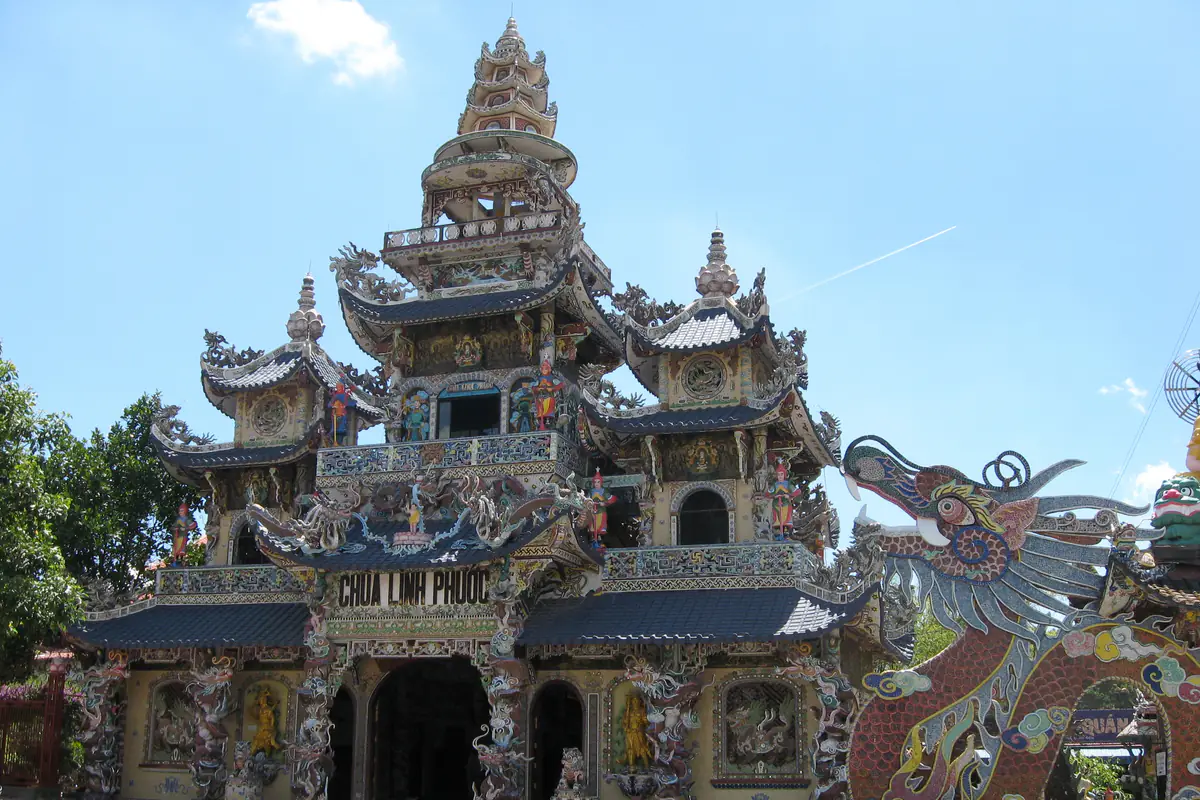
With more time, Trai Mat is also the gateway to the Cau Dat tea hills and valley-view cafés. On a return ticket with a 30-minute stop, though, stick to the pagoda and head back to the platform in good time.
A half-day plan around Da Lat railway station
Here is a morning route we suggest. Train times are for reference only, so check the board when you arrive.
| Time | What to do | Notes |
|---|---|---|
| 8:30 | Arrive and buy a return train ticket | Your ticket covers entry to the station |
| 8:45–9:45 | Photograph the facade, waiting hall and old carriages | Best light of the day |
| 9:55–10:25 | Ride to Trai Mat | Grab a window seat |
| 10:25–10:55 | Walk to Linh Phuoc Pagoda | Be back on time |
| 11:25 | Back in town for lunch | Afternoon: Crazy House or Palace III |
In the afternoon, the Crazy House is in the same cluster of old buildings; see prices and hours in our Crazy House Da Lat guide. For a local lunch, our where to eat in Da Lat guide lists food streets and markets.
Is Da Lat railway station worth it?
It is not an all-day attraction, but it makes a very worthwhile morning if you like architecture and history. Here is our summary so you can decide.
What we like
- A photogenic, nearly 90-year-old French-era building and national relic
- The last working stretch of the once-unique Thap Cham to Da Lat cog railway
- Train passengers skip the VND50,000 entry fee
- Covered areas for rainy days, plus night trains for busy schedules
Watch out for
- The tenfold jump to VND50,000 drew criticism from tourism businesses when it was announced (Tuoi Tre News, September 2024)
- Timetables change by season, and some departures only run when full
- The 30-minute stop at Trai Mat feels rushed if you want to explore the pagoda
- Holiday crowds mean long ticket lines and few empty-frame photos
Quick tips before you go
- Buy a train ticket rather than an entry ticket if you plan to ride, so you only pay once.
- Carry your ID if you qualify for age-based or resident discounts.
- Go in the morning for good light and fewer groups.
- Check the train board as soon as you arrive, since times can change.
- Bring a light jacket: the windows open and the breeze is cooler than you think.
- Keep your return ticket safe until you are back where you started.
Final thoughts
Da Lat railway station lets you admire 1930s architecture and ride the last working piece of a legendary mountain railway in one morning. Go early, buy a train ticket instead of an entry pass, and save 30 minutes for Linh Phuoc Pagoda.
If you visit and find that prices, train times or discount rules differ from this guide, please tell us through our contact page so we can update it for the next traveler.
FAQ
How much is the entry fee at Da Lat railway station?
Since October 1, 2024, entry costs VND50,000 per visit (Tuoi Tre News, September 12, 2024). Trai Mat train passengers, children under 11 and people 80 and over enter free; people aged 65 to 79 and Da Lat residents pay half (Nguoi Lao Dong, September 17, 2024).
What time does the Trai Mat train leave, and how long does it take?
VietnamPlus (May 8, 2026) reports seven round trips a day, about 30 minutes each way, with the Coffee Train at 7:05 a.m. and night trains at 6:15 p.m. and 8:20 p.m. The train waits about 30 minutes at Trai Mat. Check the board at the counter, as times can change.
How much is the train from Da Lat to Trai Mat?
Regular fares were VND72,000 to VND100,000 one way depending on the seat (Viet Nam News, April 17, 2024), with 25% off return tickets. The lowest current fare is about VND70,000 (Bao Xay Dung, September 21, 2026). La Reine seats cost VND80,000 to VND170,000 (SGGP, December 25, 2024).
If I take the train, do I also need an entry ticket?
No. Under the policy reported by Nguoi Lao Dong on September 17, 2024, Trai Mat train passengers do not pay the Da Lat railway station entry fee, so you only need a train ticket.
Will the Thap Cham to Da Lat railway be rebuilt?
A VND24.92 trillion plan to rebuild 83.5 km is still under study. CafeF (September 10, 2026) reported that the pre-feasibility review was not finished and no start date had been set. The existing Trai Mat section had its track renewed from April 2026 (Thanh Nien, June 18, 2026).
How far is Linh Phuoc Pagoda from Trai Mat station?
It is a few minutes’ walk from the station. Entry is free, and the 30-minute stop on a return trip is enough to see the bottle dragon and bell tower before heading back.
Sources
Facts in this article were checked against the sources below, accessed on Sep 27, 2026. Prices and opening hours change, so please double-check before you go.
- Tuoi Tre News: Da Lat Railway Station entrance fee set to increase tenfold (September 12, 2024)
- VietNamNet: Da Lat - Trai Mat railway station begins night train service (April 17, 2024)
- Viet Nam News: Đà Lạt - Trại Mát railway station begins night train service (April 17, 2024)
- SGGP English: Da Lat launched high-end train La Reine to attract tourists (December 25, 2024)
- VnExpress International: Da Lat - Thap Cham railway’s restoration to be completed by 2030 (August 20, 2023)
- Saigoneer: Take a ride on Da Lat’s lost railway (May 4, 2019)
- VietnamPlus: The appeal of the Da Lat - Trai Mat tourist train (May 8, 2026, in Vietnamese)
- Thanh Nien: Da Lat station and tracks repaired after more than 30 years (June 18, 2026, in Vietnamese)
- Nguoi Lao Dong: New details on the Da Lat station entry fee (September 17, 2024, in Vietnamese)
- Nguoi Lao Dong: New multi-visit card at Da Lat station (April 29, 2026, in Vietnamese)
- VnExpress: Night trains launched on the Da Lat - Trai Mat line (April 12, 2024, in Vietnamese)
- Tuoi Tre: La Reine train inspired by Empress Nam Phuong’s palace (December 24, 2024, in Vietnamese)
- Nhan Dan: Vietnamese coffee aboard the vintage Da Lat train (December 2025, in Vietnamese)
- Tuoi Tre: Old Da Lat station officially becomes a tourist site (July 11, 2024, in Vietnamese)
- Bao Xay Dung: Big discount for Lam Dong residents on the vintage Da Lat train (September 21, 2026, in Vietnamese)
- Vietnam Railways (vr.com.vn): DL1/2 Da Lat - Trai Mat promotion and five-pair timetable (June 29, 2023, in Vietnamese)
- VnExpress: Nearly VND25 trillion proposed to restore the Thap Cham - Da Lat railway (January 3, 2023, in Vietnamese)
- Phap Luat TP.HCM: Where does the Thap Cham - Da Lat cog railway project stand? (July 20, 2025, in Vietnamese)
- CafeF: Vietnam weighs reviving the 84 km cog railway (September 10, 2026, in Vietnamese)
- Dan Tri: The station with Vietnam’s one-of-a-kind rack railway (September 2024, in Vietnamese)
- Wikipedia: Da Lat station
- Wikipedia (Vietnamese): Ga Đà Lạt
- Wikipedia: Linh Phước Temple