Da Lat cable car: tickets, hours and a half day at Truc Lam Zen Monastery
The Da Lat cable car glides for 12 minutes over pine forest from Robin Hill to Truc Lam Zen Monastery. We pulled together the operator’s official page and news reports (checked September 25, 2026): tickets, hours, getting there, safety, temple etiquette and a half-day plan.
By Da Lat LoversPublished Updated How we reviewĐọc bản tiếng Việt
How we put this guide together
The Da Lat cable car (Cáp treo Đà Lạt) is the city’s only cable car. It runs from Robin Hill, at the top of Prenn Pass on the edge of town, down to a station beside Truc Lam Zen Monastery, above Tuyen Lam Lake. Our Da Lat travel overview and our list of places to visit in Da Lat only give it a few lines.
This page goes further: when the line was built, how long it is, one-way versus return tickets, the weekday lunch break that catches many visitors out, how to reach each station, what you see from the cabin, and how to spend a calm half day at the monastery and the lake.
Da Lat cable car history and key facts
According to Vietnamese Wikipedia, construction began on February 3, 2002. The line was inaugurated on January 24, 2003 and opened to the public on February 1, 2003. Before 1975, Robin Hill was an artillery position; today it is a small tourist area with the station, a café and a restaurant.
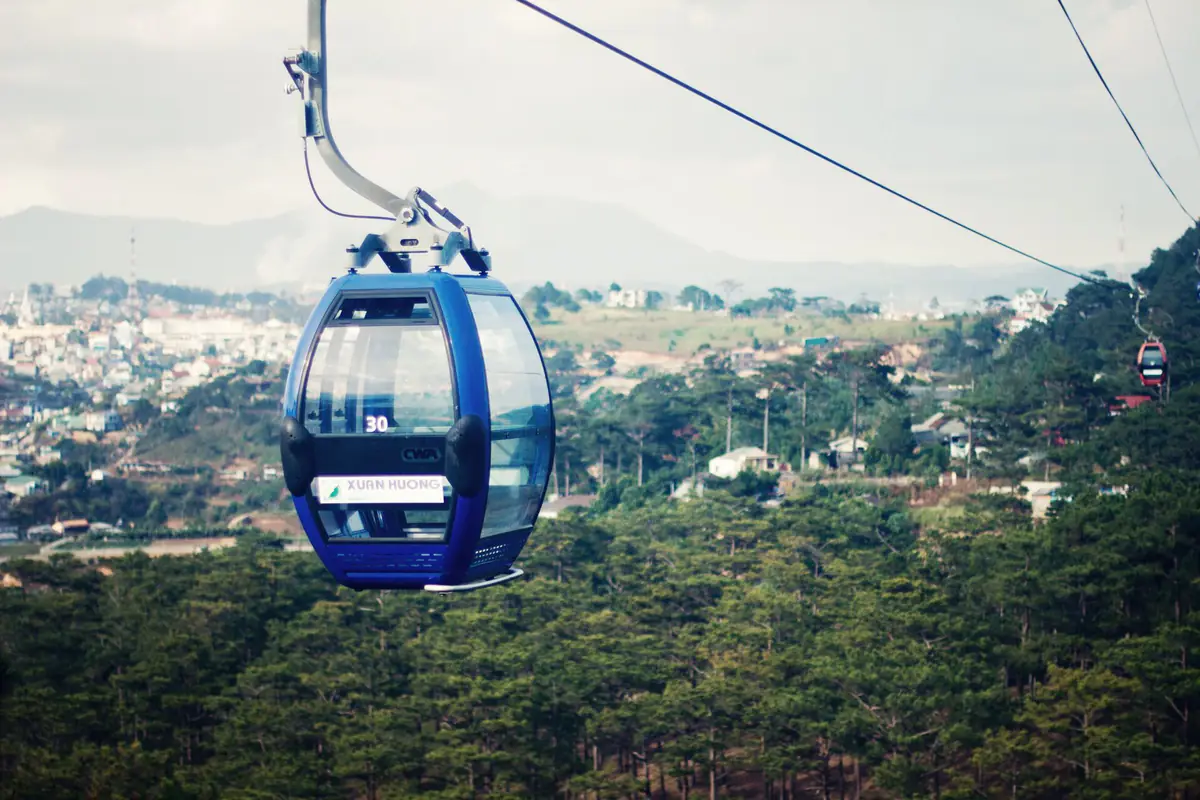
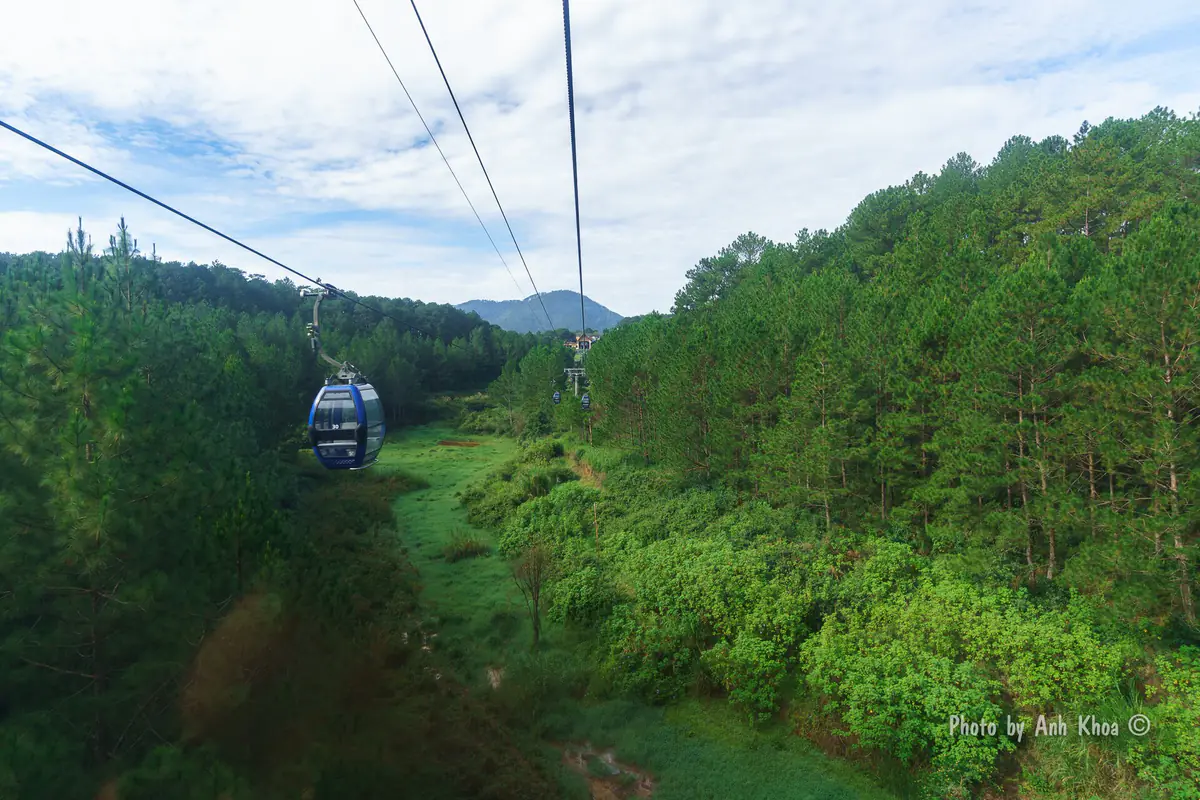
The Austrian firm Doppelmayr installed the system. The cable runs 2,267 m on 10 towers that lift it above the pines, and 50 cabins travel about 120 m apart at 1-5 m per second. At the 7,500-square-meter stations, cabins detach from the moving cable and slow down so you can step in and out (same source).
A ride takes about 12 minutes, and the line can carry up to 900 people an hour. The sources disagree on elevation: Wikipedia puts Robin Hill at 1,575 m and the upper station at 1,490 m, while Dalattourist lists Robin Hill at 1,517 m. Either way, you drift gently downhill rather than climbing a summit.
The line is run by Dalattourist, the company that also manages the Datanla and Langbiang tourist areas. According to Thanh Nien (in Vietnamese, April 6, 2026), cabins and a smart ticket gate were upgraded in 2026 to cut waiting times. Note that this was a company profile, not independent reporting.
Da Lat cable car tickets and opening hours in 2026
State broadcaster VOV (in Vietnamese, August 29, 2024) listed return tickets at VND150,000 for adults and VND120,000 for children, and one-way tickets at VND120,000 and VND100,000. The operator’s own page (record updated July 21, 2025, checked September 25, 2026) shows the same VND150,000 and VND120,000.
In other words, Da Lat cable car prices have not moved since at least August 2024. A one-way ticket only saves VND30,000, so unless someone is picking you up at Truc Lam, the return ticket is usually the easier choice.
| Ticket | Adult | Child | Source |
|---|---|---|---|
| Return | VND150,000 | VND120,000 | VOV, Aug 29, 2024; Dalattourist, Jul 21, 2025 |
| One way | VND120,000 | VND100,000 | VOV, Aug 29, 2024 |
Older English guides quote lower prices. Tuoi Tre News (April 29, 2023), for example, gave “about VND80,000” for an adult return. Treat that as history, not a budget figure.
On hours, the Dalattourist page says the line runs 7:30 a.m. to 12 p.m. and 1 p.m. to 5 p.m. on weekdays, with a one-hour lunch break, and 7:30 a.m. to 5 p.m. straight through on weekends. Last boarding is at 4:45 p.m.
That weekday break matters. If you ride down at 10:30 a.m. and wander until noon, you will wait at the upper station until 1 p.m. Plan to head back before 11:45 a.m., or have lunch near the lake and ride back in the afternoon. The operator also runs e-wallet promotions around holidays, such as a 10% VNPAY discount for the September 2, 2024 holiday (VOV).
Be careful with prices on blogs and booking sites
Getting to the Da Lat cable car station on Robin Hill
The lower station sits at the end of Dong Da Street, near the intercity bus station and the top of Prenn Pass (Vietnamese Wikipedia). Tuoi Tre News gave the address as No. 1 Dong Da Street; the operator simply writes “Robin Hill, Xuan Huong - Da Lat ward.” The easiest move is to type “Cap treo Da Lat” into your map app.
From the Xuan Huong Lake area, take a taxi, a ride-hailing car or bike, or your own rented motorbike. Our Da Lat travel tips cover motorbike rental rules and costs. If you arrive by sleeper bus at the intercity station, the cable car is a short hop away; bus options are in our guide from Ho Chi Minh City to Da Lat.
Driving straight to Truc Lam
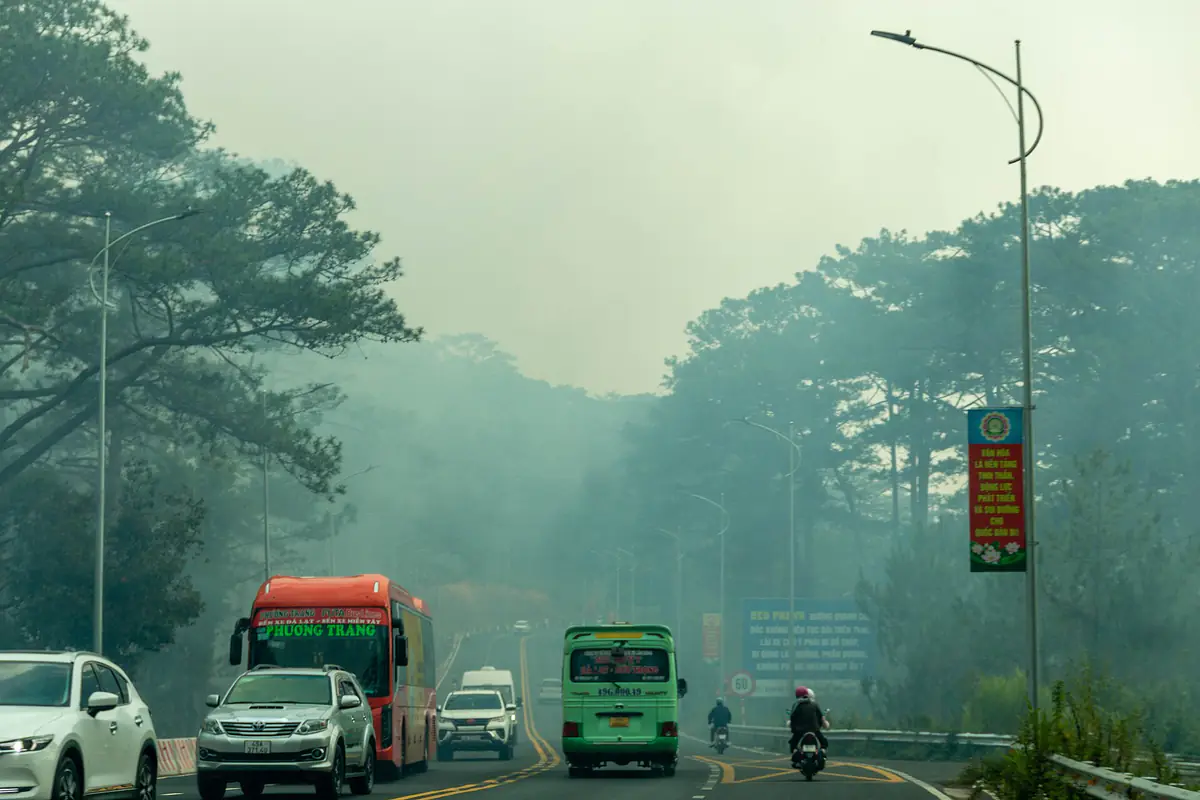
You can also drive to the monastery and ride the cable car in the other direction. According to English Wikipedia, the monastery road turns off the route from the city center toward Prenn Pass. That is one reason many people prefer the cable car: you get the views without riding a stretch of pass that is being watched for landslides.
Prenn Pass is under an emergency order (updated September 25, 2026)
What you see during the 12-minute ride
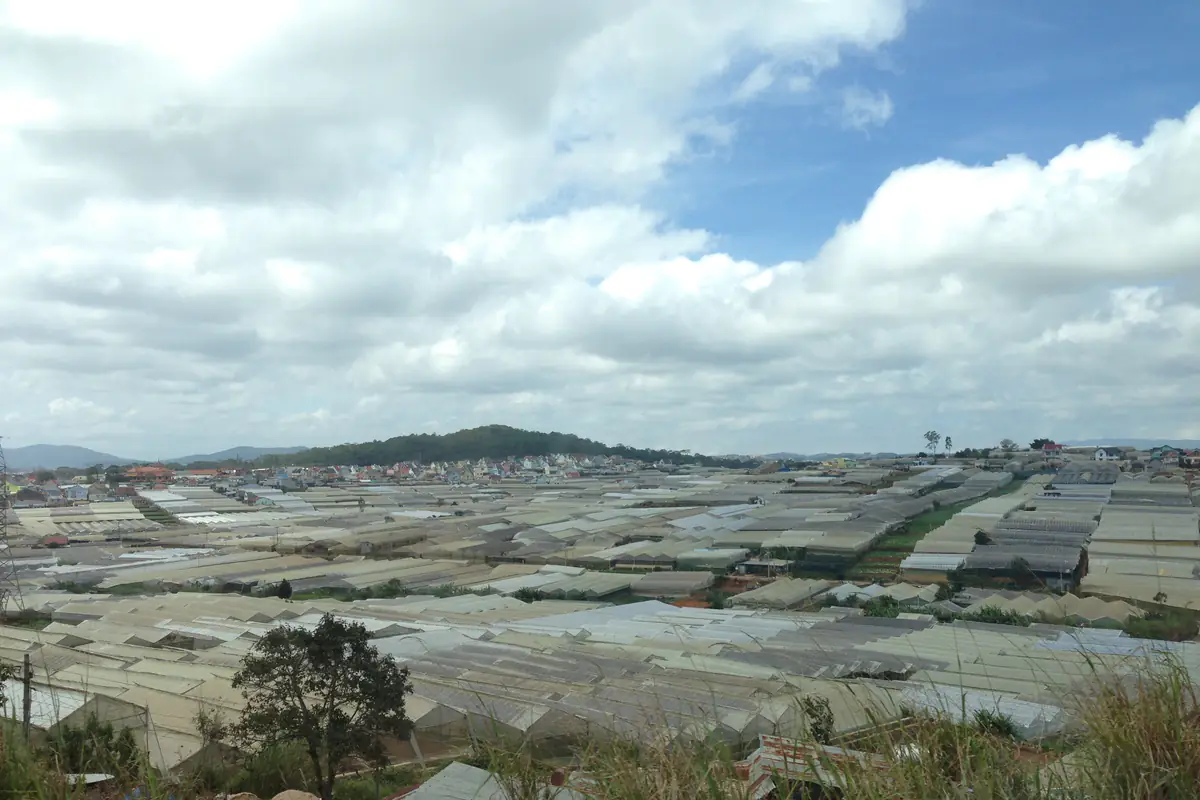
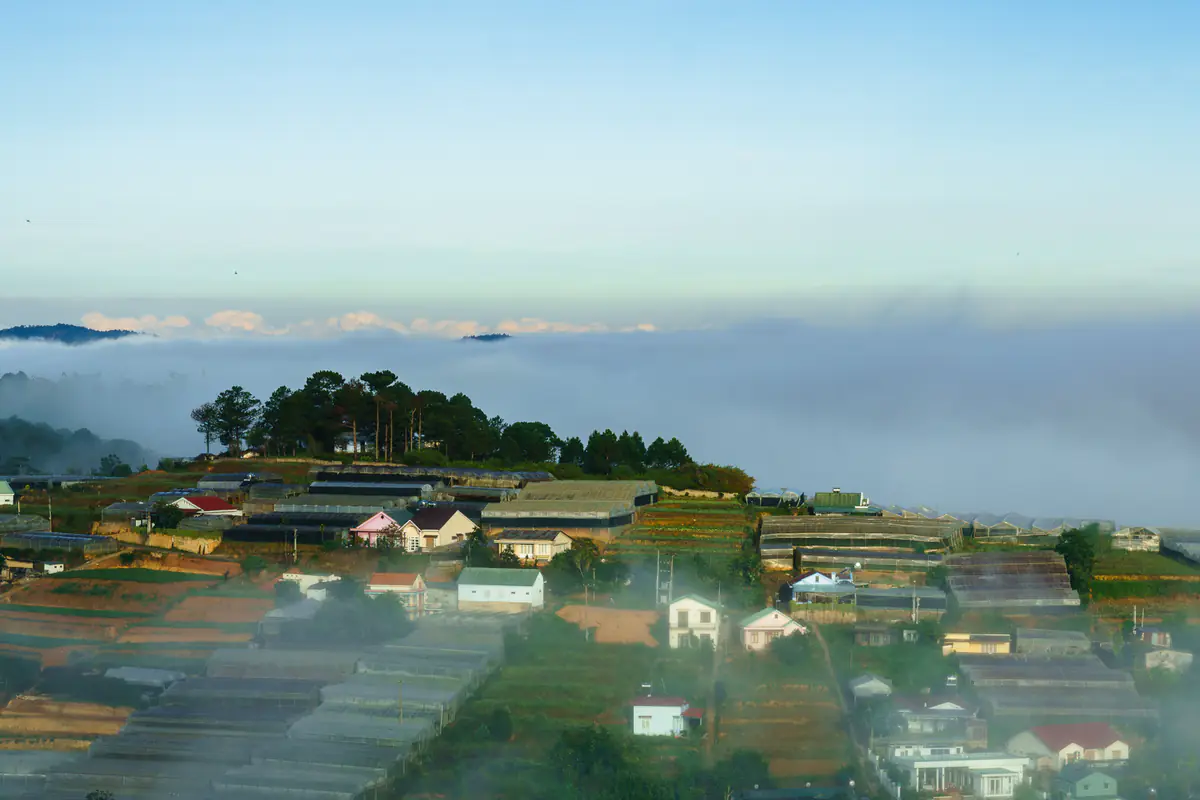
As the cabin leaves Robin Hill, you float over the edge of town: rooftops, greenhouses and valleys of vegetables and flowers. Thanh Nien (in Vietnamese, June 16, 2026) singled out the farm valleys drifting in and out of thin mist as the highlight.
In the second half, houses thin out, the pines close in and the cable threads between two forested slopes. Near the end, Tuyen Lam Lake appears in the distance. Tuoi Tre News (2023) described the ride as a way to take in the panorama of the lake, the mountains, pine forests, flower gardens and old villas.
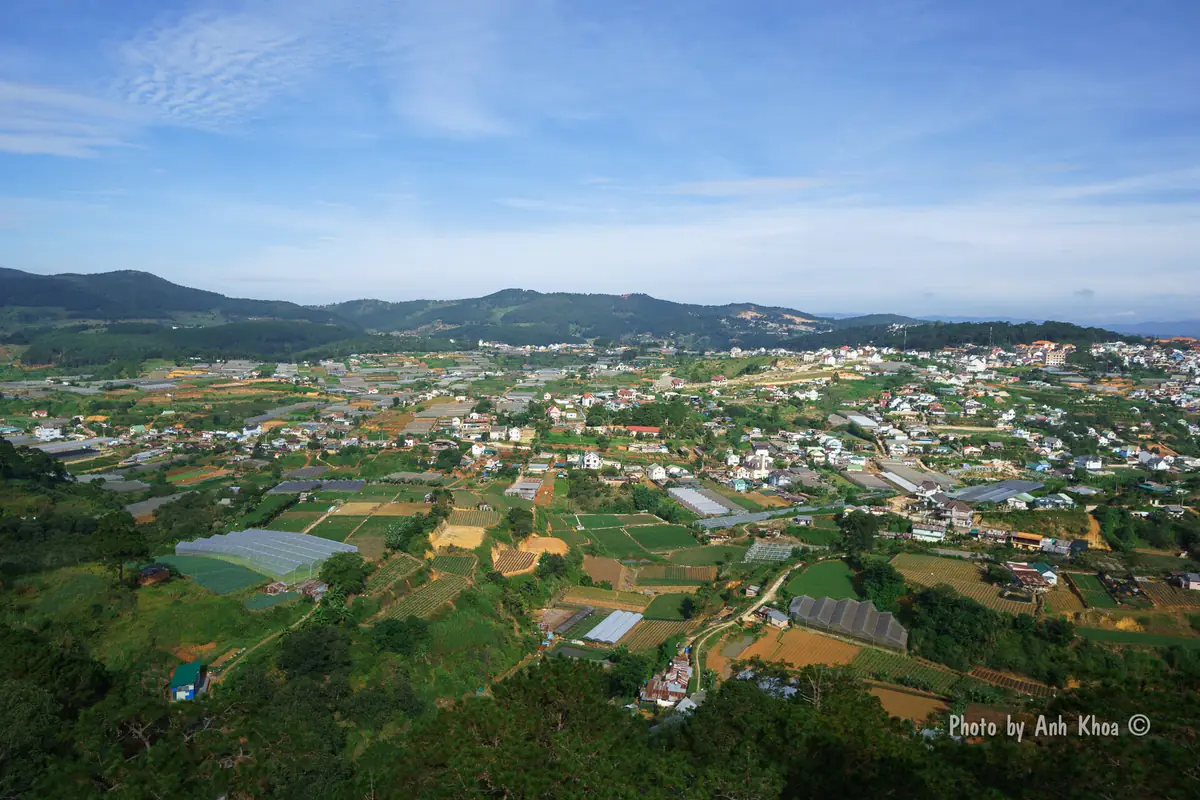
A small photo tip for the Da Lat cable car: face forward on the way down to see the lake, and face backward on the way up to see the city. The windows reflect, so press your lens against the glass and turn off the flash. Clear mornings usually give sharper photos than hazy afternoons.
Safety and weather: when does the Da Lat cable car stop?
We found no news reports of incidents on the Da Lat cable car in recent years. Still, it is an outdoor system, and according to many travel blogs the operator may pause it in heavy rain, thunderstorms or strong wind. Take that as a sensible safety call, not an inconvenience to argue about.
Da Lat’s rainy season runs roughly from May to October, and the rain tends to come in the afternoon. If you visit then, read our guide to Da Lat weather in October and book a morning ride.
Simple rules in the cabin
- Tuck in loose straps, backpack buckles and scarves before boarding. VnExpress (in Vietnamese, February 3, 2026) reported a tourist in Japan who died after a loose backpack buckle caught on a lift seat.
- Board and exit when staff tell you to; cabins keep creeping through the station rather than stopping.
- Do not rock the cabin, open the door or hold phones and selfie sticks out of the window.
- Keep small children next to an adult; if you dislike heights, sit facing away from the deepest valley.
- Bring a light jacket: the cabin is sheltered, but the upper station can feel cooler than downtown.
Truc Lam Zen Monastery at the top of the line
Step out of the upper station and you are at Truc Lam Zen Monastery (Thiền viện Trúc Lâm) on Phung Hoang, or Phoenix, mountain. Thanh Nien (in Vietnamese, March 1, 2026) tells its origin story: in 1987, the Most Venerable Thich Thanh Tu dreamed he was flying on the back of a great phoenix, and the site later proposed to him was a peak of the same name.
The monastery was built in 1993-1994 (Vietnamese Wikipedia), and English Wikipedia dates the opening of its public area to March 13, 1994. Architect Ngo Viet Thu, who designed Saigon’s Independence Palace, worked on the early sketches, and architect Vu Xuan Hung drew the curved, timber-style roofs (Thanh Nien).
It follows the Truc Lam school of Zen, founded by Emperor Tran Nhan Tong (1258-1308) at the end of the 13th century. Thanh Nien, citing a Buddhist information portal, calls it Vietnam’s largest Zen monastery in both space and scale of practice. The site covers about 24 hectares, but only about 2 hectares are built on.
What you can visit
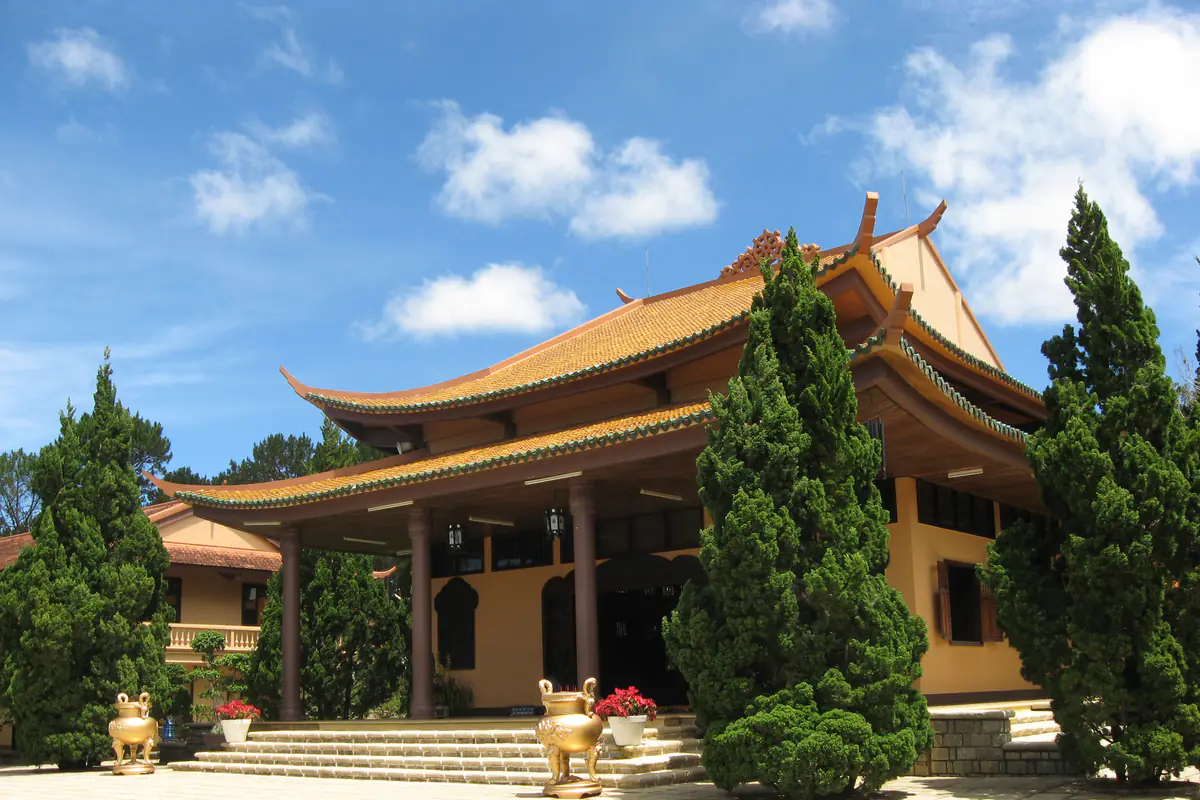
The monastery has four areas: the outer area for visitors, the abbot’s quarters, and separate inner quarters for monks and nuns. The inner quarters are closed to visitors (Thanh Nien). You can see the courtyard, the main hall, the bell tower, the patriarchs’ hall behind the main hall and the flower gardens.
The 192-square-meter main hall houses a statue of the Buddha holding a lotus, flanked by the bodhisattvas Manjushri and Samantabhadra. The bell tower holds a bronze bell of about 1.1 tonnes (Vietnamese Wikipedia). From the courtyard, you look straight down onto Tuyen Lam Lake.
For the traditional approach, walk down to the boat landing on the lake and climb 222 stone steps through three gates to the main courtyard (Thanh Nien). The side entrance from the car park is much shorter; English Wikipedia counts about 61 steps. If your knees complain, use the side entrance and admire the lake from above.
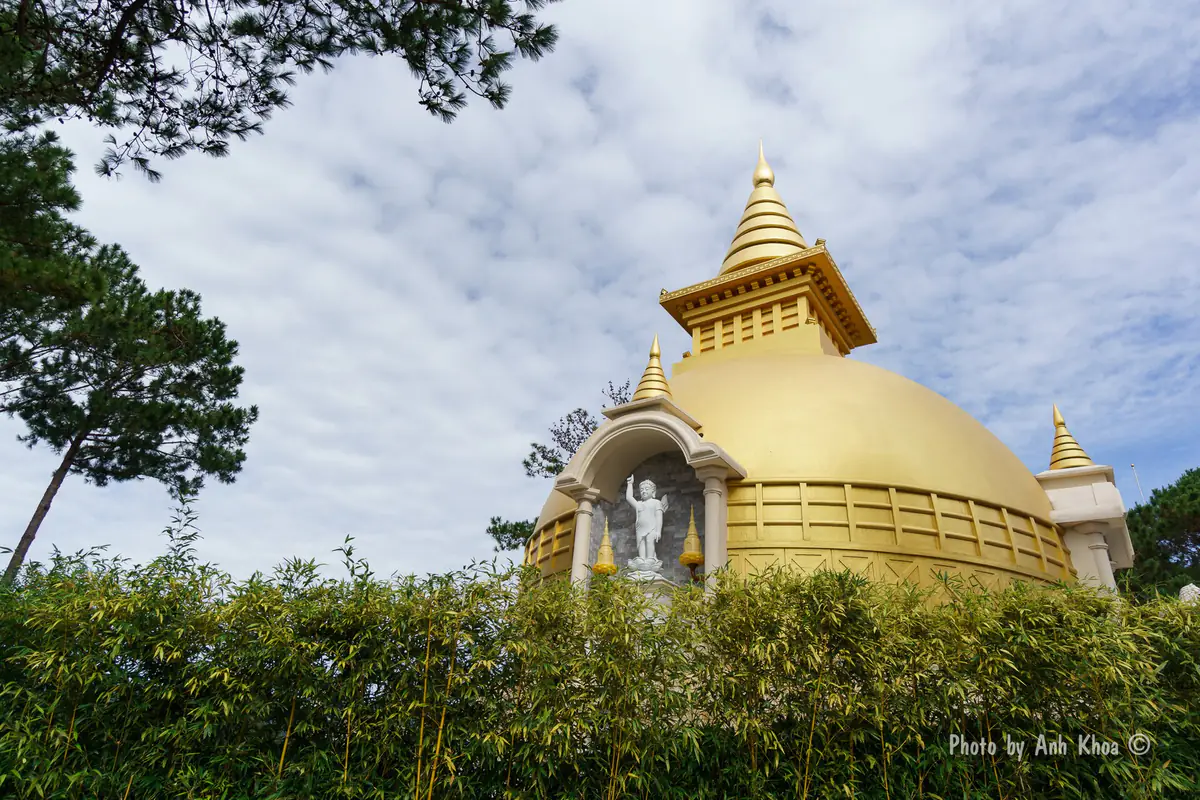
Dress code, timing and etiquette
There is no entry ticket. This is a working monastery, so wear trousers or a skirt below the knee and a top that covers your shoulders, and skip anything tight or see-through. Many travel blogs say wraps are available at the gate for visitors in shorts; please do not count on it.
We could not find official opening hours for the monastery, and blogs disagree. The safe approach is to visit while the Da Lat cable car is running. Vietnamese Wikipedia lists three daily meditation sessions for the monks and nuns: 3:30-5:30 a.m., 2:30-4:30 p.m. and 7:30-9:30 p.m. If you visit in the afternoon, be extra quiet.
- Speak softly, no music, no loudspeakers while filming.
- Ask before photographing monks or nuns; avoid silly poses in front of the main hall.
- Take off your shoes to enter the main hall where signs ask you to.
- Do not bring food into the grounds, and use the bins.
- Do not pick flowers or climb walls or into areas marked off-limits.
Tuyen Lam Lake below the monastery
Tuyen Lam Lake (Hồ Tuyền Lâm) was created between 1982 and 1987 by damming the Tia stream and covers about 320 hectares (Vietnamese Wikipedia). It was listed as a national historical and cultural site on August 30, 1998, and became a national tourism area in 2017 (VietnamPlus, in Vietnamese, May 25, 2024).
According to Thanh Nien (in Vietnamese, June 9, 2026), Lam Dong province has just approved the brief for a master plan covering more than 2,944 hectares to 2050, with the area forecast to receive over 4 million visitors a year by 2030. VietnamPlus (July 14, 2026) listed it among Lam Dong’s busiest attractions this summer.
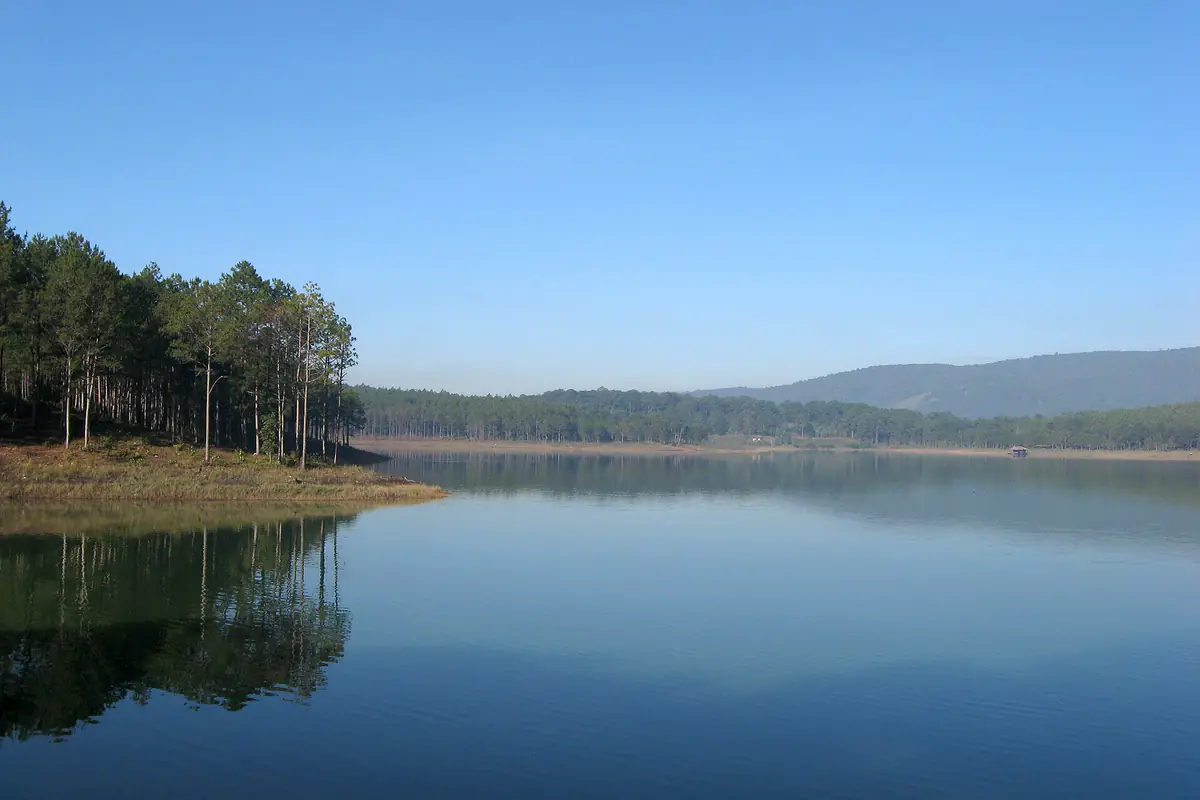
Boat trips on the lake: the 2026 situation
This is where many older guides are out of date. The same Thanh Nien report says boat tours on Tuyen Lam Lake have been suspended for three years because there was no master plan, and services such as pedal boats and tourist piers had no legal basis to operate.
Earlier, VietnamPlus (May 25, 2024) described a 52-household boat cooperative that once carried about 300 visitors a day, mostly from South Korea, and found itself operating “illegally” after the lake changed hands in 2020. So if someone offers you a boat ride at the landing, ask whether it is licensed and only board with a life jacket.
Walks, paddleboarding and lakeside cafés
The simplest plan is to walk from the monastery down to the boat landing and follow the shore for a while under the pines. Mornings are usually still, which is good for reflection photos. Tuoi Tre News (April 29, 2023) reported stand-up paddleboarding on the lake from VND200,000 per person, with life jackets required.
There are also cafés and resorts around the lake. We do not recommend wild camping in the forest here; see why, and the new fines, in our guide to Da Lat homestays. According to VnExpress International (July 26, 2023), the area also received an “outstanding Asia-Pacific tourism area” title announced by the Vietnam Federation of UNESCO Associations.
A half-day plan with the Da Lat cable car
Here is the plan we suggest for a weekday morning, built around the lunch break. On weekends you can stretch it, since the line runs straight through to 5 p.m.
| Time | What to do | Notes |
|---|---|---|
| 7:15 a.m. | Arrive at Robin Hill, buy a return ticket | The line opens at 7:30 a.m.; fewer tour groups early |
| 7:30-7:45 a.m. | Ride down to the Truc Lam station | Face forward to see the lake |
| 7:45-9:15 a.m. | Visit Truc Lam Zen Monastery | Main hall, bell tower, gardens, stupa |
| 9:15-10:45 a.m. | Walk down to the landing and along Tuyen Lam Lake | Take the 222 steps back up slowly, with breaks |
| 11:00-11:30 a.m. | Ride back to Robin Hill | Weekday lunch break 12-1 p.m. |
If you still have energy after lunch, Datanla Waterfall is on the same side of town, and we cover it in our guide to Datanla Waterfall and its alpine coaster. To add more sights in the south of the city, use the area-by-area routes in places to visit in Da Lat.
Robin Hill has the Léguda vegetable buffet at VND69,000 (Thanh Nien, April 6, 2026), handy for lunch once you are back. For more local food, see our guide to where to eat in Da Lat.
Is the Da Lat cable car worth it?
The Da Lat cable car is not Vietnam’s longest or flashiest line, but it has real advantages. Here is our summary before you spend VND150,000 on a return ticket.
What we like
- Return ticket of VND150,000, unchanged since at least August 2024
- The upper station is right next to Truc Lam Zen Monastery, which has no entry fee
- You skip driving Prenn Pass while it is under landslide watch
- Twelve minutes over pine forest, farm valleys and Tuyen Lam Lake
Watch out for
- Weekday lunch break from 12 to 1 p.m. can leave you waiting
- May pause in heavy rain, storms or strong wind, especially on rainy-season afternoons
- Boat trips on Tuyen Lam Lake are suspended pending a master plan (Thanh Nien, June 9, 2026)
- The 222 steps from the lake up to the main hall are tiring for older visitors
The biggest mistake is rushing. Many people ride down, snap a photo and ride straight back, missing the monastery and the lake, which are the best part. With half a day, go slowly; with only an hour, a one-way ticket plus a pickup at Truc Lam may suit you better.
Quick tips before you go
- Check prices and hours on Dalattourist’s official channels right before your visit.
- Take the 7:30 a.m. ride to beat tour groups and get clear views.
- On weekdays, be back at the upper station before 11:45 a.m.
- Dress for the monastery from the start, since you go straight there from the cable car.
- Wear shoes with grip, and pack a light jacket and a compact raincoat.
- Keep your return ticket safe until you are back on Robin Hill.
Final thoughts
The Da Lat cable car is the gentlest way to see the city from a new angle: 12 minutes over the pines, then a quiet morning at Truc Lam and Tuyen Lam Lake. Go early, plan around the lunch break and dress respectfully, and it is a half day well spent.
If you have just been and found different prices, hours or boat services, please tell us through our contact page so we can update this guide for the next traveler.
FAQ
How much is the Da Lat cable car in 2026?
According to VOV (August 29, 2024), a return ticket costs VND150,000 for adults and VND120,000 for children; one way is VND120,000 and VND100,000. The operator Dalattourist’s page (updated July 21, 2025, checked September 25, 2026) lists the same VND150,000 and VND120,000. Confirm at the counter before you buy.
What are the Da Lat cable car opening hours?
Monday to Friday 7:30 a.m.-12 p.m. and 1-5 p.m., so there is a one-hour lunch break; Saturday and Sunday 7:30 a.m.-5 p.m. without a break. Last boarding is 4:45 p.m., according to Dalattourist.
How long is the ride from Robin Hill to Truc Lam?
About 12 minutes each way on a 2,267 m line with 50 cabins and 10 towers (Vietnamese Wikipedia). On weekends and holidays, allow extra time for queues at both stations.
Do I need a ticket for Truc Lam Zen Monastery, and what should I wear?
There is no entry ticket. Wear trousers or a skirt below the knee and a top that covers your shoulders, avoid tight or see-through clothes, keep quiet and stay out of the monks’ and nuns’ inner quarters.
Can I take a boat on Tuyen Lam Lake?
According to Thanh Nien (June 9, 2026), boat tours on the lake have been suspended for three years pending a master plan, which the province has now started. If someone offers a ride, ask whether it is licensed and only board with a life jacket.
Does the Da Lat cable car run in the rain?
Light rain is usually fine, but the operator may pause the line in heavy rain, thunderstorms or strong wind. In the rainy season (roughly May to October), showers tend to come in the afternoon, so ride in the morning.
Sources
Facts in this article were checked against the sources below, accessed on Sep 25, 2026. Prices and opening hours change, so please double-check before you go.
- Tuoi Tre News: Da Lat in Vietnam’s Central Highlands, perfect picnic spot, sports destination for holidays (April 29, 2023)
- Dalattourist: Cable car tourist area, official site dalattourist.com.vn (record updated July 21, 2025, checked September 25, 2026)
- VOV: Da Lat cable car holiday offer and ticket prices (August 29, 2024, in Vietnamese)
- Tuoi Tre News: Lam Dong declares emergency over landslides on Prenn Pass (September 23, 2026)
- Thanh Nien: Why Truc Lam Zen Monastery was born from a phoenix dream (March 1, 2026, in Vietnamese)
- Thanh Nien: Proposal for piers and a helipad at Tuyen Lam Lake (June 9, 2026, in Vietnamese)
- Thanh Nien: Dalattourist in 2026 (April 6, 2026, company profile, in Vietnamese)
- Thanh Nien: Summer with Dalattourist (June 16, 2026, company profile, in Vietnamese)
- VietnamPlus: Tuyen Lam Lake boat cooperative seeks a legal license (May 25, 2024, in Vietnamese)
- VietnamPlus: Lam Dong launches new tourism products to boost summer travel (July 14, 2026)
- VnExpress International: Tuyen Lam to become Vietnam’s first UNESCO-recognized Asia-Pacific tourism area (July 26, 2023)
- VietNamNet: 10 top tourist attractions in Da Lat (September 6, 2016)
- VnExpress: Tourist dies after backpack caught on a lift (February 3, 2026, in Vietnamese)
- Thanh Nien: Prenn Pass closed for one week for landslide repairs (January 7, 2026, in Vietnamese)
- Wikipedia (Vietnamese): Cáp treo Đà Lạt
- Wikipedia (Vietnamese): Thiền viện Trúc Lâm Đà Lạt
- Wikipedia: Trúc Lâm Monastery of Da Lat
- Wikipedia (Vietnamese): Hồ Tuyền Lâm
- Various travel blogs (dress code, wraps at the gate, weather pauses), used for context only, not for figures