What to pack for Vietnam: a first-time visitor's checklist
If you're visiting Vietnam for a short holiday with just a phone and a small suitcase, you can pack fairly light. Travelers bringing laptops, cameras or electrical appliances from overseas should spend more time checking voltage, plug compatibility and airline battery rules.
By Da Lat LoversPublished Updated
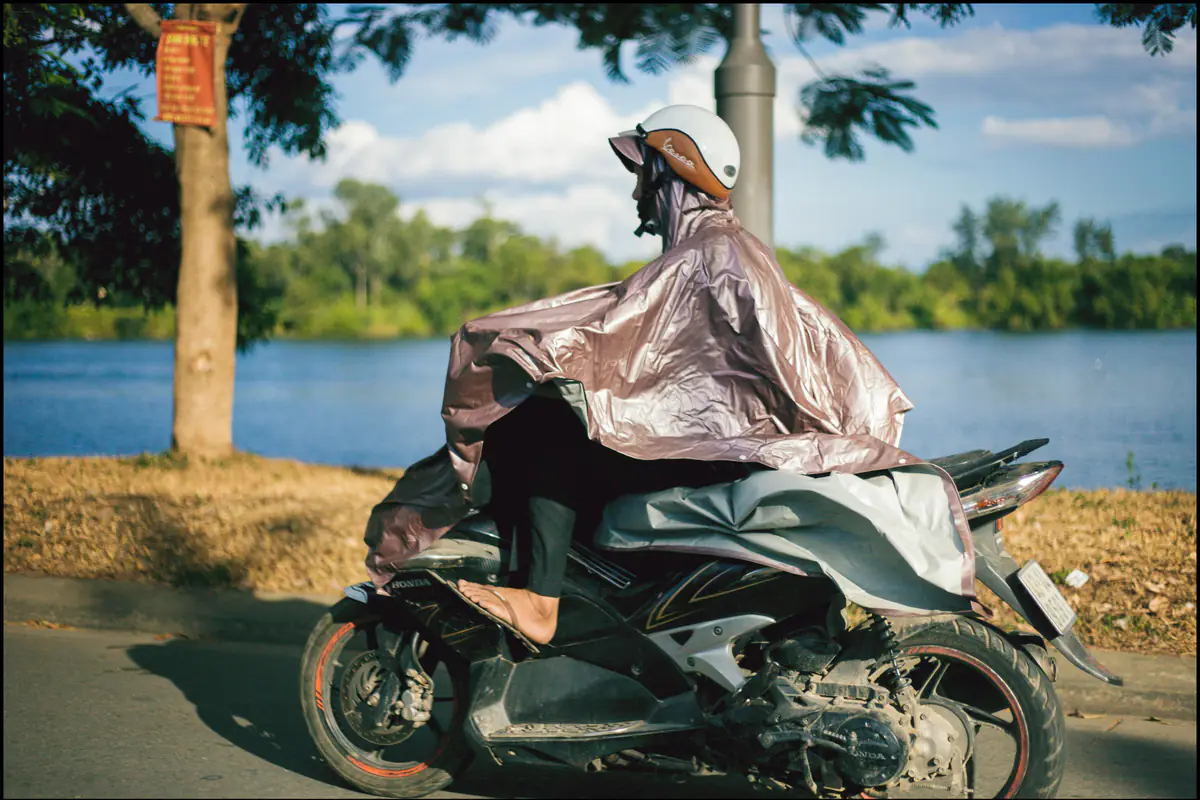
A motorbike rider in a rain poncho beside the water in Hue.
Turn over your phone charger and look for the small line beginning with "INPUT." That line is worth checking before buying a travel adapter for Vietnam. The country uses approximately 220-230V electricity at 50Hz, and while most modern phone and laptop chargers can handle it, some appliances from the United States and Japan cannot.
For most visitors, a passport, phone, suitable charger, payment card, essential medication and a few everyday items are enough to get started. The important part is knowing which things need checking before you leave home and which you can easily buy after arriving.
What to pack for Vietnam: the essential checklist
For a 7-14-day trip covering places such as Hanoi, Da Nang, Hoi An or Ho Chi Minh City, you don't need an enormous suitcase.
Everyday toiletries, umbrellas, basic clothing and travel accessories are widely available in Vietnam. Documents, prescription medicines, electrical equipment and specialized personal items deserve more attention because they can be harder to replace.
| Category | What to bring | What to check |
|---|---|---|
| Travel documents | Passport, visa if required, travel insurance | Passport validity and entry requirements |
| Money | Bank cards and some cash | International withdrawal and transaction fees |
| Phone | Smartphone, charging cable, wall charger | Charger input supports 100-240V |
| Travel adapter | Plug adapter if needed | Plug type, voltage rating and grounding |
| Power bank | One clearly labeled portable charger | Watt-hour rating and airline restrictions |
| Internet | eSIM, physical SIM or roaming plan | Phone compatibility and activation conditions |
| Medication | Personal medicines and prescriptions | Vietnamese import restrictions |
| Toiletries | Small toiletries, sunscreen, insect repellent | Carry-on liquid limits |
| Day bag | Lightweight backpack or crossbody bag | Comfortable for walking |
| Weather protection | Compact rain jacket or umbrella | Weather at your destinations |
This is a general packing list, not a clothing guide for every part of Vietnam.
A week in Ho Chi Minh City, a mountain trip in northern Vietnam and a December holiday in Da Lat call for different clothing. Check your destination's weather separately instead of packing the same outfits for the whole country.

Keep three things within easy reach throughout your journey: your passport, a charged phone and a working payment method.
You'll need them before you've even reached your hotel.
What plug types are used in Vietnam?
Vietnam commonly uses Type A and Type C plugs and sockets. You'll also find some Type B outlets and combination sockets designed to accept more than one plug shape.
There isn't one identical wall socket in every Vietnamese hotel, apartment or guesthouse.
| Plug type | Appearance | Compatibility in Vietnam |
|---|---|---|
| Type A | Two parallel flat pins | Commonly accepted |
| Type B | Two flat pins and one round grounding pin | Requires a suitable grounded socket |
| Type C | Two small round pins | Widely compatible |
| Type E/F | Two round pins with grounding contacts | Grounding compatibility must be checked |
| Type G | Three rectangular pins, used in the UK | Usually needs an adapter |
| Type I | Two angled flat pins, sometimes with a grounding pin | Usually needs an adapter |
| Type O | Three round pins, used in Thailand | Works only with compatible sockets |
Many hotels have combination outlets that accept both Type A and Type C plugs.
Some newer properties also provide USB-A or USB-C charging ports beside the bed or desk. These can be convenient, but you shouldn't assume they'll be available or deliver enough power for your devices.
A small guesthouse may have ordinary two-pin sockets. A modern hotel might provide several socket types in the same room.
If you're coming from the UK, Singapore or Australia, bringing an appropriate travel plug adapter is sensible.
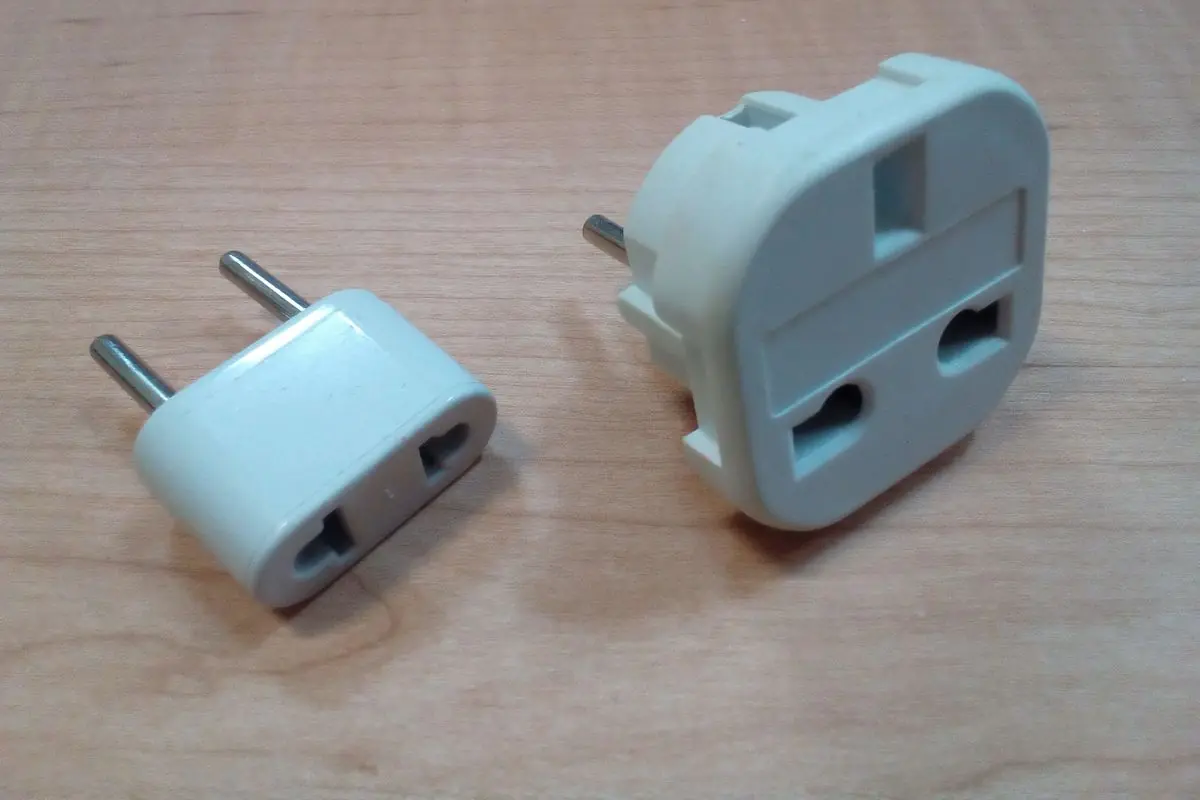
If your phone charger already has a Type C plug with two small round pins and accepts Vietnam's voltage, you often won't need an adapter at all.
Are two-pin and three-pin plugs interchangeable?
Not always.
The third pin on many plugs provides an electrical ground connection. Grounding is an important safety feature for equipment designed to use it.
Some laptop power supplies, electrical appliances and equipment with metal housings use grounded plugs.
Similarly, a European Type E or F plug may physically fit a two-hole socket without receiving its intended ground connection. A physical fit doesn't necessarily mean the connection is safe.
For equipment requiring grounding, use a correctly grounded outlet and a suitable adapter. Ask your accommodation if you're unsure.
What about universal travel adapters?
A good universal travel adapter can be useful if Vietnam is one stop on a longer Asian trip.
Check the supported plug types, electrical rating and grounding arrangement before buying.
Some adapters include USB charging ports, which can reduce the number of separate wall chargers you need. Those ports still need to provide enough power for your devices.
An adapter advertised as suitable for Asia isn't automatically suitable for every appliance or every outlet.
Is Vietnam 220V or 230V?
Vietnam's electricity is commonly described as 220V, 50Hz, while the nominal supply is also listed as 230V, 50Hz.
For travel preparation, treat Vietnam as a 220-230V, 50Hz destination.
The difference between these descriptions usually doesn't matter for modern chargers rated for a wide voltage range. What matters is the voltage range printed on your own device.
Check the INPUT label on your charger
Look at the back or underside of your phone charger, laptop power supply or camera charger.
You might see one of the following:
| Input label | Suitable for Vietnam? |
|---|---|
| INPUT: 100-240V ~ 50/60Hz | Yes |
| INPUT: 110-240V ~ 50/60Hz | Yes |
| INPUT: 220-240V ~ 50Hz | Yes |
| INPUT: 120V ~ 60Hz | No, not directly |
| INPUT: 100V ~ 50/60Hz | No, not directly |
| INPUT: 110-120V ~ 50/60Hz | No, not directly |
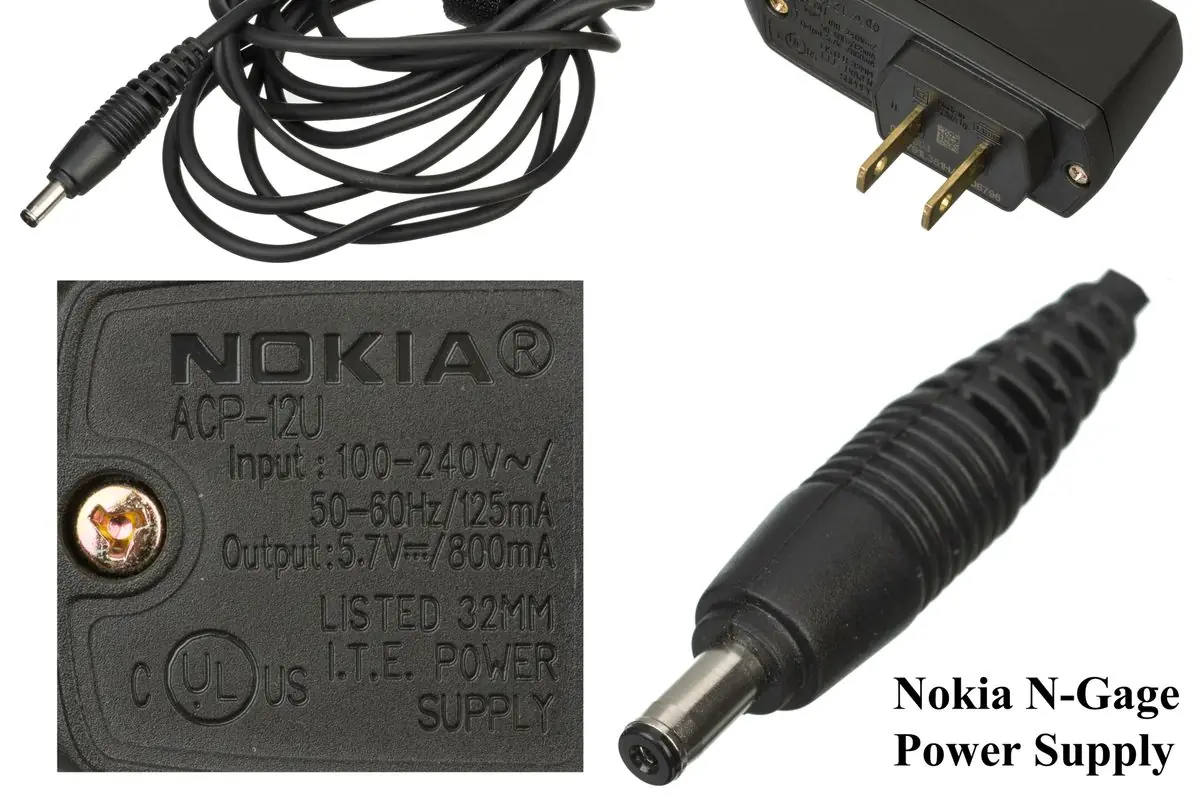
A charger labeled 100-240V ~ 50/60Hz is designed for a wide range of electrical systems.
For example, an American phone charger with two flat pins may work perfectly well in Vietnam if the charger supports 100-240V and the plug fits the outlet.
However, a 120V hair dryer from the United States cannot safely be used on Vietnam's electrical supply simply by attaching a plug adapter.
That's the distinction that saves you from buying the wrong accessory.
What does OUTPUT mean on a charger?
Laptop and phone chargers often have another label reading OUTPUT.
You might see something like 20V ⎓ 3.25A.
OUTPUT describes the electricity supplied from the charger to the device. It doesn't describe the wall socket voltage.
When checking compatibility with Vietnam's electrical supply, start with INPUT.
For USB-C charging, also check the charger's power output.
A small phone charger might charge your laptop very slowly or fail to provide enough power while you're using it. A suitable USB-C Power Delivery charger may work with several devices, but only if it supports the voltage and power profiles they require.
Before leaving your laptop charger at home, confirm that your computer supports USB-C charging, that the replacement charger provides enough power and that your cable supports the required wattage.
Not every USB-C cable has the same capabilities.
Do you need a voltage converter in Vietnam?
Most travelers carrying ordinary phones, laptops, tablets and cameras won't need a voltage converter.
They may need a plug adapter.
These two accessories serve different purposes.
A travel plug adapter changes the physical plug connection. It allows your plug to fit a compatible socket, but it doesn't convert 220-230V electricity into 110V.
A voltage converter or transformer changes the electrical voltage. It may be needed for certain single-voltage appliances, depending on their specifications.
For a modern laptop charger marked 100-240V, a plug adapter is generally enough.
For an appliance marked 120V only, a plug adapter alone is not enough.
Which devices need special attention?
| Device | Practical advice |
|---|---|
| Smartphone charger rated 100-240V | Keep your charger; use a plug adapter if necessary |
| Laptop charger rated 100-240V | Check the plug, grounding and power requirements |
| Camera charger rated 100-240V | Bring the original charger and compatible cable |
| 120V hair dryer | Leave it at home and use a suitable local appliance |
| Dual-voltage hair straightener | Check its voltage setting, wattage and plug |
| USB rechargeable electric shaver | Bring a compatible USB charging setup |
| Medical electrical equipment | Confirm requirements with the manufacturer |
Hair dryers, curling irons and other heating appliances deserve particular attention.
They often consume much more power than phone chargers.
A small travel voltage converter designed for low-power electronics may not support a hair dryer. Motor-driven appliances can also be affected by differences in electrical frequency.
For a short hotel stay, borrowing the hotel's hair dryer is usually more convenient than carrying a heavy transformer.
If you genuinely need a single-voltage appliance, get a converter specifically approved for that type of load and its power consumption.
Don't test compatibility by plugging an unsuitable appliance directly into the wall.
Are Vietnam and Thailand power plugs the same?
Vietnam and Thailand have similar electrical supplies, but their socket standards aren't completely identical.
Both countries operate around 220-230V at 50Hz.
That means a charger rated 100-240V, 50/60Hz will generally work in both countries from an electrical standpoint.
The plug shape is where differences appear.
Thailand uses Type C and Type O as official standards, while Type A and Type B plugs are also accepted by many Thai combination sockets.
Vietnam commonly uses Type A, Type C and various combination outlets. Some grounded combination sockets also support Type B and Type O, but you shouldn't assume every accommodation provides one.
Can you use your Thailand adapter in Vietnam?
Often, yes.
If the plug on your adapter is Type C with two small round pins, it's usually a practical choice for both countries.
A Type A two-pin adapter may also work at many Vietnamese accommodations.
But if you have a Type O plug with three round pins, check compatibility before relying on it in Vietnam.
The same caution applies to grounded appliances.
An adapter that makes an appliance fit but removes its required grounding isn't an equivalent safe connection.
For an itinerary covering Bangkok, Hanoi and Da Nang, you normally don't need to buy separate voltage converters for Thailand and Vietnam.
One suitable travel plug adapter may cover both countries.
Check the exact plug types rather than trusting a generic "Asia compatible" label.
Which adapter do travelers from different countries need?
Your country of departure is a useful starting point, but the plug and INPUT label on your actual equipment are what matter.
| Country or region | Common plugs | What to prepare for Vietnam |
|---|---|---|
| United States and Canada | Type A/B | Check voltage carefully; consider an adapter |
| United Kingdom and Ireland | Type G | Bring a suitable Type G adapter |
| Singapore | Type G | Usually needs a plug adapter |
| France, Germany and much of Europe | Type C/E/F | Type C is convenient; check grounding for E/F |
| Australia and New Zealand | Type I | Bring a Type I adapter |
| Japan | Type A/B | Pay special attention to 100V-only appliances |
| Thailand | Type A/B/C/O | Type A/C often work; check Type O |
| South Korea | Type C/F | Check physical fit and grounding |
Travelers from the United States and Canada
You should pay particular attention to voltage.
American-style flat-pin plugs are common in Vietnam, but Vietnam doesn't use the North American 120V electrical system.
A charger rated 100-240V should work with a suitable outlet.
An appliance rated only for 120V should not be plugged directly into Vietnam's mains supply.
Check your phone charger, laptop charger and other electrical appliances individually. Buying all of them in the same country doesn't guarantee they have the same voltage rating.
Also remember that some North American plugs have one flat blade wider than the other. Such polarized plugs may not fit every Type A-compatible socket.
Travelers from the UK and Singapore
The main issue is usually the plug shape rather than the voltage.
Both countries use Type G plugs with three rectangular pins.
A suitable adapter will generally allow a compatible phone or laptop charger to connect to Vietnamese outlets.
For grounded laptop power supplies, choose an adapter that preserves the required ground connection.
Travelers from continental Europe
Small Type C plugs with two round pins are often straightforward to use in Vietnam.
Larger Type E/F plugs need more care, especially when the connected appliance requires grounding.
Don't assume that any two-round-hole socket safely supports a grounded European plug.
Travelers from Japan
Japan uses 100V electricity, so it's important to check appliances individually.
Many phone chargers and laptop power supplies support 100-240V, but some domestic Japanese electrical appliances are designed for 100V only.
A Japanese hair dryer or small household appliance may therefore be unsuitable for direct use in Vietnam.
Read the numerical voltage rating rather than relying on the brand or plug shape.
How many electronic devices should you bring?
For most visitors, a smartphone can handle navigation, transport bookings, hotel confirmations, translation and communication.
You don't need every electronic device you use at home.
For a 7-10-day holiday
A practical setup includes your phone, wall charger, charging cable, headphones and one compliant power bank.
A spare cable is worth considering because it takes up little space and can replace a damaged one.
If you're bringing a camera, add its charger, memory card and any permitted spare batteries.
Unless you need to work, leaving your laptop at home will save weight and make moving between destinations easier.
For digital nomads
Focus on the equipment that keeps you working reliably.
That usually means a laptop, suitable charger, phone, headphones with a microphone and a backup internet connection.
A multiport USB-C charger can be convenient if it supports your laptop and other devices.
Check its total power output and how power is distributed when several devices are connected simultaneously.
Accommodation also matters. A desk, a reliable internet connection and a quiet room are often more important than carrying additional bulky equipment.
For photographers and videographers
Bring the camera equipment you'll actually use.
Separate installed batteries from spare batteries and portable charging banks. Airlines may classify them differently.
Keep removable lithium batteries protected against short circuits and check capacity limits before flying.
If you're bringing a drone, also check Vietnam's rules governing drone operation, flight permissions and restricted airspace.
Permission to carry a drone on an aircraft doesn't mean you can operate it anywhere in Vietnam.
Power bank rules for flights to and within Vietnam in 2026
Power banks deserve their own section because airline restrictions have become stricter.
From July 1, 2026, passengers on flights in Vietnam may carry no more than two power banks.
Power banks must travel in carry-on baggage, not checked luggage.
What power bank capacity is allowed?
| Battery energy rating | Guidance for travelers |
|---|---|
| Up to 100Wh | Normally permitted in carry-on baggage, subject to airline conditions |
| Over 100Wh and up to 160Wh | Allowed only with prior operator approval, but other airlines may prohibit them |
| Over 160Wh | Not permitted as an ordinary passenger power bank |
For international flights, especially itineraries involving multiple airlines, the simplest choice is a clearly labeled power bank rated at 100Wh or less.
If you have a larger power bank, don't assume it will be accepted. Get confirmation from every operating airline before traveling.
Is a 20,000mAh power bank allowed?
Usually, yes, when its watt-hour rating is within the permitted limit and it meets the airline's other requirements.
The important figure is Wh, not just mAh.
You can calculate energy using:
Wh = Ah x V
For example, at a nominal battery voltage of 3.7V:
| Advertised capacity | Calculated energy |
|---|---|
| 10,000mAh | 37Wh |
| 20,000mAh | 74Wh |
| 26,800mAh | Approximately 99.2Wh |
| 30,000mAh | 111Wh |
These examples assume a nominal cell voltage of 3.7V. Batteries with different nominal voltages will have different watt-hour values.
Check the Wh rating printed on the power bank itself.
A 20,000mAh power bank clearly marked 74Wh is easier for airport staff to assess than one with missing or unreadable specifications.
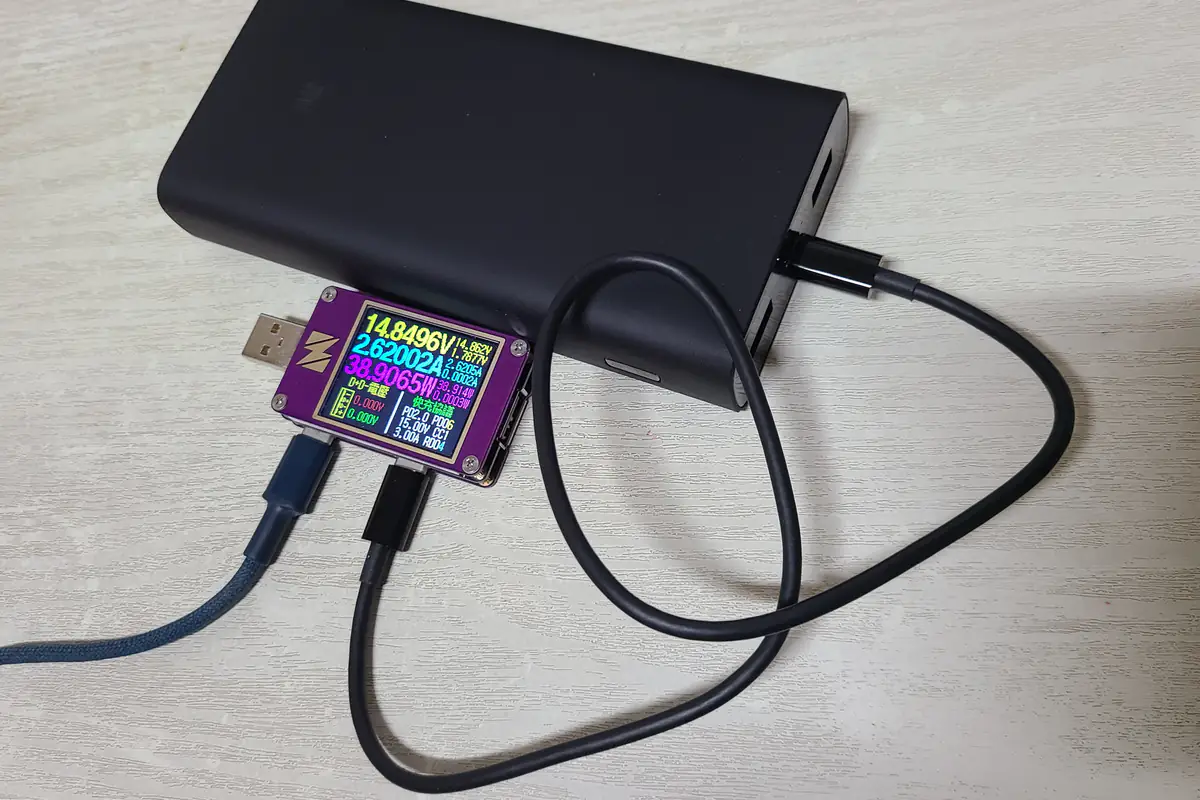
Can you use a power bank during the flight?
On flights in Vietnam, passengers must not recharge power banks or use them to charge other devices during the flight.
Power banks must be removed from carry-on bags and placed somewhere visible and easy to monitor, following cabin crew instructions.
They must also be protected individually against short circuits.
On Vietnam Airlines, that also means keeping power banks out of overhead baggage compartments and within easy monitoring distance.
Don't rely on a power bank to keep your phone running during the flight.
Charge your phone before boarding and follow the operating airline's instructions.
Are spare camera batteries treated the same as power banks?
Not exactly.
A spare battery designed for a camera or other specific device is different from a universal power bank used to charge multiple devices.
Both may contain lithium cells and fall under aviation dangerous goods rules, but their permitted quantities and energy limits can differ.
Protect exposed terminals using the manufacturer's case, terminal covers or another suitable method.
Check with your airline if you're carrying several spare batteries or any battery rated above 100Wh.
Which electronics should go in carry-on luggage?
When organizing your luggage, separate batteries from ordinary charging accessories.
| Item | Where to pack it |
|---|---|
| Smartphone | Carry-on recommended |
| Laptop | Carry-on recommended |
| Camera | Carry-on recommended |
| Power bank | Carry-on only |
| Spare lithium batteries | Carry-on, individually protected |
| Charging cables without batteries | Carry-on or checked baggage |
| Travel plug adapter without a battery | Carry-on or checked baggage |
| Ordinary wall charger without a battery | Carry-on or checked baggage |
Some electronic devices with installed batteries may be permitted in checked baggage if they meet the applicable conditions and are fully switched off and protected from accidental activation.
However, keeping valuable devices such as laptops and cameras in your carry-on is usually more practical.
One detail matters if your cabin bag is taken at the boarding gate and transferred to the aircraft's cargo hold.
Don't leave them inside a small pocket and forget about them.
For battery-powered medical equipment or specialized electronic devices, contact the operating airline before departure to confirm the relevant conditions.
What should you leave at home?
Packing less often makes traveling around Vietnam easier.
Start by removing things that are heavy, electrically incompatible or readily available at your destination.
Single-voltage hair dryers and styling tools
If your hair dryer is rated for 120V only, it's usually better to leave it at home.
Many hotels provide hair dryers, although availability can vary at small guesthouses and homestays.
Ask your accommodation before packing one.
A heavy voltage transformer rarely makes sense for an appliance you'll use only briefly each day.
Bulky power strips
A power strip from your home country doesn't automatically solve voltage, plug shape or grounding differences.
Avoid chaining multiple plug adapters and extension leads together, particularly for high-power appliances.
A properly rated multiport USB charger is often a more compact solution for phones, headphones and other small devices.
Large bottles of everyday toiletries
Shampoo, toothpaste, shower gel and basic personal-care products are available at supermarkets, pharmacies and convenience stores across Vietnam.
Bring small amounts for the first few days and keep any products that are difficult to replace.
Prescription skincare and specialist products may be worth bringing from home.
A full-sized shampoo bottle usually isn't.
Vapes, e-cigarettes and heated tobacco products
Do not pack e-cigarettes, vaping devices or heated tobacco products for entry into Vietnam.
This isn't simply an airline battery issue. Importing these products raises a separate legal concern.
Things you can buy after arrival
Umbrellas, rain ponchos, shampoo, ordinary sandals and simple travel accessories are widely available.
There's no need to fill your suitcase with duplicates unless you need them immediately or require a specialist product.
Toiletries, liquids and medication: what to know before flying
On international flights, each ordinary liquid, gel or aerosol container in your carry-on can hold no more than 100ml, with a total allowance of up to one liter per passenger.
Other airlines and transit airports may impose their own security requirements.
Many airports require liquids to be packed in a clear, resealable bag.
Remember that the container's capacity matters, not just how much liquid remains inside.
A 200ml sunscreen bottle containing only 30ml of product is still a 200ml container.
Transfer toiletries into properly labeled, travel-sized containers when appropriate.
What medication can you bring into Vietnam?
Pack essential prescription medication in its original packaging and carry a copy of your prescription.
Your documentation should clearly identify the patient, medication and prescribed dosage.
Some medicines that are legal in your home country may be controlled in Vietnam.
Medicines classified as narcotic or psychotropic drugs can be subject to strict quantity limits and customs declaration requirements.
The general allowance is up to seven days of prescribed narcotic medication, or ten days of prescribed psychotropic medication or medication containing controlled precursors, subject to the applicable conditions.
Travelers needing larger quantities or carrying controlled medicines should confirm the requirements with Vietnamese authorities before departure.
Don't assume all prescription medicines can enter Vietnam under the same rules.
If you rely on medication daily, keep the necessary supply in your carry-on rather than placing everything in checked baggage.
A small personal health kit
For an ordinary holiday, a simple kit may include personal medication, adhesive bandages, basic wound-care supplies and insect repellent.
Sunscreen is useful for outdoor sightseeing, while repellent is worth bringing when visiting places where mosquitoes are common.
Use these products according to their instructions.
You don't need to pack an entire home medicine cabinet. Prioritize anything prescribed specifically for you or difficult to replace.
Phone, internet and money: prepare before landing
Your phone should be ready to use when you arrive at Noi Bai Airport in Hanoi, Tan Son Nhat Airport in Ho Chi Minh City, Da Nang International Airport or Cam Ranh International Airport.
There are three useful things to arrange before your flight.
Set up mobile internet
If your phone supports eSIM, you can arrange a suitable data plan before leaving home.
Check when the plan activates. Some begin their validity period when first connected at the destination, while others use different activation rules.
If you're buying a physical SIM, make sure your phone is unlocked.
Major Vietnamese mobile operators include Viettel, VinaPhone and MobiFone.
Coverage and performance depend on your location.
For a holiday concentrated in Hanoi or Ho Chi Minh City, many options may work well. If you're traveling to remote mountain areas or islands, check coverage for the specific places on your itinerary.
Save offline maps and hotel details
Download the map of your first destination before departure.
Save your hotel's name, full street address and phone number.
Keep the address in Vietnamese as well as English when possible.
If your accommodation is down a narrow alley, the street number and alley entrance may be more useful to a driver than its English marketing name.
Store your flight details and hotel reservation offline, too.
That way, you can still reach your accommodation if your internet connection isn't working immediately.
Bring more than one payment method
International cards are accepted at many hotels, restaurants and larger businesses, but cash remains useful for small purchases, markets and local services.
Check your bank's overseas transaction fees and ATM withdrawal charges.
Also make sure you'll be able to receive security or verification messages while abroad.
A backup payment card stored separately can be useful if your main card stops working.
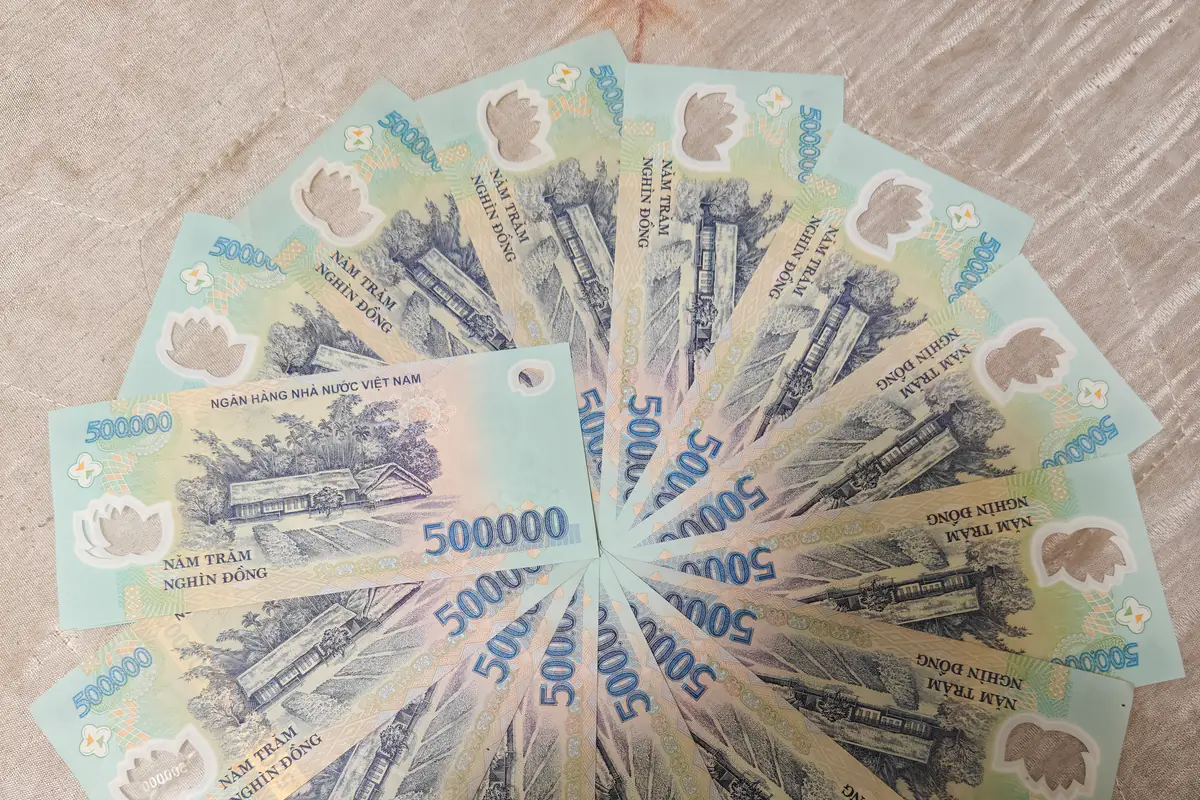
Circular No. 15/2011/TT-NHNN requires travelers entering or leaving Vietnam through international border checkpoints with a passport to declare cash amounts exceeding:
- USD 5,000, or the equivalent in another foreign currency.
- VND 15,000,000 in Vietnamese currency.
These are customs declaration thresholds, not absolute limits on how much money a traveler may carry.
What should be in your day-one bag?
Your arrival day usually involves several practical tasks: immigration, baggage collection, internet setup, transport arrangements and hotel check-in.
A small, organized day bag makes those steps easier.
Keep the following items accessible:
- Passport and necessary entry documents.
- Phone with enough battery for arrival.
- Charging cable and compatible wall charger.
- Payment card and some cash.
- Offline hotel booking confirmation.
- Medication needed during the journey.
- Basic personal-care items.
- Headphones and a light layer for the flight if needed.
Your power bank should remain packed according to the relevant aviation requirements, including any cabin crew instructions on where it must be placed.
If you're arriving late at night, knowing how you'll reach your accommodation is more useful than bringing several extra gadgets.
Save the exact hotel address and a practical transport plan before you leave.
Suitcase or backpack?
A wheeled suitcase is convenient when you're staying in hotels, using taxis and changing accommodation only a few times.
A travel backpack can be easier if your trip involves regular transfers, stairs, uneven walkways or accommodation with limited vehicle access.
But don't assume Vietnam requires a backpack.
If you're spending ten days in Da Nang and Hoi An, a regular suitcase may be perfectly practical.
A small daypack is useful with either option.
How to pack without buying unnecessary accessories
Start with the essentials: passport, medication, phone and important electrical devices.
Next, put your chargers and cables together.
Check whether any of your devices can share a charging setup.
For example, a phone, headphones and camera may all support USB-C charging.
That doesn't mean every USB-C charger or cable will provide the required power, but checking compatibility may allow you to leave several accessories at home.
Then organize your clothing and toiletries around the space you have left.
One device, one clear charging plan
For each electronic device, answer five questions:
- Which charging connector does it use?
- Is the charger rated for Vietnam's electrical supply?
- Does the plug fit local outlets?
- Does the equipment require grounding?
- Does its battery need to be carried in cabin baggage?
These questions are more useful than buying a large universal travel adapter without knowing whether your equipment needs it.
A laptop may support USB-C charging but require a much more powerful charger than your phone.
A camera may charge through USB or use a dedicated external battery charger.
An electric shaver might support worldwide voltage or be designed for one region only.
Check the actual label on each device.
Don't buy a voltage converter too early
This is one of the easiest ways to spend money on something you won't use.
If all your chargers are rated 100-240V, you generally don't need a voltage transformer just because Vietnam uses 220-230V electricity.
You may only need a small travel plug adapter.
Even when one appliance is incompatible, leaving it at home or using a suitable locally supplied alternative may be simpler than purchasing a converter.
Vietnam packing checklist: 48 hours before your flight
Two days before departure is a good time to check your essentials.
| Check | Done |
|---|---|
| Passport and Vietnam entry requirements confirmed | ☐ |
| Flights and accommodation confirmed | ☐ |
| Phone charger accepts 100-240V | ☐ |
| Laptop charger has suitable input voltage and power output | ☐ |
| Correct travel plug adapter packed if needed | ☐ |
| Grounded equipment has a suitable connection | ☐ |
| Power bank has a readable Wh rating | ☐ |
| Power bank quantity meets airline restrictions | ☐ |
| Power banks are in carry-on luggage | ☐ |
| Spare lithium batteries have protected terminals | ☐ |
| Liquids meet international cabin baggage requirements | ☐ |
| Prescription medication and documents are prepared | ☐ |
| eSIM, SIM or roaming option arranged | ☐ |
| Offline maps and hotel address saved | ☐ |
| Backup payment method available | ☐ |
| Prohibited or restricted items removed from luggage | ☐ |
A damaged cable or missing charging connector is easier to replace at home than at the airport.
For electrical compatibility, check specifications and certified equipment. Don't test a single-voltage appliance by plugging it into an unsuitable electrical supply.
Packing advice for different types of Vietnam trips
A ten-day trip with carry-on luggage only
Keep your electrical setup small.
A phone, compatible wall charger, spare charging cable, appropriate plug adapter and one compliant power bank should cover most everyday charging needs.
Pack toiletries within the liquid limits for your flights.
Buy ordinary consumables after arrival rather than using up your entire carry-on allowance.
Unless you genuinely need it, don't pay for checked baggage just to bring large bottles of shampoo or equipment you won't use.
A multi-city trip across Vietnam
If you're moving between several cities, choose your luggage based on how often you'll need to carry it.
A large suitcase may be comfortable at the airport but inconvenient when boarding trains, climbing stairs or reaching accommodation in a narrow alley.
If you're changing hotels every two or three nights, reducing the number of rarely used items can make a noticeable difference.
Keep all your chargers together in a small pouch.
That makes it easier to check the room before leaving and reduces the chance of forgetting a cable behind the bedside table.
A trip combining holidays and remote work
Prioritize your laptop, charger, mobile internet and data backups.
Ask your accommodation about Wi-Fi, workspace and noise if you need to make regular video calls.
A good desk and reliable connection will usually contribute more to your working day than carrying a large collection of accessories.
If you need multiple displays or specialist equipment, consider whether your stay is long enough to justify the extra weight.
Visiting Vietnam after Thailand
If you've already been using your phone and laptop chargers in Thailand and they're rated for 100-240V, they should generally be electrically compatible with Vietnam's supply.
Check your plug adapter rather than automatically buying another voltage converter.
Type A and Type C plugs are commonly accepted in Vietnam.
Type O and grounded plugs require more careful checking.
One suitable adapter may be enough for a trip covering both countries.
Before buying a travel adapter, check the INPUT label on your phone and laptop chargers. Then review the power bank policy of your operating airline, such as Vietnam Airlines or Vietjet, and run through the 48-hour packing checklist before you fly.
FAQ
What should I pack for my first trip to Vietnam?
Bring your passport, required entry documents, phone, compatible charger, travel adapter if needed, payment cards, some cash, essential medication and basic toiletries. Choose clothing based on your destinations and season. For most short holidays, you can buy everyday supplies locally instead of bringing large quantities from home.
Do I need an adapter in Vietnam?
It depends on your plug type. Vietnam commonly uses Type A and Type C sockets, along with combination outlets. Travelers from the UK, Singapore and Australia usually benefit from bringing an adapter. If your charger already has a compatible Type C plug, you may not need one. A charger labeled 100-240V, 50/60Hz generally doesn't require a voltage converter.
What plug adapter do I need for Vietnam?
Choose an adapter designed to connect your home-country plug to a compatible Vietnamese Type A or Type C outlet, or use a properly rated universal travel adapter. If your device requires grounding, the adapter and socket must provide an appropriate grounded connection. Remember that plug adapters don't convert 220-230V electricity into 110V.
Are Thailand and Vietnam power plugs the same?
Not completely. Both countries use approximately 220-230V electricity at 50Hz, and Type A and Type C plugs are commonly accepted. Thailand also uses Type O three-round-pin plugs. Some Vietnamese combination sockets support Type O, but not all do. Check your adapter before traveling between the two countries.
Can I bring a 20,000mAh power bank on a flight to Vietnam?
Usually, yes, provided its Wh rating is within the permitted limit and the airline accepts it. A 20,000mAh battery rated at 3.7V has an energy capacity of approximately 74Wh. From July 1, 2026, passengers on flights in Vietnam may carry no more than two power banks in carry-on baggage, and they must not use them to charge other devices during the flight. Always check the operating airline's rules before departure.