Meteor showers in Vietnam: which nights to watch, best hours and where to go
From late October 2026 to early January 2027, viewers in Vietnam can still catch several meteor showers, starting with the Taurids in early November and the Leonids before dawn on November 18. For a dedicated stargazing trip, consider the night of December 14-15, after about 10 p.m. in Vietnam. The Moon will have set, but you will still need a clear local forecast.
By Da Lat LoversPublished Updated How we review
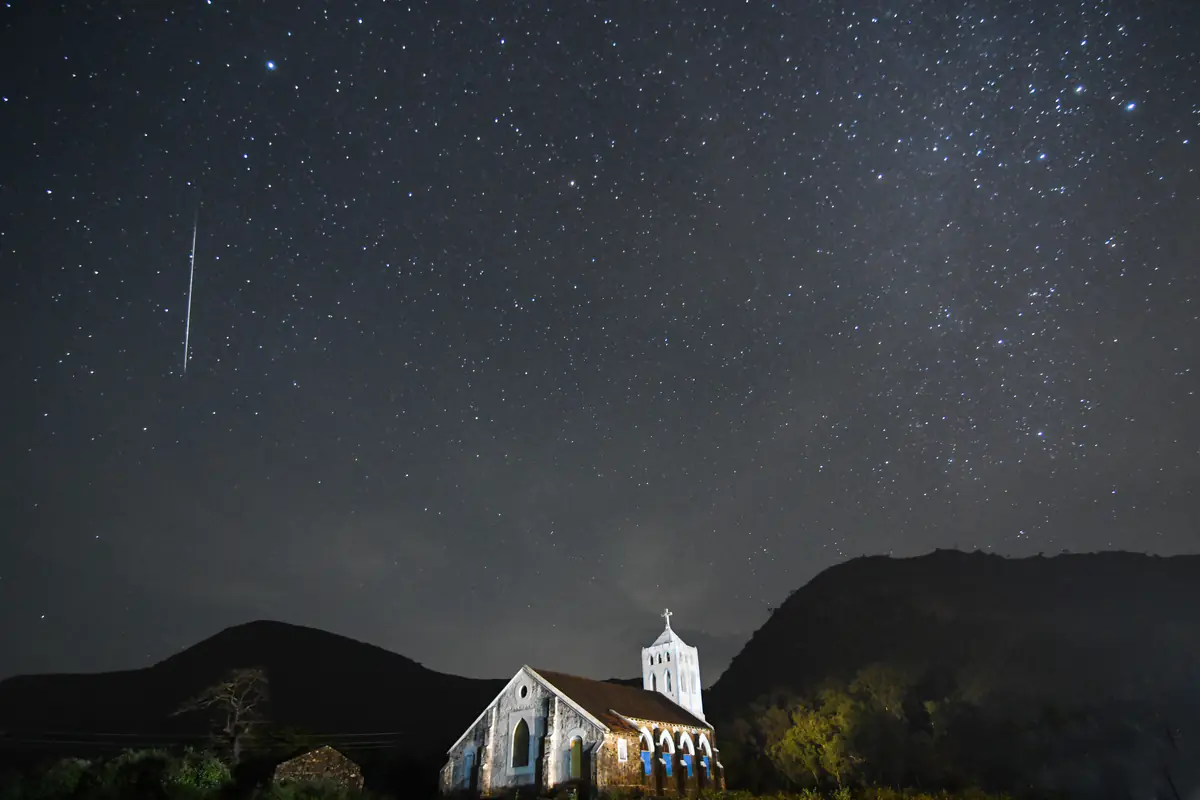
A Geminid meteor above an old church at Sunkarametta, India. Photo: Drashokk / CC BY-SA 4.0
Is there a meteor shower tonight? What to see in the coming weeks
- Until November 7: the Orionids peaked on October 21-22 but stay active at falling rates until November 7, according to the IMO’s 2026 calendar. Full Moon on October 26 lights up most of the night in late October.
- Nights of November 5-6 and 12-13: the two Taurid branches peak. Expect only a few meteors an hour, many of them slow and bright. New Moon on November 9 keeps the nights in between dark.
- Before dawn on November 18: the Leonids, from moonset (11:49 p.m. on November 17 in Hanoi, 11:56 p.m. in Ho Chi Minh City) until first light.
- Night of December 14-15: the Geminids, the one worth a dedicated trip; details in the Geminids section below.
On an ordinary clear, dark night with no shower, NASA says you can usually still see several meteors an hour. None of these showers needs a telescope.
Meteor shower 2026 calendar: peak times in Vietnam and moonlight
| Shower | Active | Peak (UTC) | In Vietnam | Moon | ZHR | Realistic per hour |
|---|---|---|---|---|---|---|
| Orionids | Oct 2-Nov 7 | Oct 21, 18:16 (NASA via KASI) | Oct 22, 1:16 a.m. (passed); low rates to Nov 7 | Full Oct 26; bright most of the night in late Oct | 20 (IMO) | 10-20 at peak (NASA) |
| Southern Taurids | Sep 20-Nov 20 | Nov 5, 18:45 (KASI) | Nov 6, 1:45 a.m.; watch until moonrise | 10% crescent, rises ~3 a.m. | 5-10 (IMO); 10 (KASI) | Low; many slow, bright meteors |
| Northern Taurids | Oct 20-Dec 10 | Nov 12, 18:02 (KASI) | Nov 13, 1:02 a.m.; dark all night | New Moon Nov 9; sets before 8 p.m. on Nov 12 | 5 (IMO); 15 (KASI) | Low; many slow, bright meteors |
| Leonids | Nov 6-30 | Nov 17, 23:45 (IMO) | Nov 18, 6:45 a.m. (daylight); watch midnight-5:30 a.m. | First quarter, sets ~11:50 p.m. | 15 | Fewer than 3 (NASA) |
| Geminids | Dec 4-20 | Dec 14, 14:00 | Dec 14, 9 p.m.; watch 10 p.m. to dawn | 22% crescent, sets ~9:45 p.m. | 150 | 40-50 (NASA) |
| Ursids | Dec 17-26 | Dec 22, 22:00 | Dec 23, 5 a.m. | 96% lit, full Dec 24 | 10 | Very few (bright Moon) |
| Quadrantids | Dec 28-Jan 12 | Jan 4, 2027, 03:25 | Jan 4, 10:25 a.m. (daylight); watch 2-5:45 a.m. | 12% crescent, rises ~3-3:30 a.m. | 80 (60-200) | Fewer than 10 (NASA) |
The IMO defines the zenithal hourly rate (ZHR) as the number of meteors one observer would see in an hour under a perfectly clear, very dark sky with the radiant directly overhead. Real nights have cloud, lights and a lower radiant, so counts drop sharply. Peak times are predictions, and some showers remain worth watching for several hours or nights around the peak.
November: are the Taurids and Leonids worth staying up for?
Taurids: few but bright
The Taurids come in two branches, southern and northern, and together cover most of November. The IMO lists their maxima as November 5 and 12 in UTC; KASI’s 2026 almanac gives clock times that fall at about 1:45 a.m. on November 6 and 1 a.m. on November 13 in Vietnam. The two sources differ on rates: the IMO gives a ZHR of 5-10 for the southern branch and 5 for the northern, while KASI, citing NASA, lists 10 and 15.
Either way, expect low counts. The IMO notes that many Taurids are bright and slow, which makes them good photo targets, and the radiant in Taurus is up for most of the night.
Leonids: go before dawn, and don’t expect a storm
The IMO’s calculated peak, 23:45 UTC on November 17, falls after sunrise in Vietnam, so the useful window there is from moonset around midnight to dawn on November 18. Models cited in the IMO’s 2026 calendar show Earth crossing only low-density dust trails this year, not enough for a significant outburst.
Geminid meteor shower: what time to watch on December 14?
The IMO calls the Geminids the best and most reliable of the major annual showers. This year the peak is at 14:00 UTC on December 14, which is 9 p.m. in Vietnam, and the thin crescent Moon sets soon after: 9:43 p.m. in Hanoi, 9:51 p.m. in Ho Chi Minh City.
The maximum is broad: according to the IMO, rates of 100 or more usually last 10 to 12 hours. In Vietnam, that favors the evening of December 14 from about 10 p.m.; the radiant in Gemini is highest near 2 a.m. local time. NASA notes the shower starts around 9 or 10 p.m., so children can join without an all-nighter.
Ursids and Quadrantids: why they’re hard from Vietnam
The Ursids peak around 5 a.m. on December 23 in Vietnam, with a bright Moon making viewing difficult; the IMO expects little reliable data this year. Their radiant lies near the North Star, so the farther south you are, the lower it sits.
The Quadrantids open 2027 with no moonlight to speak of, but their peak is narrow, usually quoted at about four hours, and falls in daylight across Southeast and East Asia. The darkest hours before dawn on January 4 in Vietnam are still about five hours before the peak, so expect far fewer meteors than the ZHR suggests.
Where to watch in Vietnam: finding a dark sky
Three things decide a good site: darkness, cloud and safety. Darkness is often described on the Bortle scale, from 1 (darkest) to 9; central Hanoi and Ho Chi Minh City usually rate 8 to 9. Before you go, open lightpollutionmap.info, switch on the World Atlas 2015 or VIIRS layer and look for the darkest colors within reach.
- Pick open ground with no tall buildings or hills blocking the sky, and keep the nearest town behind you.
- Check the cloud forecast for your viewing site and planned hours before setting out. A clear sky at a moderately dark site beats cloud at a very dark one.
- Stay only where overnight access is allowed, such as a campsite or homestay; avoid stopping on mountain-road shoulders, go in a group and tell someone where you are.
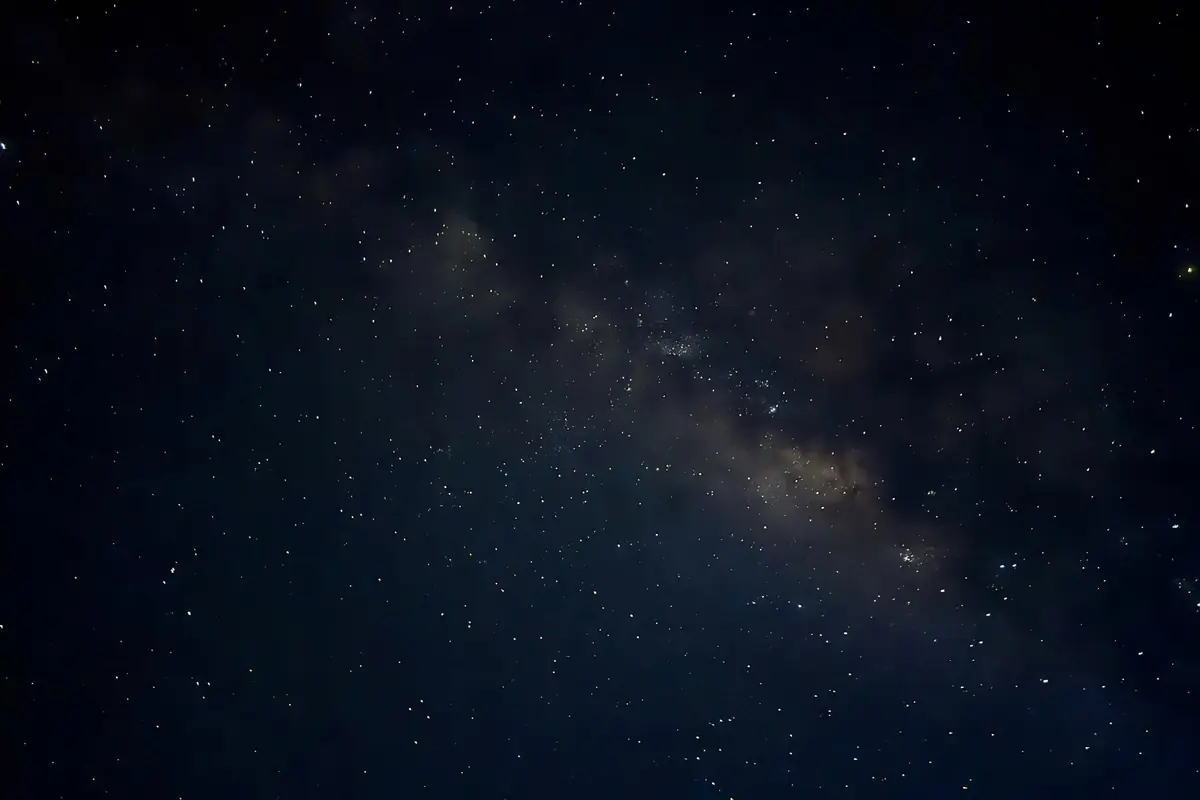
Northern Vietnam
Nguyen Hai Trieu, a researcher in astronomy education, suggests Ba Vi, Soc Son, Chuong My and My Duc on the edge of Hanoi, and Tam Dao, the Long Coc tea hills, Mai Chau, Moc Chau and Dong Cao farther out. Vietnam’s official tourism site adds Ta Xua and the Na Ka and Pha Luong valleys around Moc Chau for camping under the stars.
Southern Vietnam and the coast
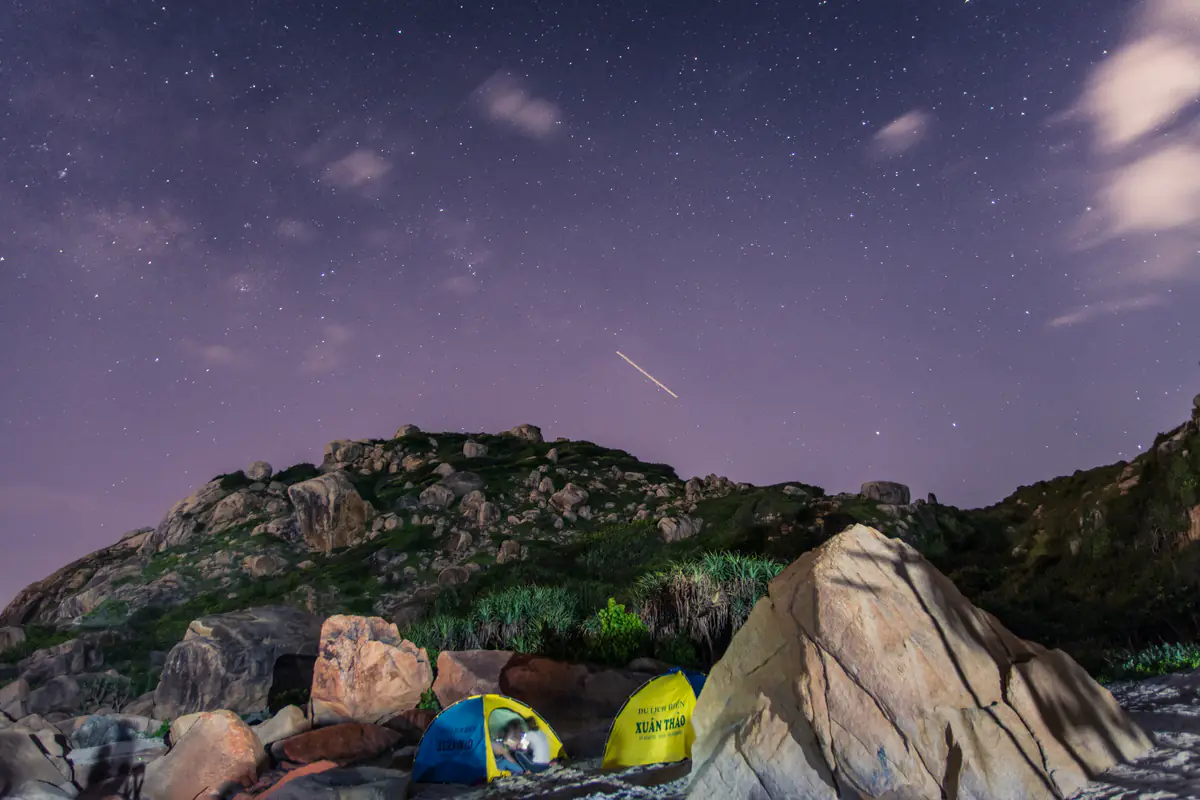
From Ho Chi Minh City you usually need to travel. Vietnam’s official tourism site recommends former Ninh Thuan, now part of Khanh Hoa, with Vinh Hy Bay and the semi-arid land around Phan Rang, and former Phu Yen, now in Dak Lak, for Dai Lanh Cape and Da Dia Reef. Con Dao has Milky Way trips too. For anything closer, scan the light pollution map, then check road access and where you are allowed to stop. Heading to Da Lat in mid-December? See Da Lat weather in December.
How to watch: where to look and what to bring
- No telescope or binoculars: meteors appear all over the sky, and optics only narrow your view.
- Don’t stare at the radiant. According to NASA, meteors 45 to 90 degrees away from it look longer, while those near it appear short.
- Lie back and take in as much sky as you can. Allow about 30 minutes for your eyes to adapt, NASA says, keep your phone screen off and use a red light.
- Bring a reclining chair or mat, a blanket or sleeping bag, a warm layer, water, insect repellent and a power bank.
- Look up moonrise and moonset for where you will be, for example on the USNO site, rather than for the nearest city.
- Give it at least an hour. Hourly rates are averages, and several minutes can pass with nothing.
How to photograph a meteor shower with a phone or camera
NASA’s guide, written mainly for cameras with manual controls, boils down to these steps:
- Use a tripod and a self-timer or remote release to avoid shake.
- Choose a wide-angle lens so the frame holds plenty of sky.
- Focus manually at infinity, take a test shot and zoom in on a star until it is sharp.
- Set the exposure with the 500 rule: 500 divided by focal length in mm gives the longest exposure in seconds before stars trail; with a 20 mm lens, about 25 seconds.
- Aim at the general area around the radiant and shoot continuously, changing one setting at a time.
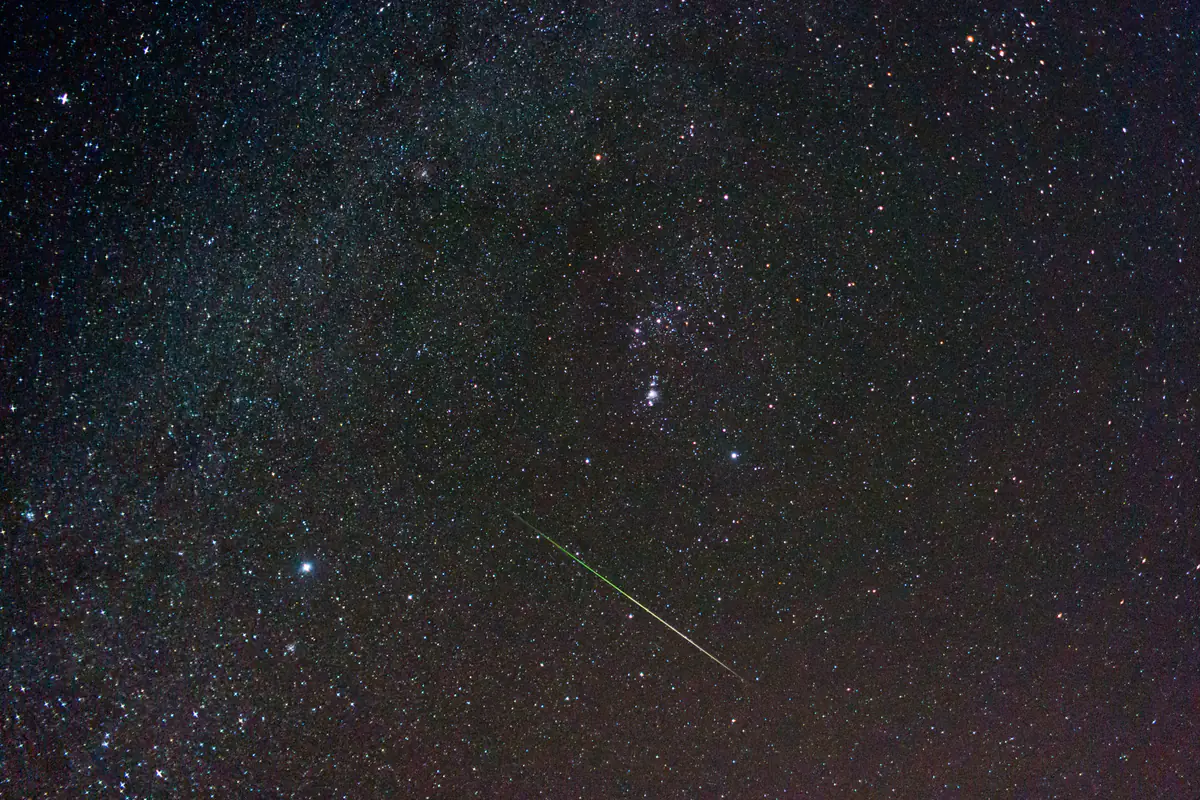
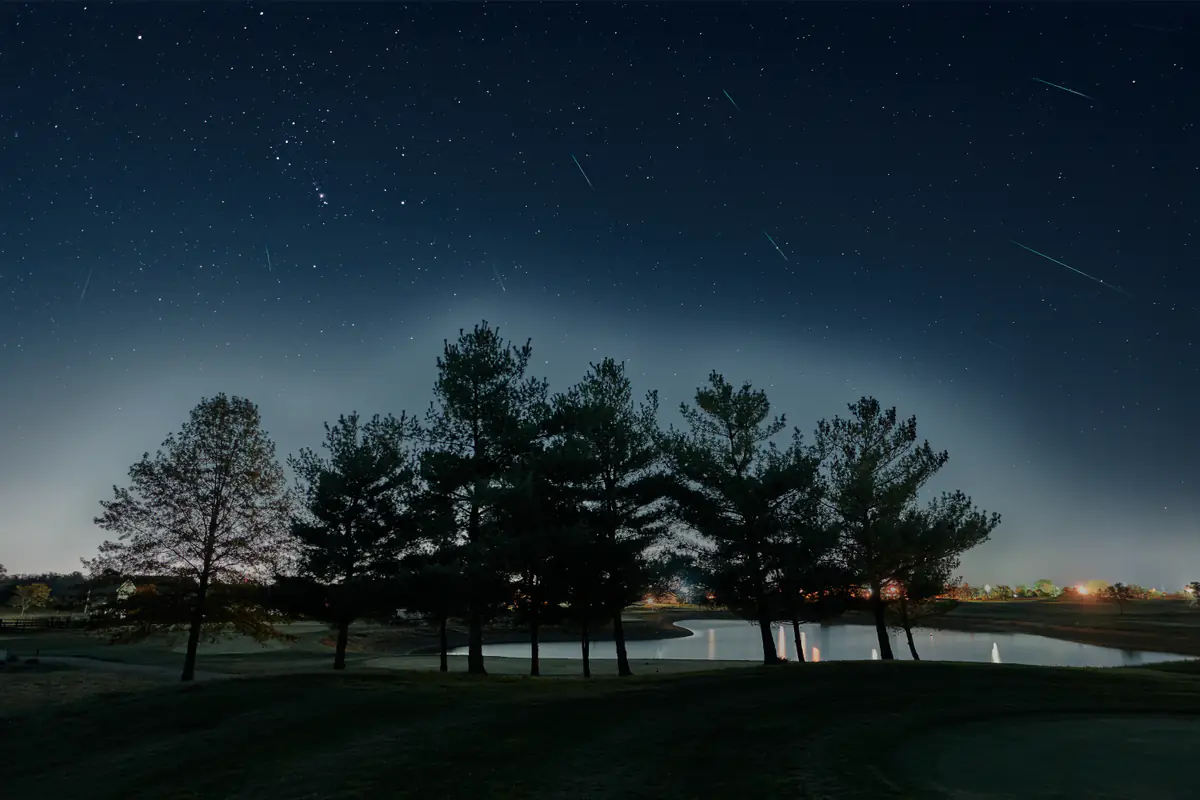
The Orionid composite below combines 19 frames picked from one night of shooting; the meteor frames were 15 seconds at ISO 800 and f/2.2, a sensible starting point.
On a phone, keep it steady on a mount, turn off the flash and try a sequence of night-mode photos. Apple says iPhone Night mode sets the exposure automatically but lets you adjust it. If you use timelapse, test how your phone saves the footage before relying on individual frames.
FAQ
What time is best to see a meteor shower?
For most showers, NASA says rates are highest in the hours after midnight and before dawn. Check local moonrise and moonset times, and when the radiant is well above the horizon. Look for a dark viewing window with little moonlight before dawn.
Can you see a meteor shower from a city?
Yes, but only the brightest meteors. If you can’t travel, find a dark rooftop or open ground with no lights shining directly at you, and save the effort for a strong shower like the Geminids.
What if it’s cloudy on the peak night?
Try the nights around it. Each shower lasts days or weeks: the Leonids run from November 6 to 30 and the Geminids from December 4 to 20. NASA describes the Geminid maximum as nearly a day wide, so December 13-14 is a solid backup.
Which meteor shower comes after the Quadrantids?
The IMO’s 2027 calendar has the Lyrids peaking on April 23, 2027, only three days after Full Moon. The Eta Aquariids peak on May 6, 2027, with a ZHR around 50 and no moonlight; they are visible only in the hours before dawn and favor latitudes south of about 40°N, including Vietnam.
Sources
These are the sources used for this article. It was last updated on Oct 21, 2026; prices and opening hours may have changed since, so please double-check before you go.
- NASA: Orionids, facts and viewing tips (page updated August 13, 2026)
- NASA: Geminids (page updated August 13, 2026)
- NASA: Leonids (page updated August 13, 2026)
- NASA: Quadrantids (page updated August 13, 2026)
- NASA: Meteors & Meteorites (page updated September 21, 2026)
- NASA: How to Photograph a Meteor Shower (November 13, 2018, updated November 5, 2024)
- International Meteor Organization: 2026 Meteor Shower Calendar, ed. J. Rendtel (PDF, read October 21, 2026)
- International Meteor Organization: 2027 Meteor Shower Calendar, ed. J. Rendtel (checked October 21, 2026)
- Korea Astronomy and Space Science Institute: 2026 astronomical almanac (December 2, 2025, in Korean)
- US Naval Observatory: sun and moon rise/set for Hanoi and Ho Chi Minh City (checked October 21, 2026)
- Vietnam Tourism (Vietnam National Authority of Tourism): A celestial journey through Vietnam (checked October 21, 2026)
- Dan Tri: Where Hanoi residents can watch a meteor shower tonight (August 12, 2026, in Vietnamese)
- VnExpress: How much is a starry night worth? (May 1, 2026, in Vietnamese)
- Light pollution map (lightpollutionmap.info): VIIRS and World Atlas 2015 layers (checked October 21, 2026)
- Apple Support: iPhone User Guide, Night mode photos (checked October 21, 2026)