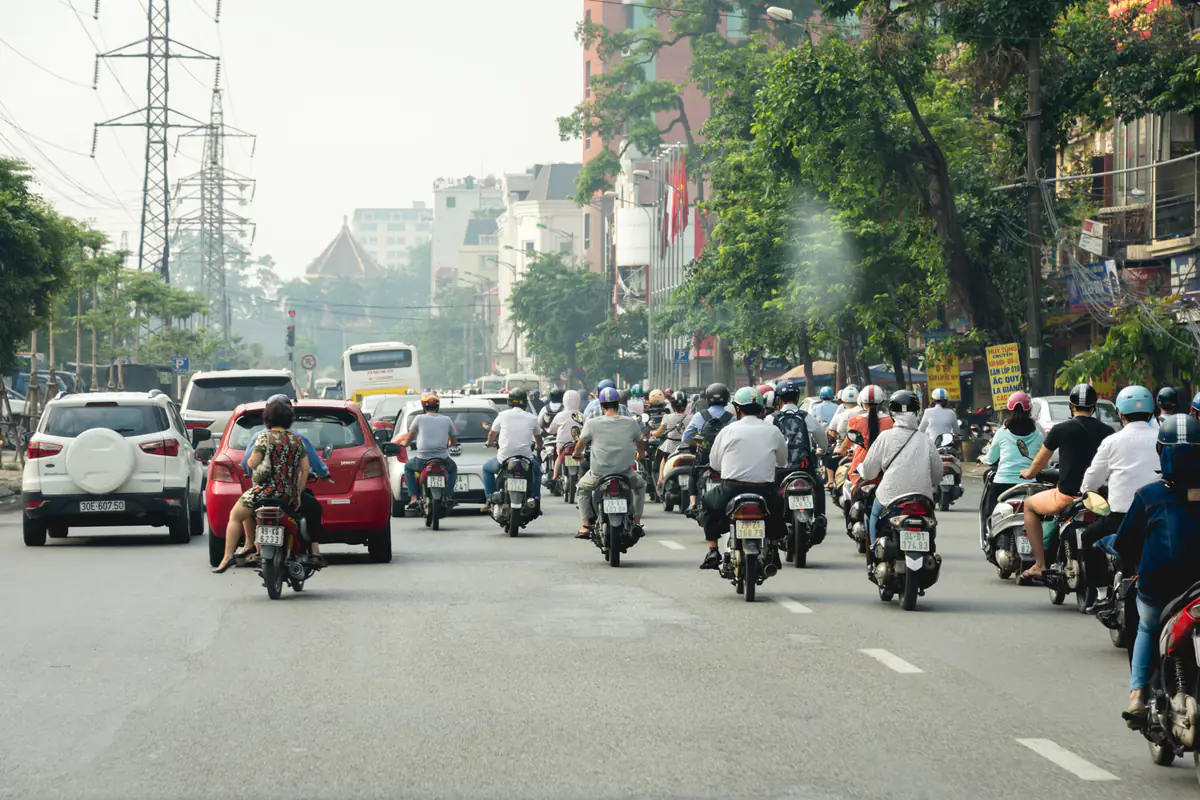
Sleeper bus Vietnam: regular or cabin, which one has a toilet?
A regular sleeper bus suits travelers who want to save money and don't mind using restrooms at scheduled stops. A cabin bus offers more privacy and sleeping space, but an onboard toilet is never guaranteed.
By Da Lat LoversPublished Updated
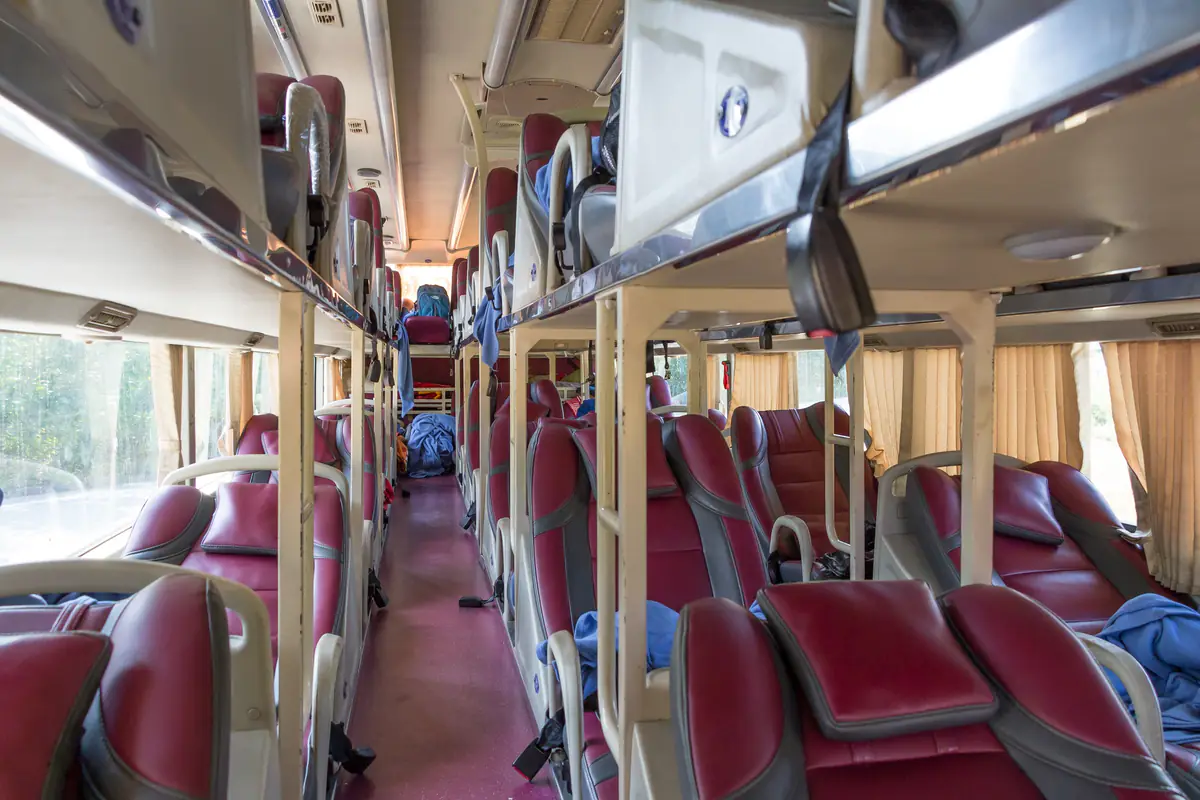
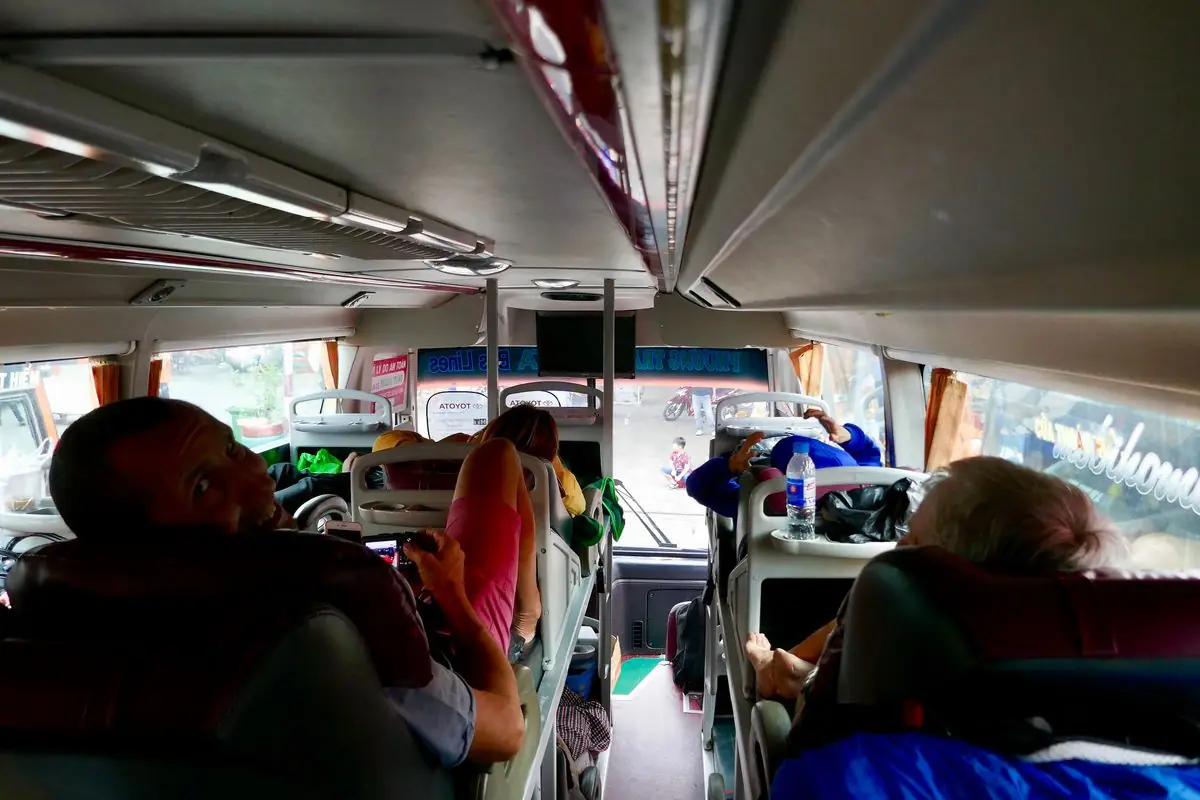
Stacked berths and an aisle inside a Thaco Mobihome sleeper bus in Vietnam.
A 40-berth sleeper bus can travel for hours without a toilet on board. Most standard sleeper buses in Vietnam do not have toilets, although some 34-berth VIP buses and premium cabin buses are equipped with them. Don't assume a bus has a bathroom just because its booking page says "VIP" or "limousine." Look for the WC symbol and confirm the facilities with the operator before booking.
What does a sleeper bus in Vietnam look like?
A sleeper bus is a long-distance coach fitted with sleeping berths or heavily reclining beds instead of conventional passenger seats. These buses are common throughout Vietnam, especially on intercity journeys that take several hours or run overnight.
On a typical Vietnamese sleeper bus, the beds are arranged in three long rows: one along each side of the vehicle and another down the middle. Two narrow aisles separate the rows.
The beds are usually stacked in two levels, with one passenger assigned to each berth.
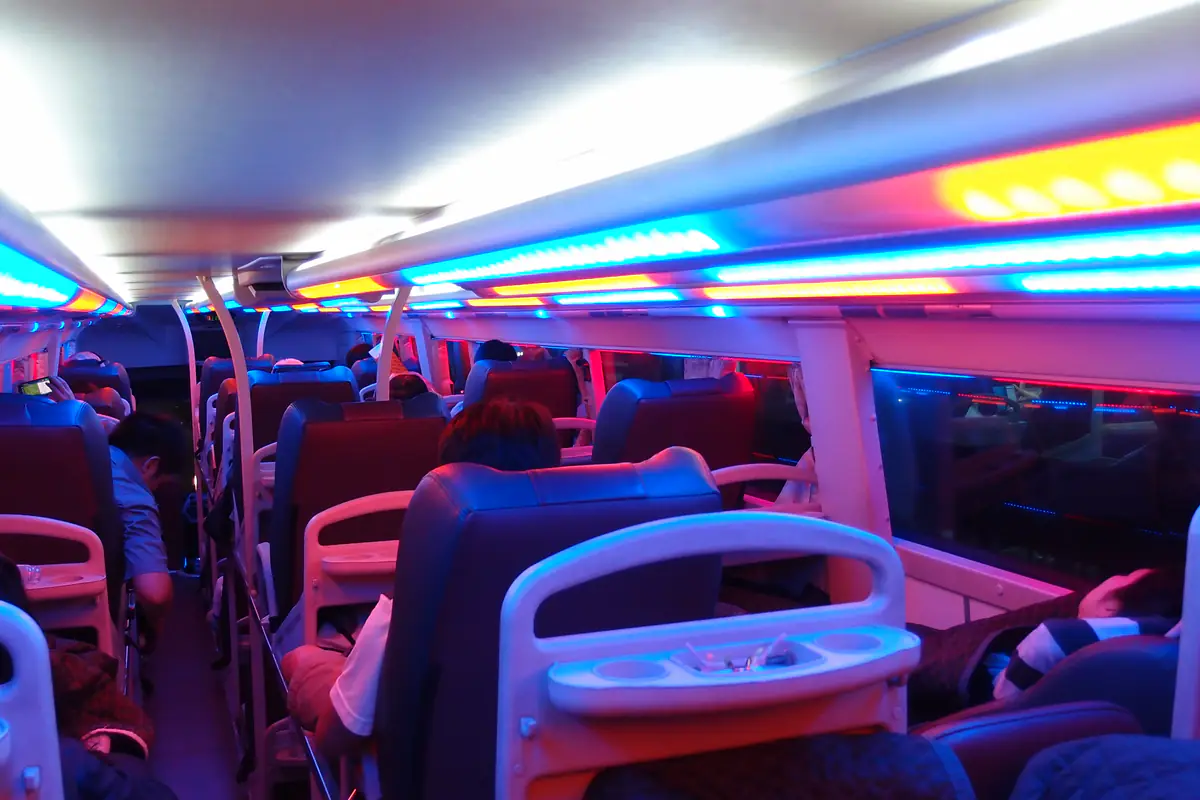
Passengers on the upper level climb a short ladder or a set of built-in steps. Those on the lower level can enter their beds directly from the aisle. Most beds face toward the front of the bus.
A standard berth generally includes a padded backrest, a recessed space for your feet, a small pillow, and a blanket. Some buses also have curtains, USB charging ports, reading lights, or personal entertainment screens.
However, a sleeper bus bed is not necessarily a completely flat mattress.
On many standard buses, the backrest remains slightly raised, and your legs extend into a narrow compartment. There may be little room to turn onto your side.
Travelers taller than approximately 180 cm should ask about bed length before buying a ticket. Some sleeper buses have fairly short foot compartments, forcing taller passengers to bend their knees.
Don't assume a more expensive cabin automatically solves this problem. Bed dimensions vary between vehicle models.
Three common types of sleeper buses
| Bus type | Typical layout | Main features | Onboard toilet |
|---|---|---|---|
| Standard sleeper bus | Around 40-44 berths | Shared cabin, relatively narrow beds | Usually no |
| VIP sleeper bus | Around 32-34 berths | Wider beds, sometimes with privacy curtains | Depends on the vehicle |
| Cabin sleeper bus | Around 20-24 cabins or berths | Partitions, curtains or doors, more privacy | Available on some buses |
These capacities describe common configurations rather than fixed categories.
Two buses advertised as 34-berth VIP sleepers can have different bed lengths, aisle widths, air-conditioning systems, and toilet arrangements.
The term limousine can also be confusing in Vietnam.
It is used for several types of upgraded passenger vehicles, including luxury seated vans and cabin sleeper buses. A listing that says "limousine" doesn't necessarily mean the vehicle has beds, private cabins, or a toilet.
Check the interior photos and seating plan before purchasing your ticket.
Do sleeper buses in Vietnam have toilets?
Some sleeper buses in Vietnam have onboard toilets, but this is not a standard feature. On buses without toilets, passengers generally use restrooms at designated roadside stops.
Some 34-berth sleepers and 21-berth limousine sleepers carry "WC" right in the vehicle type when you book. So onboard toilets are not exclusive to cabin buses.
At the same time, plenty of cabin buses operate without a toilet.
There are three situations worth understanding before you travel.
Sleeper buses without toilets
This is what you should expect from a standard sleeper bus unless the booking information explicitly mentions a bathroom.
During a longer journey, the driver typically stops at a rest area, restaurant, or roadside service station.
Passengers can get off to use the toilet, buy drinks, eat, or stretch their legs.
Depending on the route, you might go several hours between stops. Some longer journeys include one or two scheduled breaks, while others stop more frequently.
There is no universal rule that every Vietnamese sleeper bus makes a passenger restroom stop every two or three hours.
Shorter routes may not include a dedicated break at all.
If you need frequent bathroom access, ask when the bus is expected to reach its first rest stop.
Sleeper buses with onboard toilets
On buses equipped with toilets, the bathroom is generally a small compartment inside the vehicle, often toward the rear or in another designated area.
It may contain a toilet bowl, a small water supply, and a waste-storage system.
The space is much smaller than a typical public restroom.
Standing or moving around inside can be difficult when the bus travels along winding roads or over uneven pavement.
Having an onboard toilet reduces your dependence on roadside stops, but it doesn't guarantee that the bathroom will always be available.
The toilet could be temporarily out of service, undergoing maintenance, or subject to restrictions imposed by the bus operator.
Even when you have booked a bus with a WC, use a restroom before departure.
Buses with toilets that may not be available throughout the journey
This is an important detail for first-time travelers.
A photograph showing a toilet doesn't necessarily confirm that the exact vehicle operating your journey has a working one.
Before booking, ask the operator three questions:
- Does this particular departure have a working onboard toilet?
- Can passengers use it while the bus is traveling?
- Where is the first scheduled restroom stop, and approximately when will the bus arrive there?
The words "specific bus" matter.
A company may operate different vehicle types on the same route. Features advertised for one model might not be available on another.
What are rest stops like in Vietnam?
On major intercity routes, rest stops often have toilets, handwashing facilities, drink stalls, and small food counters.
Larger service areas may have both Western-style sitting toilets and squat toilets. Smaller stops can be more basic.
Bring your own toilet paper and hand sanitizer in a small bag. Don't pack these items in a suitcase stored under the bus.
When the bus stops, ask the driver or attendant how long the break will last.
Some stops are only long enough for a quick bathroom visit. There may not be enough time to order a meal or sit down at a restaurant.
Take a photo of the bus's license plate before walking into the service area, particularly when several vehicles from the same company are parked nearby.
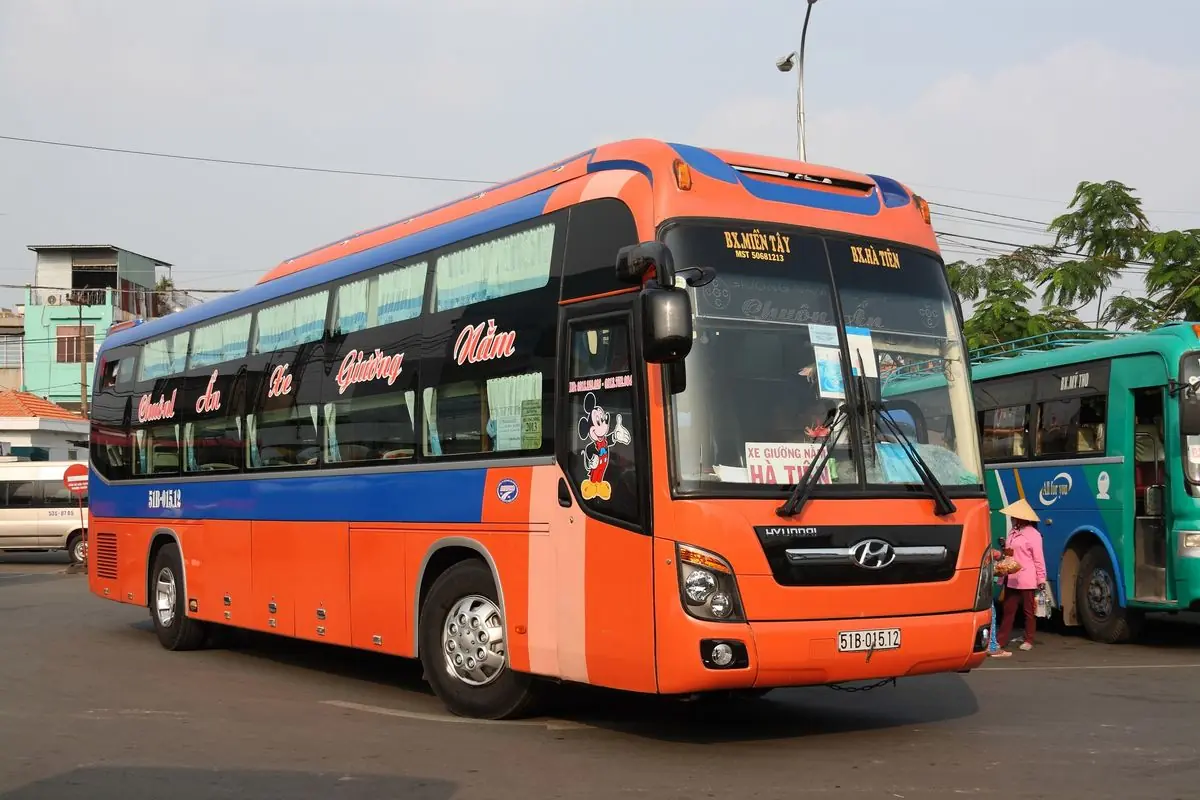
If you don't understand announcements in Vietnamese, ask a staff member directly:
"What time should I be back at the bus?"
Stay close to the service area. Rest stops can be busy at night, and finding the correct bus among several similar vehicles is not always straightforward.
Regular sleeper bus vs. cabin sleeper bus: which should you choose?
The biggest difference between a regular sleeper and a cabin sleeper is personal space, not toilet availability.
Regular sleeper bus: good enough for budget-conscious travelers
A regular sleeper bus is suitable if you are comfortable traveling by coach, don't need much privacy, and would rather spend your budget elsewhere.
You get an assigned berth, bedding provided by the operator, and a small amount of storage space for personal items.
Some standard buses have privacy curtains. Others use a more open layout where passengers can see people in the neighboring rows.
The main drawbacks are noise, light, and limited space.
On routes with several intermediate pickup points, staff may turn on lights or walk through the aisles during the night.
Passengers in berths close to the aisle may be disturbed more frequently.
Taller travelers should pay particular attention to the foot compartment. On some buses, it is too narrow to move your feet comfortably.
For a daytime journey of around four to six hours, a standard sleeper is often perfectly adequate.
You don't need to pay for a private cabin simply because you want to stretch your legs instead of sitting upright.
Cabin sleeper bus: better for privacy and overnight rest
A cabin sleeper bus has individual sleeping compartments separated by walls, curtains, or doors, depending on the vehicle.
Cabins generally offer more personal space than standard berths.
Some have reading lights, charging outlets, individual screens, and adjustable backrests.
The biggest advantage becomes apparent on longer journeys when you want to sleep.
Closing a curtain reduces light from the aisle and makes the space feel more private.
However, cabin buses are not completely soundproof.
You may still hear the engine, traffic, conversations, and announcements. You will also feel the vehicle turning, braking, and traveling over uneven roads.
A private cabin is not a miniature hotel room, either.
There is usually no room to stand up comfortably or change clothes, and the aisle remains narrow.
For an overnight journey lasting many hours, a cabin bus may be worthwhile if you struggle to sleep in shared spaces or need to begin sightseeing shortly after arrival.
What about double sleeper buses?
When booking buses in Vietnam, you might encounter descriptions such as "double sleeper," "double cabin," or "couple cabin."
These names usually refer to wider sleeping spaces, private compartments, or services marketed toward couples.
However, commercial descriptions do not determine how many people are legally allowed to occupy a berth.
Vietnam's technical rules for passenger vehicles say each sleeper berth is designed for one person and must have a suitable safety belt.
Therefore, don't assume that a "double sleeper" ticket allows two people to share one berth while the bus is moving.
Each passenger needs a legally compliant sleeping position with an appropriate restraint.
If you're traveling as a couple, book two nearby berths or ask the operator about a compliant arrangement.
Don't attempt to save money by sharing one bed simply because it looks large enough.
Travelers with children should also confirm the appropriate sleeping arrangements rather than assuming a child can share an adult's berth.
Which bunk is best on a sleeper bus in Vietnam?
For most first-time passengers, a lower bunk near the middle of the bus, away from the very back row, is a practical first choice.
This recommendation is based on comfort, movement, and ease of access. It does not mean that any particular berth is automatically safer than every other position in an accident.
Lower bunk or upper bunk?
The lower bunk is easier to access because you don't need to climb a ladder.
It is particularly convenient for travelers prone to motion sickness, those with mobility difficulties, and passengers who carry a small bag they need to access frequently.
Upper bunks have a different advantage.
On certain buses, they provide better window views and slightly more separation from people walking along the aisles.
However, you need to climb a narrow ladder or built-in steps to reach your bed.
Upper-level passengers may also notice side-to-side movement more strongly when the bus turns.
If you get motion sickness easily, choose a lower bunk.
The upper level is less practical if you regularly need to get off the bus at restroom stops or have difficulty maintaining your balance while climbing.
If only upper bunks remain available, check the steps and handholds before settling in.
Never stand on the edge of a berth or climb across another passenger's bed.
Front, middle, or back of the bus?
The middle section is generally a good compromise for travelers sensitive to vehicle movement.
The rear can feel bumpier when the bus crosses uneven roads or speed bumps.
Berths toward the back may also be close to the engine or onboard toilet, depending on the vehicle's design.
This isn't a problem on every bus, but it is worth checking when looking at the seating plan.
The front section can be convenient for passengers who want to stay near the exit.
On the other hand, you might hear conversations from the driver's area, traffic noise, or be disturbed by lights near the front.
If you get motion sickness, don't insist on booking the very first berth.
A lower bunk around the middle of the vehicle is often a better starting point.
Window bunk or middle bunk?
A window berth provides a wall on one side and usually feels more private.
Fewer people walk directly past that side of the bed, and you can look outside during daytime journeys.
On buses with three rows of berths, the middle row has an aisle on both sides.
Passengers who wake easily may find this arrangement less comfortable.
However, the middle row isn't necessarily a poor choice.
A lower berth in the middle of the bus can be more comfortable than a window berth at the very back.
Consider the bunk level, location along the vehicle, and actual layout together.
Best bunk by travel style
| Your needs | Recommended position | Why |
|---|---|---|
| Prone to motion sickness | Lower bunk, middle of bus | Often less noticeable swaying |
| Older traveler | Lower bunk | No ladder required |
| Light sleeper | Window berth, away from entrance | Less foot traffic |
| Enjoys the scenery | Upper window berth | Better views on many models |
| Tall traveler | Cabin with confirmed bed dimensions | More options for bed size |
| Needs frequent restroom access | Lower bunk with easy exit access | Easier to get off at stops |
| Traveling with a companion | Two nearby berths | Easier communication and assistance |
When booking online, look at the seating plan for your particular departure.
Don't assume that berth code A always indicates the lower level or that code B always means the upper level.
Numbering systems vary between operators.
Are sleeper buses in Vietnam safe?
Sleeper buses are permitted to operate in Vietnam when they meet the legal and technical requirements.
However, you cannot judge a bus's safety simply by whether it has beds, private cabins, or premium facilities.
Vehicle condition, maintenance, driver behavior, road conditions, weather, and proper use of safety equipment all affect the journey.
A spacious cabin with a personal screen and onboard toilet is not a substitute for a working safety belt.
Do Vietnamese sleeper buses have seat belts?
Yes. Safety belts are required for sleeper berths under the applicable vehicle standards.
The QCVN 09:2024/BGTVT standard for new vehicles requires an appropriate safety belt on every sleeper berth, with at least a two-point belt.
Commercial passenger vehicles that lack the required belts at sleeper positions can be fined.
Vietnam's road traffic law also requires passengers to fasten safety belts at equipped positions while the vehicle is moving.
Sleeper bus belts may look different from the three-point shoulder belts found in passenger cars.
Many sleeper berths use a lap belt that fastens across the hips, with the buckle positioned beside the mattress.
When you board, locate the belt and buckle before settling into bed.
Check that the belt isn't twisted, damaged, or trapped underneath the mattress. Fasten and adjust it according to the operator's instructions.
The belt should fit securely rather than hanging loosely.
If the buckle doesn't work or the belt appears damaged, ask a staff member to resolve the problem before departure.
Is it safe to take an overnight sleeper bus through mountain roads?
Sleeper buses operate on both relatively flat highways and mountainous routes throughout Vietnam.
The main difference is the road environment.
Routes approaching mountain destinations such as Da Lat or Sa Pa may include long climbs, sharp bends, and periods of fog.
These conditions can make passengers who suffer from motion sickness feel uncomfortable.
Heavy rain or poor visibility can also lead to slower travel or changes to the planned journey.
If you have never traveled through Vietnam's mountains, particularly if you get motion sickness or find it difficult to sleep in moving vehicles, consider a daytime departure.
Daytime travel doesn't guarantee safety.
Its practical advantage is that you can more easily see the surroundings, remain awake, and adjust your plans if road or weather conditions change.
Don't choose an overnight service solely because it promises a very early arrival.
Think about what you will do after getting off the bus.
Arriving at 3 a.m. may leave you searching for transportation or waiting for your accommodation to become available.
How to choose a reliable bus operator
Don't judge a company only by its average review score.
Read recent passenger reviews and pay attention to comments about driving behavior, berth condition, seat belts, pickup locations, and whether the actual bus matched the advertised type.
A company can operate several vehicles, and their facilities may not be identical.
Before booking, check the operator's name, departure time, boarding address, and vehicle type.
A booking page with a clear berth map and specific amenity information is more helpful than a generic description saying "luxury VIP sleeper."
When you board, identify emergency exits, emergency hammers, and other evacuation equipment according to the signs and staff instructions.
In a cabin with a curtain or door, make sure you understand how to open it from inside.
Keep luggage, shoes, and bulky belongings clear of the aisles and emergency exits.
If the staff attempt to assign two people to one berth or provide a sleeping arrangement that does not match your confirmed booking, ask them to resolve the issue before departure.
How to board a sleeper bus in Vietnam for the first time
Taking a sleeper bus is straightforward, but a few details differ from ordinary coach travel.
Go to the exact pickup point
Your ticket may show a bus station, a company office, or a roadside pickup point.
These are not necessarily the same place.
For example, My Dinh Bus Station in Hanoi is a major passenger terminal.
However, if your ticket gives an operator's private office address elsewhere in the city, you cannot automatically assume your bus will board at My Dinh.
Some companies provide a shuttle service from their office to the main departure location.
If your booking includes a shuttle, confirm when you need to arrive for that transfer rather than using the main bus departure time.
For first-time travelers, arriving around 20-30 minutes early is a practical precaution unless the operator specifies another time.
Save the pickup address in Vietnamese so you can show it to a taxi driver if necessary.
Remove your shoes before entering the sleeping area
Many Vietnamese sleeper buses require passengers to remove their shoes or sandals before stepping into the sleeping section.
Staff may provide a plastic bag for your footwear or show you where to store it.
Wear shoes that are easy to remove.
Trainers with complicated laces are less convenient when you have to take them off at boarding and put them back on during a short restroom stop.
Always put your footwear back on before leaving the bus.
Don't walk barefoot through a roadside service station.
Check your assigned berth
Once you board, a staff member will usually direct you to the bed number shown on your ticket.
Check the number, safety belt, and storage area before arranging your belongings.
Don't switch berths with another passenger without informing the operator, especially on cabin buses with fixed assignments.
If the bed provided is different from the type you purchased, raise the issue before departure.
Once the bus is on the road, changing beds may be difficult, particularly when the vehicle is full.
Keep valuables in your carry-on bag
Large suitcases and bulky backpacks are generally stored in the luggage compartment underneath the bus.
Bring only a small bag containing what you need during the journey.
Keep your passport, cash, phone, medication, and important documents in a zipped bag close to you.
Avoid leaving your wallet or phone loose on the edge of the mattress while sleeping.
If the operator issues a luggage claim tag, keep it until you retrieve your bag.
Check your luggage carefully before leaving the arrival point, especially when several passengers have similar-looking suitcases.
What should you pack for an overnight sleeper bus?
A small overnight bag is enough for most journeys.
There's no need to bring everything from your suitcase into the cabin. Focus on items that will be difficult to access once the bus has departed.
Toilet paper, tissues, and hand sanitizer
Keep these near the top of your bag.
Not every roadside restroom has toilet paper, soap, or a reliable handwashing facility.
A small packet of tissues and some hand sanitizer will make your stops more convenient.
Wet wipes are useful for cleaning your hands, but don't flush them down the toilet because they can cause blockages.
A light jacket and socks
Air-conditioning can feel cold at night, even when the departure city is warm.
The blanket provided by the bus operator might not cover your entire body.
A light jacket or hoodie is usually enough. Pack socks if your feet get cold easily.
There's no need to carry a large blanket because it takes up valuable sleeping space.
If you're concerned about the cleanliness of shared bedding, bring a thin personal travel liner or lightweight scarf.
Earplugs, eye mask, and neck pillow
Earplugs can help reduce disturbances from traffic, conversations, electronic devices, and other passengers.
An eye mask is useful when interior lights are switched on during intermediate stops.
A neck pillow is optional.
Many sleeper buses already provide a small pillow, and some travelers find that sufficient.
If your neck becomes uncomfortable when lying on a slightly raised backrest, an additional small pillow may help you adjust your position.
Drinking water and light snacks
Bring a small bottle of water and drink according to your needs.
Don't deliberately avoid drinking throughout a long journey simply because you're worried about bathroom access.
A more practical approach is to use the restroom before departure and avoid consuming a large amount of liquid immediately before boarding.
For snacks, choose something simple and unlikely to spill, such as crackers, a small sandwich, or dry packaged food.
Avoid meals with strong smells or large amounts of sauce.
Sleeper bus cabins are relatively enclosed, so strong food odors can disturb other passengers.
If you're prone to motion sickness, avoid a very heavy meal immediately before getting on the bus and lying down.
Power bank and offline travel information
Some sleeper buses provide USB charging ports or individual power outlets, but these don't always work reliably.
Charge your phone before departure and bring a power bank if needed.
Save your electronic ticket, operator contact details, accommodation address, and an offline map of your destination.
Mobile coverage may be weaker on remote mountain roads.
Foreign visitors should save their destination address in Vietnamese.
Showing a driver the complete written address is often more effective than giving only an English hotel name.
Personal medication
Keep prescription medication and essential personal care items in your carry-on bag.
If you often experience motion sickness, ask a pharmacist about appropriate medication and follow the instructions.
Some motion sickness medicines cause drowsiness or may not be suitable for everyone.
Don't exceed the recommended dosage.
If you start feeling unwell on the bus, inform a staff member.
Don't unfasten your belt and stand up to look for fresh air while the vehicle is moving.
What to do during an overnight sleeper bus journey
- Before departure
Before departure
Use the restroom, check your safety belt, and organize your personal belongings.
Keep your water bottle, tissues, and phone within reach, but make sure they cannot fall into the aisle.
If the vehicle has no onboard toilet, ask about the expected rest stops.
You can also ask whether the bus will pick up additional passengers during the night, since these stops may involve announcements and interior lighting.
If you plan to sleep immediately, set an alarm shortly before your expected arrival time.
The bus may reach its destination earlier or later than the timetable indicates.
- Night stop
During a nighttime rest stop
Leave your berth only after the vehicle has stopped safely and passengers are permitted to get off.
Put on your shoes and take your phone and important documents with you.
You don't need to carry every piece of luggage for a short break.
If you've been asleep, you might miss an announcement.
Ask the attendant how long the bus will remain stopped before going into the service area.
At night, use well-lit restroom facilities within the rest area.
Don't wander onto the main road looking for a shop or a photo location.
- Near arrival
When the bus is approaching your destination
The driver or attendant will usually announce the next stop or let passengers know when to prepare.
Check your pockets, bag, and bedding for your phone, passport, wallet, shoes, and smaller belongings.
After leaving the vehicle, wait for staff to retrieve luggage from the lower compartment.
Avoid standing close to the side of the bus while the luggage doors are being opened or moving into passing traffic.
If you arrive late at night or early in the morning, have your onward transport arranged or know which services are available.
Check your accommodation's check-in policy and whether luggage storage is available.
Arriving at 4 a.m. doesn't mean your hotel will let you enter your room immediately.
Sleeper bus, seated coach, or train: which is better?
A sleeper bus isn't the right option for every journey.
For a trip lasting approximately three to four hours, a reclining-seat limousine or conventional coach may be more comfortable if you dislike lying in a narrow compartment.
You can sit upright, adjust your position, and look outside more easily.
For a six-to-ten-hour journey, sleeper buses have an advantage because you can stretch your legs and rest.
However, travelers prone to motion sickness should still consider departure time and road conditions rather than assuming lying down will automatically help.
For longer overnight journeys, a cabin sleeper is worth considering if you value privacy and uninterrupted rest.
Before paying extra, confirm the bed dimensions, permitted occupancy, and availability of a toilet.
On routes served by suitable railway services, a sleeper train offers another option.
Trains provide onboard toilets, and passengers can move around within permitted areas of the train.
The facilities vary by train and carriage class, but travelers who need more predictable bathroom access may find rail travel more convenient.

When should you avoid sleeper buses?
Consider another form of transport if you cannot comfortably remain in a narrow sleeping space, have difficulty climbing, or need frequent and reliable access to a restroom.
Taller travelers should confirm actual bed dimensions instead of relying on the words "VIP" or "luxury."
Families with children need an appropriate sleeping arrangement for each passenger rather than assuming everyone can fit into one wider berth.
Travelers who get sick easily on winding mountain roads might prefer daytime departures or a vehicle that allows a more comfortable upright seating position.
A journey that leaves you exhausted can spoil your first day at the destination, regardless of how luxurious the bus looked in the booking photographs.
Six things to check before booking a sleeper bus
Once you've selected a route and operator, review these six details before paying.
- Vehicle type: Is it a standard sleeper, VIP sleeper, or cabin bus? Are the interior photos and berth layout specific to your departure?
- Toilet facilities: Is there a working onboard WC, or will passengers rely on roadside rest stops? Is the toilet available during the journey?
- Bed location: Is your berth on the lower or upper level? Is it near the front, middle, or rear? Is the bed long enough, and does it have a working safety belt?
- Boarding location: Are you departing from a bus station, company office, or roadside pickup point? Do you need a shuttle transfer?
- Departure and arrival times: When must you arrive for boarding, and when is the bus expected to reach your destination? Does the arrival time work with your accommodation plans?
- Passenger capacity: Does every traveler have a permitted sleeping position? Have you confirmed the arrangement rather than assuming a "double berth" can accommodate two passengers?
For international visitors, an operator with clear booking information and English-language support can make the experience easier.
However, an English booking page doesn't replace the need to confirm the actual pickup address and facilities of the specific vehicle.
You don't need every premium amenity.
A suitable bed, working safety belt, clearly identified boarding point, and restroom arrangements that meet your needs matter far more than an entertainment screen or a luxury label.
Choose a regular sleeper bus if you want to save money and don't mind using restrooms at roadside stops. For more privacy and better sleeping space, consider a cabin bus. If having a toilet is essential, book only after confirming that your specific vehicle has a working WC, and always check the sleeping arrangement and safety belt before departure.
FAQ
Do sleeper buses in Vietnam have toilets?
Most standard sleeper buses in Vietnam don't have onboard toilets. Passengers generally use restrooms during roadside stops. Some VIP and cabin sleeper buses, including certain 34-berth models, have onboard WCs. Always verify that the toilet is available and working on your specific departure.
Which bunk is best if I get motion sickness?
A lower bunk near the middle of the vehicle is generally the best starting point. It is easier to access and often feels less affected by swaying than an upper bunk. However, choosing a particular berth cannot guarantee that you won't experience motion sickness.
Are sleeper buses in Vietnam safe, and do they have seat belts?
Sleeper buses can legally operate when they meet the requirements. Every sleeper berth must have a safety belt, and passengers must wear it while the bus is moving. Choose an operator with clear information, check your belt before departure, and avoid getting out of bed while the bus is moving.
Can two people share a double sleeper bus bed?
Don't assume that a double sleeper or couple cabin allows two passengers to occupy one berth. Vietnam's technical rules for passenger vehicles say each sleeper berth is designed for one person. Both travelers need appropriately permitted sleeping positions with their own safety restraints.
Do overnight sleeper buses stop for bathroom breaks?
Many long-distance sleeper buses stop at roadside service areas where passengers can use the toilet and buy food or drinks. However, there is no universal stop schedule, and shorter journeys may not include a dedicated restroom break. Ask the operator about the stops on your specific service before booking.