Glamping near Ho Chi Minh City: lake, mangrove or beach for one night away?
For an air-conditioned tent with dinner cooked for you, Tri An Lake has plenty of choice, 1.5 to 2.5 hours from District 1. The cheapest option is your own tent and food, paying only for a pitch, as at the campsites on Dau Tieng Lake. Can Gio is close but means a ferry and mosquitoes; Ho Tram and Ho Coc are for beach people. Before paying a deposit, get the camp’s date-change, refund and bad-weather terms in writing.
By Da Lat LoversPublished Updated How we review
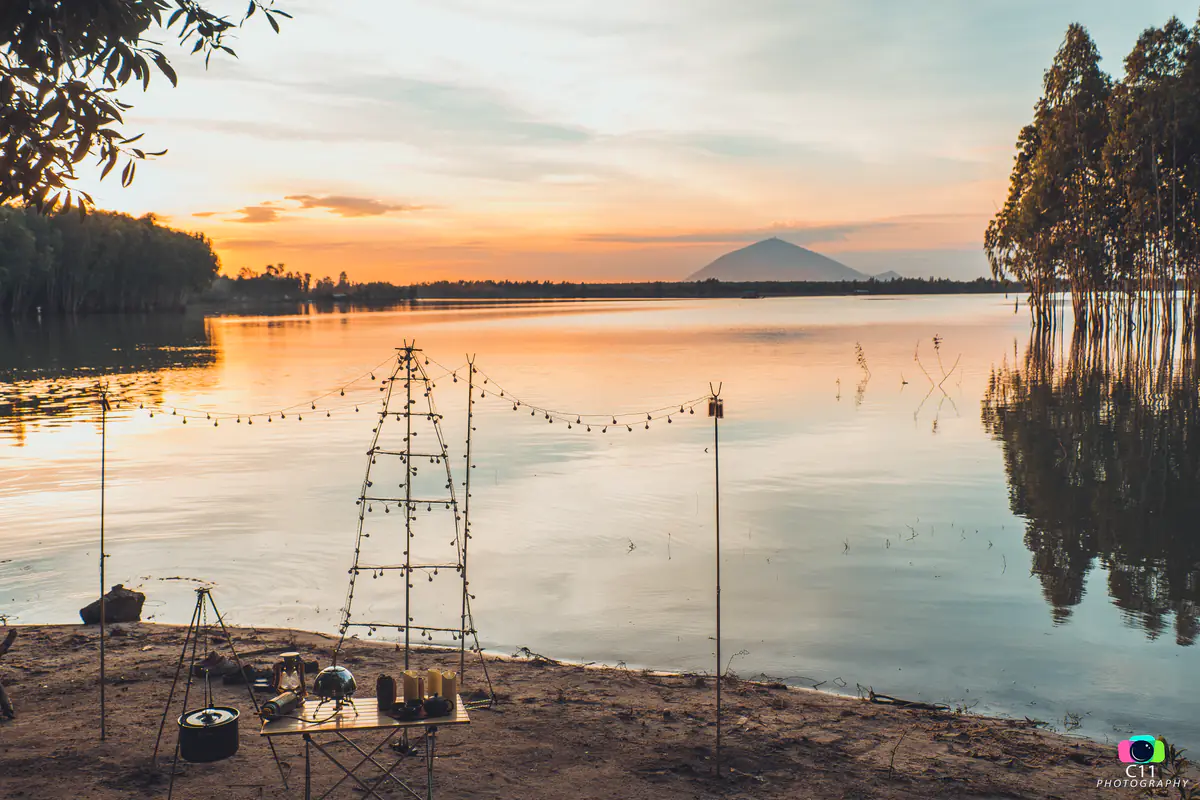
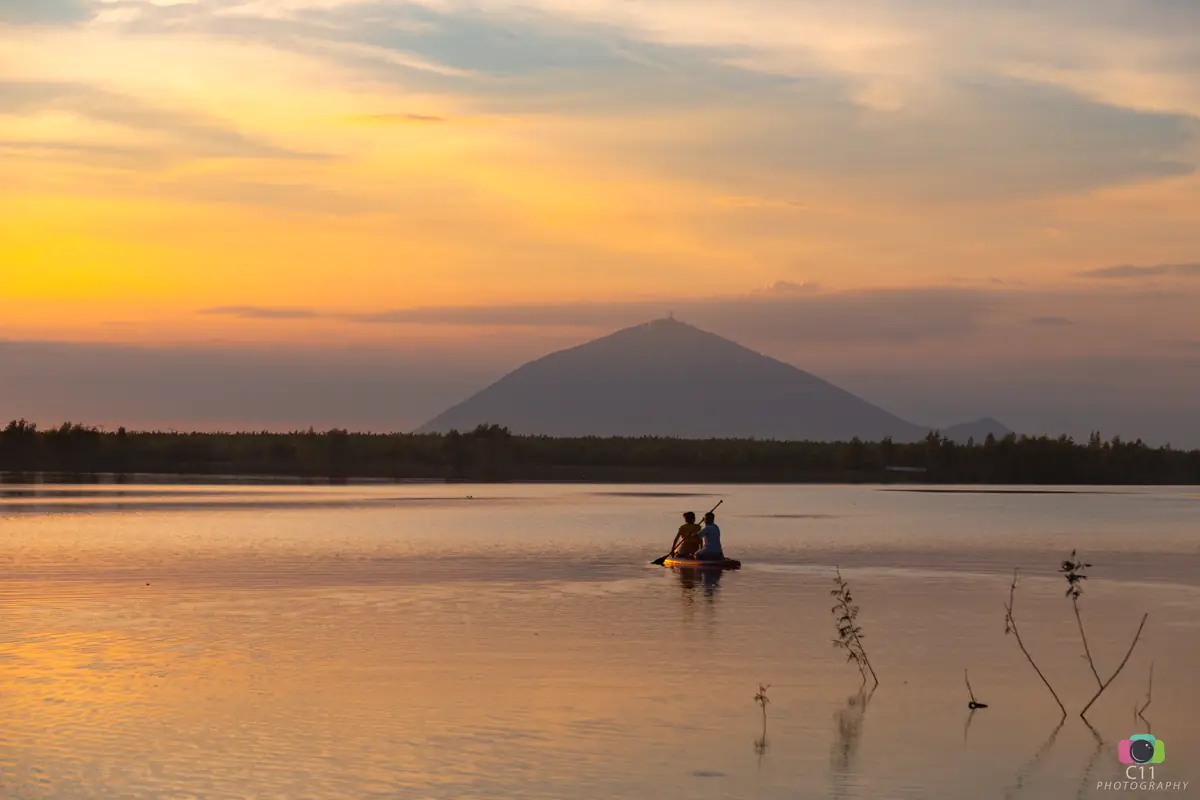
String lights, a folding table and camp cookware on the shore of Dau Tieng Lake at sunset, with Ba Den Mountain in the distance, December 2020. Photo: Cuong Tran / Public domain
Glamping near Ho Chi Minh City: which area fits your weekend?
All four areas below work as a one-night trip. What changes is the scenery, the price, and how much is done for you. Drive times are from District 1 outside rush hour; Friday evening and Sunday afternoon traffic in and out of the city can add an hour.
| Area | Drive | Typical price and what’s included | Good for |
|---|---|---|---|
| Tri An Lake (Dong Nai) | 1.5-2 h to the Ma Da side; 2-2.5 h to La Nga and Dinh Quan | Two example camps on the La Nga side: 1.79-2.39 million VND ($69-93) per adult per night, including an air-conditioned tent, private bathroom, barbecue dinner and breakfast | Couples and friends who want comfort and no cooking |
| Dau Tieng Lake | About 2-2.5 h | One camp’s price list: own tent 150,000 VND ($6) per adult; pre-pitched tent 1.2-2.4 million VND ($47-93) per tent for 2-6 people; entry included, food not | Bigger groups with gear who like to grill |
| Can Gio | About 2 h, including the Binh Khanh ferry | Roughly 250,000-700,000 VND ($10-27) per person depending on tent and package, as reported on December 30, 2025; ask for current rates | A short hop and a night in the mangroves, if you can handle mosquitoes |
| Ho Tram, Ho Coc | 2 h plus, up to 3 h in traffic | One example camp: $83 for an air-conditioned tent on Saturday Nov 7, taxes included; ask whether meals are included | A beach walk at sunrise |
Ba Den Mountain isn’t in the table because its management board is warning against unauthorized camping trips there (more below). If you just want a night under canvas without going far, the Long Phuoc area of the former Thu Duc district, a little over 20 km from the center, has a few riverside camps. Overnight packages there were roughly 360,000 to 1.1 million VND ($14-43) per person in prices reported on December 30, 2025. Expect a river and gardens, not a big lake or forest.
Getting there without a car
Public transport won’t get you close to most of these camps. Most people without a car book one through a ride-hailing app or hire a car and driver for the weekend. The ride out is easy; the ride back from a rural lakeshore at Tri An or Dau Tieng on a Sunday is harder, since few drivers are waiting nearby. Agree on a return pickup time with the same driver, or ask the camp whether it can arrange transport.
Tri An Lake: comfortable camps with meals included
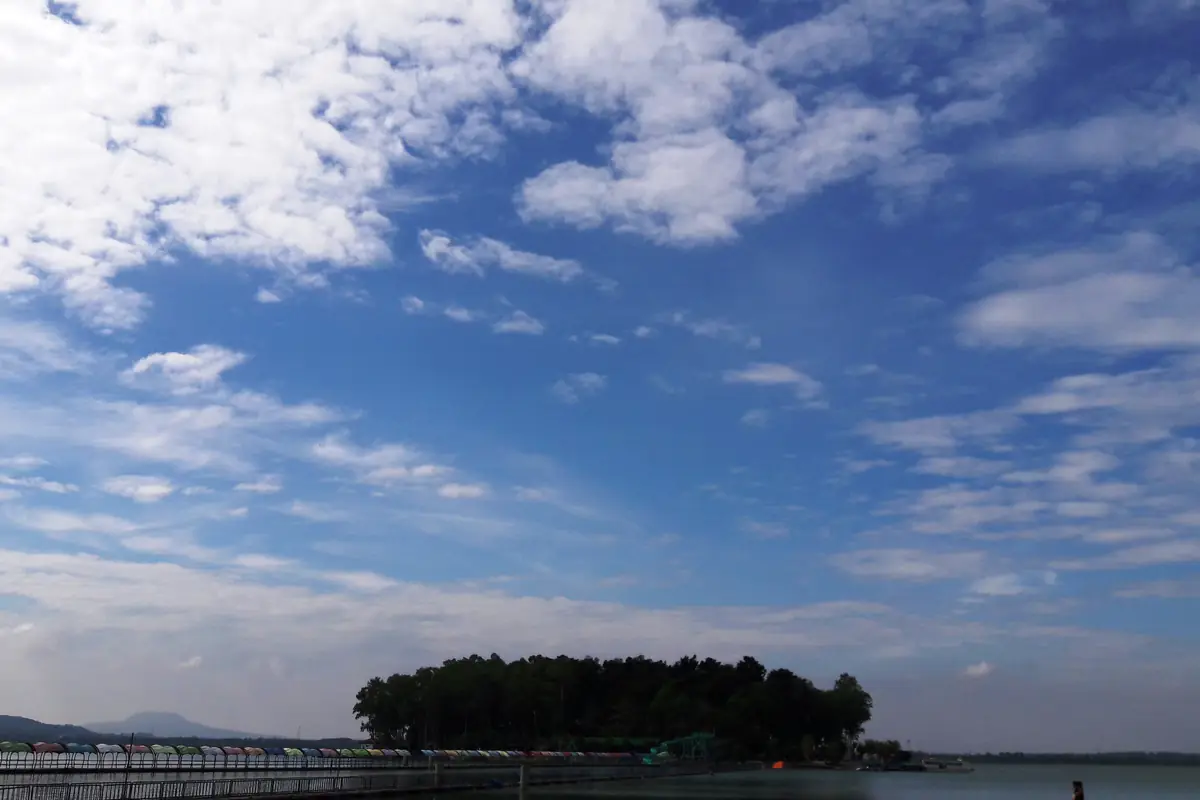
Tri An is a large hydropower reservoir ringed by low hills, forest and small islands. Camps cluster on two sides. The Ma Da side is closer to the city and has many small camps right on the water. La Nga, in Dinh Quan, is about 40 km farther, and that’s where you find camps on hilltops looking down over the lake.
On the Ma Da side, many lakeside spots sit on land leased from the nature reserve or on seasonally flooded ground, and in 2023 the authorities tore down illegal structures there, including at some campsites. If you book on that side, ask whether the camp holds a business license.
In November and December the lake is full after the rainy season. The green meadows in the middle of the lake that fill Instagram usually appear when the water drops, around May to August, so they’re hard to find late in the year. If they’re what you’re after, ask the camp for recent photos.
Prices and what they cover
Two examples on the La Nga side, both priced per adult and both including a barbecue dinner and breakfast. This isn’t a ranking; other camps may cost more or less.
- Tropical eGlamping: a sunset-facing tent with its own bathroom was 1.79 million VND ($69) on Wed Nov 4 and 2.39 million ($93) on Sat Nov 7. Tents that share a bathroom start around 1.14 million ($44). Children 6 to 10 pay half, under 6 stay free.
- Panorama Glamping: every tent has air conditioning and a private bathroom; 1.89 million VND ($73) on Wed Nov 4 and 2.39 million ($93) on Sat Nov 14. The pool and campfire are included, paddleboards and ATVs cost extra. When we checked on October 26, Saturday Nov 7 was already sold out.
Both camps take bookings through GlampingHub. Under its booking terms (checked October 26, 2026), paid bookings aren’t refunded. You can move your date once, free, with at least seven days’ notice, to a new date within 30 days and subject to availability; with less notice you lose the whole deposit. Natural disasters, epidemics or government orders get a credit or a new date, but the terms say nothing about an ordinary rainy day. These are GlampingHub’s terms only: other camps, and Panorama itself when sold on Booking.com (priced per tent), have their own cancellation rules.
Dau Tieng Lake: good for your own tent
Dau Tieng is a huge irrigation reservoir with flat water and gently sloping dirt banks; from the eastern shore you look west to the cone of Ba Den Mountain. The shore in the former Dau Tieng district of Binh Duong (now part of Ho Chi Minh City) has campsites with power, water and toilets. On the Tay Ninh side, what’s written up is mostly open ground for wild camping; we couldn’t confirm any site there with services or staff.
One example is Bang Lang Glamping in Dinh An. Its price page (checked October 26, 2026; the page carries no update date) lists:
- Bring your own tent: 150,000 VND ($6) per adult and 100,000 VND per child under 1.4 m, entry included.
- Pre-pitched tents: 1.2 million VND ($47) for 2-3 people, 1.5 million ($58) for 4, 2.4 million ($93) for a six-person yurt-style tent. Mattress, bedding, fan, light, power socket and a grill; shared toilets.
- Air-conditioned room for two with a private bathroom: 1.1 million VND ($43) Monday to Friday, 1.2 million ($47) on weekends.
- Food isn’t included. You can bring your own, or order ahead. 50% deposit. Check-in 2 p.m., check-out noon the next day.
- There’s no pool. The page says guests may swim at their own risk and can borrow life jackets for free.
- The price page doesn’t list cancellation or rescheduling terms, so ask before you pay the deposit.
With your own tent, each person pays just 150,000 VND ($6) for the pitch. A pre-pitched tent split four to six ways comes to about 375,000 to 400,000 VND ($15-16) each. Neither includes food, so don’t compare them straight against an air-conditioned tent with two meals at Tri An. You’ll need to prepare dinner and clean up yourself; if quiet matters to you, ask about quiet hours and the spacing between pitches.
Can Gio: close, but there’s a ferry and mosquitoes
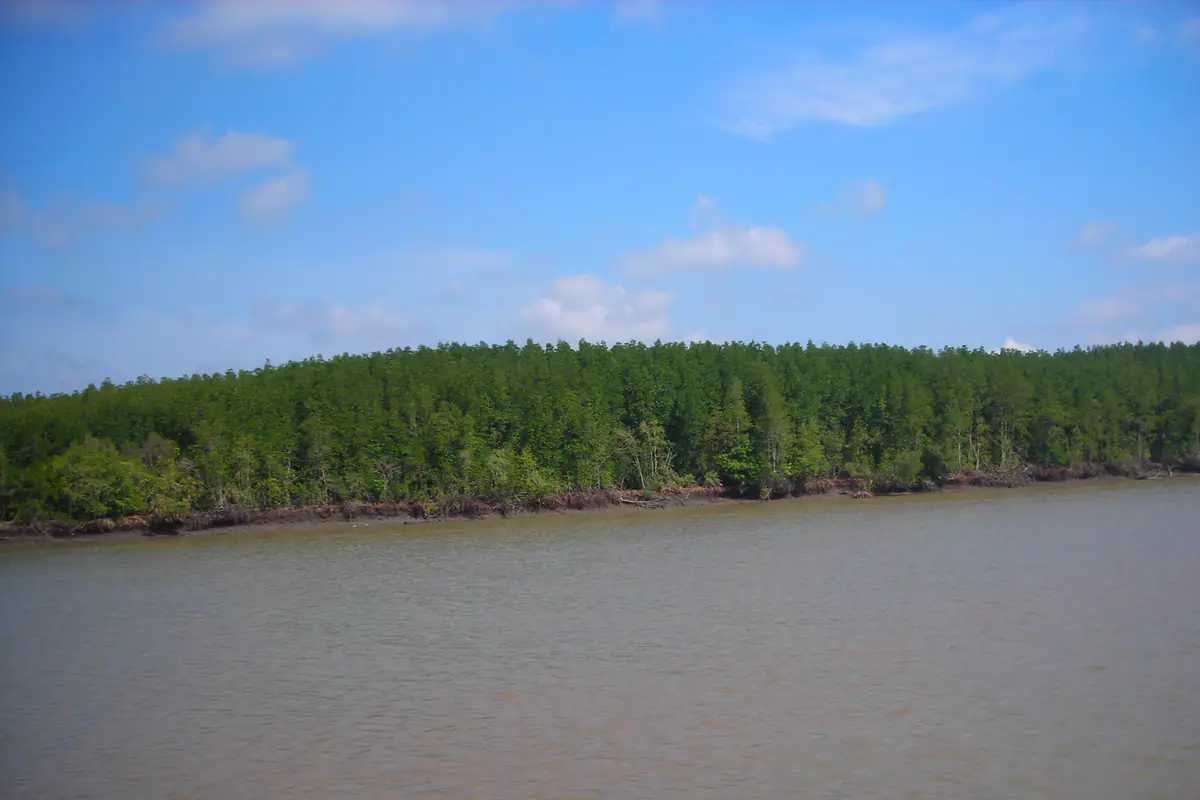
Can Gio is a coastal mangrove forest in the far south of the city. Camps sit under the trees or beside creeks along Duyen Hai road. The only road in crosses the Binh Khanh ferry, so expect queues on Saturday mornings and Sunday afternoons. The sea here is muddy brown with wide flats at low tide; it isn’t a swimming beach in the Vung Tau sense.
The latest published prices are SAY Camp Forest’s, as reported by Dan Tri on December 30, 2025: about 250,000 VND ($10) per person in a double tent if you sort things out yourself, about 550,000 ($21) per person for the full package, and 400,000-700,000 ($16-27) per person for an air-conditioned tent. Under-5s were free and 5 to 10s half price. Check-in was 3 p.m., check-out 11 a.m., with a surcharge of about 100,000 VND for bringing your own alcohol. Lata Camping, also in Can Gio, has air-conditioned tents too. Both were posting for guests in October 2026; message them for current rates.
Sleeping in a mangrove means mosquitoes, especially at dusk and in the last rainy weeks. With small children, pick a closed, air-conditioned tent and pack repellent.
Vung Tau, Ho Tram and Ho Coc: if you want the sea
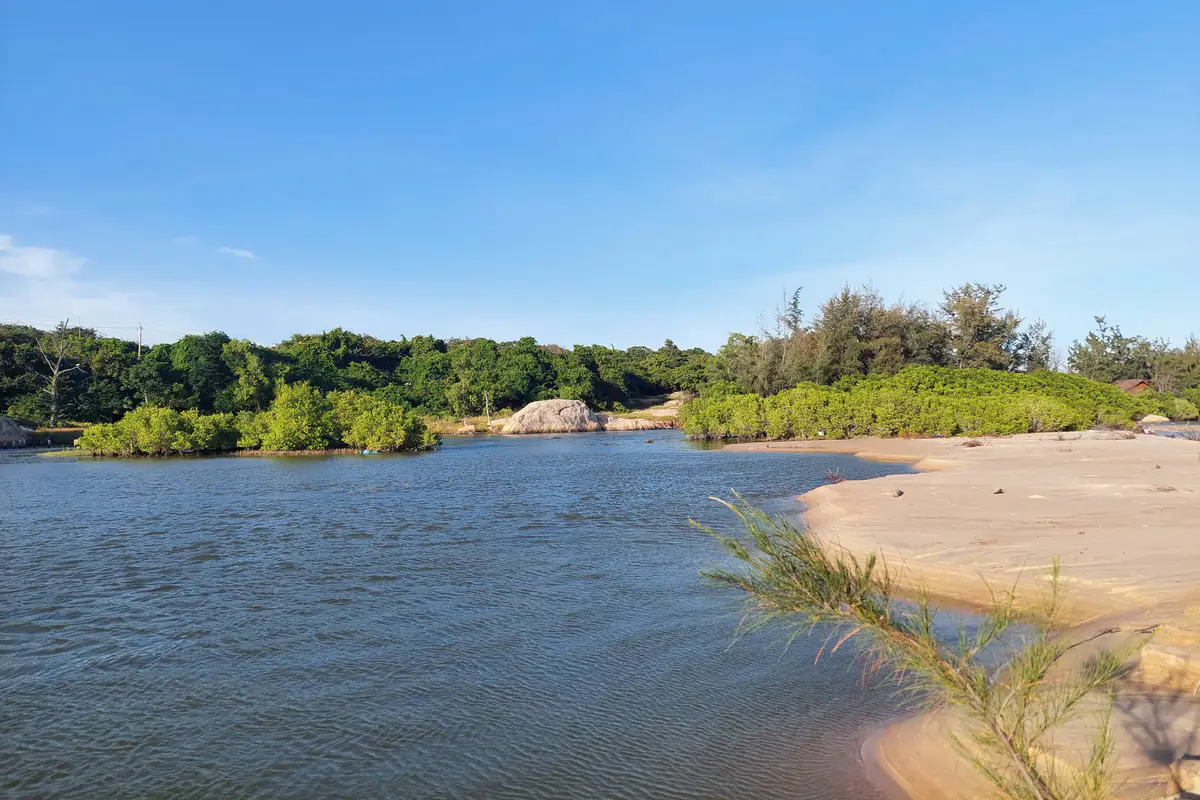
Vung Tau city itself has almost nowhere to camp. The camps are farther east along the coast road through Ho Tram, Ho Coc and Binh Chau, where coastal forest runs down to the sand. In a car, the Bien Hoa-Vung Tau expressway, open end to end since May 18, 2026, speeds up the run toward Ba Ria.
One example is Hang Soi Glamping near Ho Coc, with air-conditioned tents and private bathrooms. On October 26, a Deluxe tent for Saturday Nov 7 was $83 including taxes on Hotels.com, free to cancel until Nov 6. Those terms belong to that Hotels.com rate; other dates and channels may differ, and ask whether meals are included. On Ho Coc beach itself you can also rent a tent pitched on the sand; ask for the price.
The coast from Binh Chau and Ho Coc to Ho Tram and Long Hai is known for rip currents. Swim only where there are lifeguards and flags allowing it. Stay out where you see no-swimming signs, a patch of oddly calm water, or water that’s a different color from the rest.
Ba Den Mountain: go for the day, sleep at Dau Tieng
On August 19, 2026, the Ba Den Mountain tourist area management warned against anyone advertising, taking bookings for or leading trekking and paid camping in areas and on routes that aren’t approved, and said it doesn’t partner with anyone offering them. Organizers who run tourism in a forest without the forest owner’s permission can be fined under Decree 146/2026.
So skip the “overnight camping on the mountain” trips sold on social media. If you want the mountain and a tent, go up during the day by cable car or on the tourist area’s own routes, then sleep at a camp on Dau Tieng Lake, where many spots look straight at the peak.
Bringing your own tent: where can you pitch?
Glamping here means a pre-pitched tent with real beds, usually air conditioning, a bathroom and meals in the price. Camping means you bring the gear and pay for a pitch at a site with toilets.
For Dau Tieng and the Ho Tram and Ho Coc beaches we haven’t seen any rule that spells out where camping is or isn’t allowed, so don’t assume any empty patch of shore is fine. At Tri An, the lakebed and islands are managed by the nature reserve. The safe approach:
- Pitch at a fee-paying site with staff and toilets, and ask separately whether there’s a solid building to shelter in during a storm.
- Before pitching a tent, confirm with the landowner or site operator that camping is allowed there. If it’s unclear who manages the land, choose a site with an operator; if there’s a no-entry sign, move on.
- In the rainy season, don’t camp on exposed lakebed or right at the waterline; water levels can rise overnight.
- Light fires only where the site allows, and take your trash home.
Rainy season or dry season?
This year forecasters expect the southern rainy season to end in the first half of November 2026, though November may still see 7-15 rainy days and December 4-10. Late-season rain mostly comes as short afternoon or evening thunderstorms with lightning and gusts.
- November: full lakes and green hills. You may still get an afternoon storm, a slippery dirt road and a cancelled campfire.
- December to April: dry, with December and January nights the most comfortable. By March and April days are hot; a tent without air conditioning is hard to nap in, and dry sites get dusty.
- Late-year storms: rarely hit the south directly, but it can happen. A few days out, check the national weather service; if a storm or depression is heading for the south, move your dates under the terms you agreed with the camp.
Safety: lake swimming, lightning, bugs
Swimming and paddleboarding
A reservoir isn’t a pool: the bottom can drop off suddenly, there may be submerged stumps, and you shouldn’t assume there’s a lifeguard. If you do go in:
- Wear a properly fitted life jacket when paddling or getting into the lake, even if you can swim.
- Ask the camp where you’re allowed in. Go in only in permitted areas with someone supervising, and stay out wherever there’s a no-swimming sign.
- Don’t judge the whole area by how shallow it is near the shore.
- Children: no lake swimming without a lifeguard. If the camp has a pool, use that, with an adult right there.
- No swimming after drinking or after dark.
- Get out of the water at the first thunder.
Thunderstorms
An open lakeshore is a lightning target. When a storm comes in, leave the water and open ground for a solid building or a closed car. A tent offers no protection, and neither does a lone tree. Gusts can flatten tents and drop dead branches, so don’t pitch under big limbs.
Mosquitoes and other bugs
The rainy season is also dengue season in southern Vietnam. Use repellent, wear long sleeves after dark and keep the tent zipped. Shake out your shoes in the morning; ants and centipedes like them.
Before you pay: what to ask the camp
Many camps take bookings over Zalo or Facebook Messenger, mostly in Vietnamese, and ask for a 50% deposit or full payment by bank transfer. A translation app is fine; just get the answers in writing:
- Rain and weather warnings: can you change the date or get the deposit back, how much notice they need, how far out you can move it, and what they do when a storm warning is issued. Ask too what happens if you’re already there and rain wipes out the barbecue or campfire.
- Bathrooms: private in the tent or shared, hot water or not, and how far from your tent.
- Power: all night or evenings only, whether the air conditioning runs all night, and whether there’s a socket in the tent.
- Food: which meals are included, whether you can bring your own food and beer, any corkage fee, and vegetarian or kid-friendly options.
- Per person or per tent, how children are charged, and how much more Saturdays and holidays cost.
- Check-in and check-out (usually 2-3 p.m. and 11 a.m.-noon), and quiet hours.
- Access: is the last stretch a dirt road, and can a car get through after rain?
- Safety: life jackets, anyone watching the swimming area, and a business license.
Booking a Saturday
FAQ
Do glamping sites near Ho Chi Minh City speak English?
Some reply in English, many don’t. Booking platforms such as Booking.com or Hotels.com list a few camps in English; otherwise message in Vietnamese with a translation app and keep the confirmation in writing.
Can I pay by card?
If you book through Booking.com, Hotels.com or a camp’s own site, check whether payment is collected online or by the property, when it’s due, and which methods are accepted. Smaller camps usually want a Vietnamese bank transfer for the deposit, so ask whether they accept card or cash on arrival if you don’t have a local account.
Can I bring my dog?
It depends on the camp. Some only allow pets in set areas for a fee, others don’t allow them at all. Ask before booking, especially for air-conditioned tents.