Allow 5-6 hours to reach Da Lat from Hoi An by air
If you are in Hoi An and want Da Lat without an overnight bus, look for a nonstop flight from Da Nang first. Allow 5-6 hours to reach your accommodation, then consider the road if the flight dates fail or you want a Nha Trang stop.
By Da Lat LoversPublished Updated

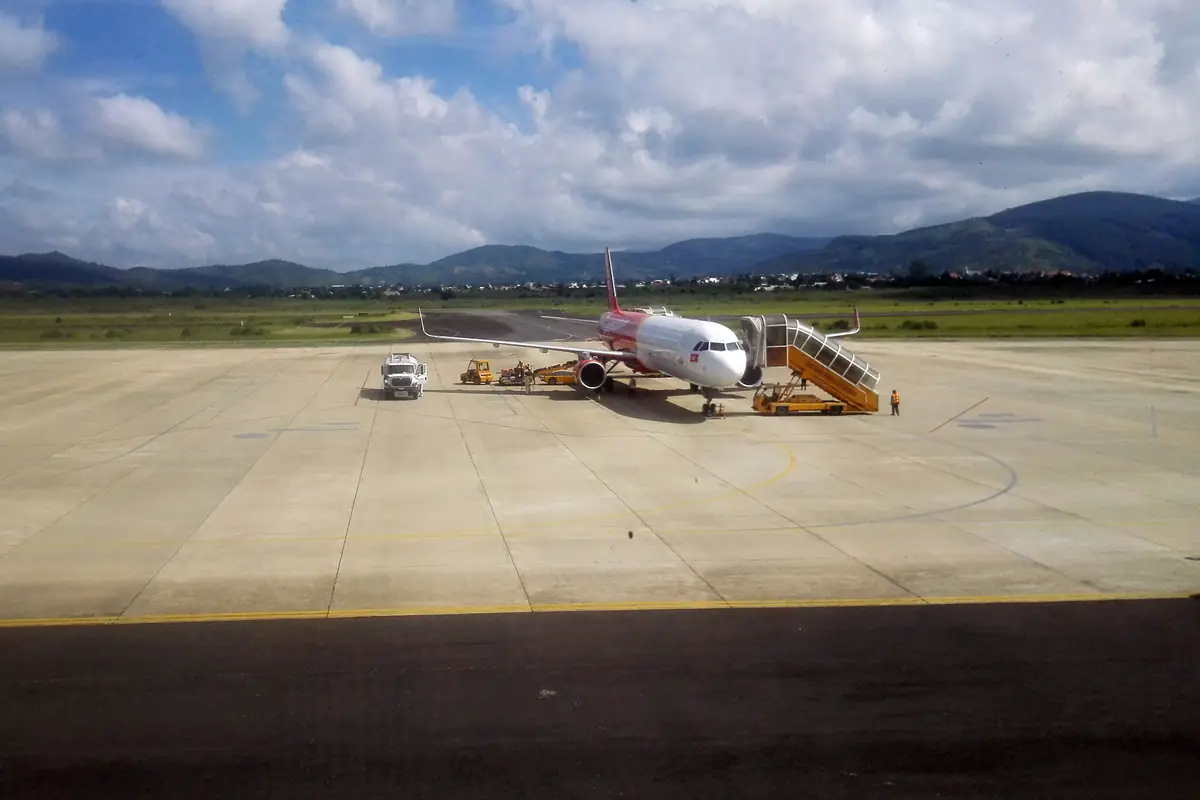
A Vietnam Airlines aircraft at Da Nang Airport.
“Can I fly straight from Hoi An (Hội An) to Da Lat?” You first need a car to Da Nang (Đà Nẵng) Airport, then a flight to Lien Khuong, the airport serving Da Lat (Đà Lạt). We would take that option on most short vacations. The flight is a little over an hour, but the whole move needs half a day.
Start with the nonstop flight dates
For Hoi An to Da Lat, the first decision is whether a nonstop flight works on your date. Find it before buying a nonrefundable Da Lat room.
| Option | Time to allow | Best reason to choose it |
|---|---|---|
| Fly from Da Nang | 5-6 hours from Hoi An to a Da Lat hotel | Preserve time and energy |
| Sleeper bus | An overnight journey; allow 13-18 hours depending on the ticket | Lower spending matters more than comfort |
| A night in Nha Trang | Two travel days with a proper bed between them | You actually want to stop there |
| Private car with driver | Better split across two days | Your group wants stops along the coast |
A flight connecting through Ho Chi Minh City (Thành phố Hồ Chí Minh) may lose much of the advantage. Compare its full duration with staying another night in Hoi An to catch a nonstop. One ticket’s advertised journey time is not the whole move.
Flying means two road transfers as well
Da Nang (DAD) to Lien Khuong (DLI) has nonstop service, but do not assume it operates every day. Allow around 1 hour 20 minutes for the flight and search your date on Vietnam Airlines or Vietjet. Compare tickets with equivalent baggage and change conditions.
We would allow about an hour by car from Hoi An and aim to reach domestic departures about two hours before the flight. Add time for heavy traffic or rain. After landing, baggage collection and the drive into Da Lat still come next; Lien Khuong is roughly 30 km from the center. The 5-6 hours in the title assumes normal operations.
For a first budget draft, assign VND1.5-2.5 million per person to the one-way flight and VND1 million per car in total for the two airport transfers. These are allowances, not quoted fares. Replace them with the airline’s final price and a transfer quote. Two travelers can split a car, but each needs a flight ticket.
For a worked example, imagine a flight departing at 2 p.m.; this is an illustration, not an advertised service. Leave Hoi An at 11 a.m., reach the airport around noon and fly from 2 to 3:20 p.m. Allow until about 4 p.m. to collect bags, then roughly another hour to reach your accommodation. You have used six hours without a particularly long flight. Leave that evening flexible instead of booking a prepaid activity immediately after arrival.
Tell the transfer provider both the passenger count and the number of suitcases. Enough seats do not necessarily mean enough luggage space. Ask whether airport access fees and baggage-collection waiting are included. Give each provider the same pickup and drop-off addresses so that the quotes cover the same journey. A cheaper car that cannot take your bags is not a usable comparison.
For example, two travelers each buying a VND1.5 million flight and sharing VND1 million in total car costs would spend VND4 million together, or VND2 million each. That is arithmetic using the planning assumptions, not a package offer. It stops applying if you take separate cars or book different flights.
A through bus ticket may involve a change
Ask whether you stay on the same bus, whether pickup is actually in Hoi An, and what happens to the onward leg if the first bus runs late. A ticket labeled Hoi An - Da Lat does not answer those questions. A direct departure from Da Nang also needs a separate trip from Hoi An to its pickup point.
The Sinh Tourist’s timetable lists separate Hoi An - Nha Trang and Nha Trang - Da Lat legs. Even when they line up, you travel overnight and arrive the following day. Use 13-18 hours as a planning range for the long bus journey, and get the actual scheduled arrival from your operator. Road disruption can make it longer.

We would choose the sleeper only if you sleep reasonably well on buses and have no fixed plan immediately on arrival. Ask about berth seat belts, luggage storage and the drop-off address, not just the cabin photos.
Read departures after midnight against the actual ticket date. A 12:30 a.m. Friday departure means being ready to leave your accommodation on Thursday night, not Friday night. Save the pickup address and the service’s contact number as well as the route name. If you bought a connection from one seller, ask who you contact if the first leg arrives too late. A single payment does not, by itself, explain how that seller handles a missed bus.
A night in Nha Trang makes the road option easier
Book two separate legs if you want dinner, a shower and a real bed before the climb into the highlands. Reach Nha Trang by bus from Hoi An or by train from Da Nang. The main north-south railway does not continue into Da Lat. Choose a departure on Vietnam Railways before reserving the room.
A predawn arrival does not give you immediate access to a room booked for that afternoon. Arrange early check-in or reserve from the previous night if you need to sleep. Take the mountain transfer the next morning and allow at least half a day: the scheduled bus leg is around four hours, with extra time possible for road holds.

For a real overnight break, choose an arrival that leaves time for dinner and sleep before the next morning’s mountain leg. Reaching Nha Trang before dawn and continuing immediately is a vehicle change, not a restorative hotel night. Compare those as different itineraries. On a short vacation, the version with a proper stop may be pleasant but still use too much of the trip; leaving Da Lat for another visit can be the better choice.
Heavy rain can change the route
Central Vietnam floods can disrupt roads, railways and flights. Khanh Le Pass on National Route 27C is exposed to landslides and can have traffic restrictions. A route still appearing on a map does not mean it is open at every hour.
Before booking the mountain leg, have the operator confirm its road, permitted travel window and closure policy. If the national forecast service warns of heavy rain, flooding or landslides on your route, postpone the pass journey instead of finding a smaller vehicle to get around restrictions. Flying reduces the long road journey but can also be delayed by weather.
A private car earns its price through the stops
A car with a driver suits a group that wants coastal stops, has substantial luggage or wants fewer vehicle changes. We would split the trip across two days. Treat it as a long-distance booking, not an ordinary city taxi ride.
Get one total covering tolls, fuel, waiting, the driver’s meals and accommodation, and any return-trip charge. Agree what happens if the mountain road closes. Compare that with flights and airport cars for the whole group; there is no universal group size at which the car becomes cheaper.
Leave half a day for the return direction too
Search Lien Khuong - Da Nang for your actual date, then add both airport rides. Do not infer the return departure from the outbound schedule. Let your Hoi An accommodation know if you will arrive late.
Via Nha Trang, choose a daytime mountain departure when the road permits it, then fit the onward service around that. Leave an overnight buffer before an important international flight, rather than putting a long pass journey immediately before it.
FAQ
Does Hoi An have an airport?
No. Travel by road to Da Nang Airport, then fly to Lien Khuong for Da Lat.
Can I take a train all the way from Da Nang to Da Lat?
No. Take a mainline train to Nha Trang, then continue by road into the highlands.
Is the flight itself five or six hours?
No. That is the planning time from Hoi An to a Da Lat hotel, including airport rides, check-in, the flight and baggage collection in normal conditions.