Da Lat pink grass hill guide: 2 best areas and when to take photos
Da Lat's pink grass is usually at its best from late November to early December, and the color shows most clearly between 5:30 and 7:30 AM. Golden Valley is the easy choice for a first visit, while Suoi Vang near the Lonely Pine Tree has more open scenery and a harder final stretch.
By Da Lat LoversPublished Updated
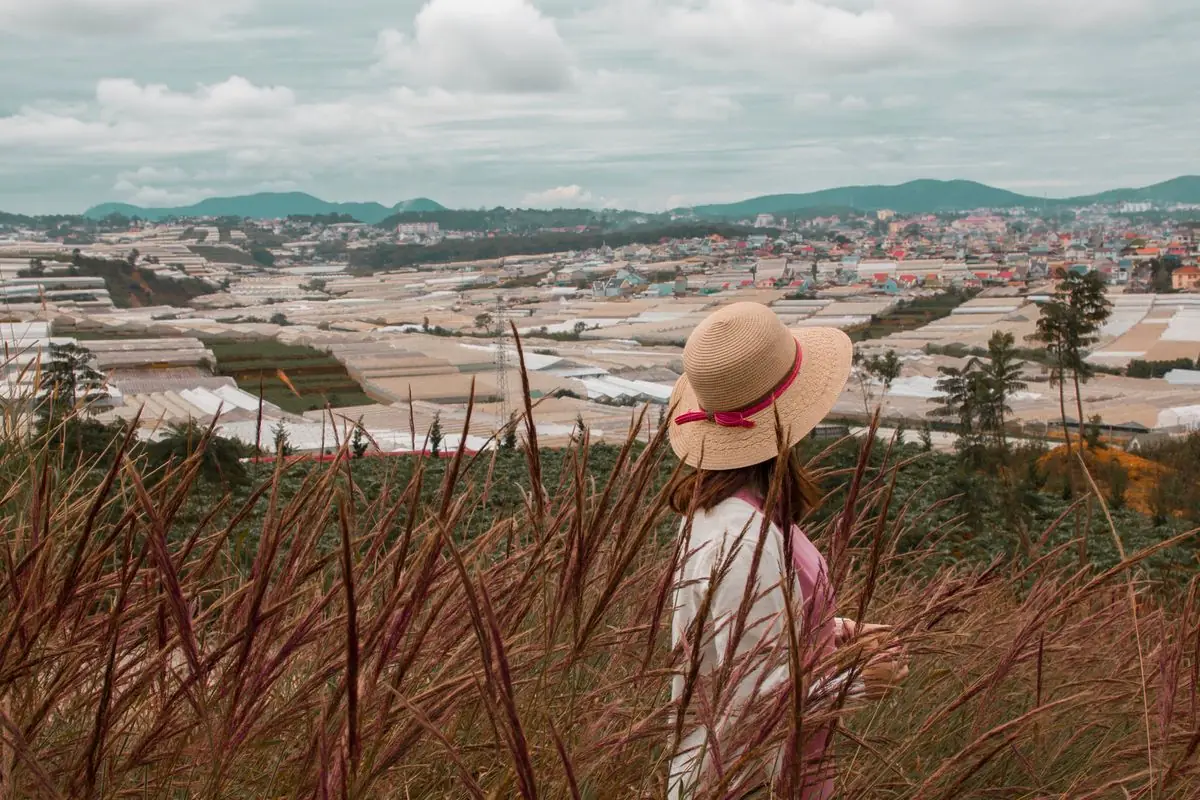
Start by choosing the right week. Late November to early December is usually the best time to see the pink grass hills in Da Lat, although the exact timing changes every year. The two areas worth checking first are Golden Valley (Thung Lung Vang) and Suoi Vang near the Lonely Pine Tree, both northwest of the city along Ankroet Road. For the best pink tones, aim to be on the hillside between 5:30 AM and 7:30 AM, provided you have confirmed that the access route is open and safe.
When is the best time to see pink grass in Da Lat?
Pink grass in Da Lat usually begins appearing in late October or early November. The color becomes more noticeable during November, and some hills remain pink well into December.
The grass does not flower on a fixed schedule.
Unlike flowers grown in managed gardens, pink grass grows naturally across open hillsides and forest clearings. Its appearance depends on rainfall, sunshine, temperature, and soil conditions.
In some years, the hills are already covered in pink by late November. In others, the most impressive colors do not appear until December.
In 2024, Golden Valley already had wide carpets of pink grass by November 25. In the 2025 season, after a prolonged rainy period, hills around Suoi Vang and Golden Valley were still showing attractive colors in mid-December.
That is why last year's photographs are not a reliable calendar for this year's trip.
Which month should you choose?
| Period | What to expect | Recommendation |
|---|---|---|
| Late October | Pink tones may begin appearing in a few areas | Visit only after checking recent photos |
| Early November | More hills begin changing color | Possible, but coverage may be patchy |
| Mid-November | Pink grass becomes more visible | Worth considering |
| Late November | Often one of the most attractive periods | Recommended |
| Early December | Many hills may still have strong pink colors | Highly recommended |
| Mid-December | Some areas remain beautiful while others begin drying | Check current conditions |
| Late December | Grass may turn brown or become sparse | Do not expect peak conditions |
This table is based on the general pattern of previous seasons. It is not an exact flowering forecast for 2026 or future years.
Travelers booking flights and hotels months in advance should leave one morning flexible. Once you arrive in Da Lat, you can choose the best day based on the weather and recent grass conditions.
This is better than planning everything around one fixed morning.
How long does the pink grass season last?
The overall season may last around one to two months, but an individual hillside does not necessarily stay beautiful throughout that period.
At the beginning of the season, pink patches appear among green grass.
When the grass reaches its most attractive stage, the small pink-purple seed heads form soft-looking carpets across the slopes.
Later, the grass ages, turns pale brown, and loses much of its delicate appearance.
Rain also changes how the landscape looks.
A hillside can be covered in pink grass but appear gray in photographs when the sky is overcast and the light is flat.
To judge the current situation, look for photographs taken within the previous three to seven days. Make sure the photographer identifies the specific location rather than simply labeling the image "Da Lat pink grass."
Is pink grass the same as snow grass in Da Lat?
Yes. The terms usually refer to the same grass under different morning conditions.
In Vietnamese, pink grass is called cỏ hồng, while cỏ tuyết means snow grass.
Snow grass describes the frosty-looking appearance created when morning dew covers the pink grass. It is not a separate type of grass.
The plants are relatively short, growing in small clumps with delicate leaves and fine flower or seed heads.
Up close, you can see shades of pink, purple, and light brown.
From a distance, those individual plants blend into a soft pink carpet.
Early in the morning, dew settles on the fine grass heads and makes the hillside look silver-white.
As the first sunlight reaches the slope, the droplets begin to sparkle, creating an effect that resembles a thin layer of snow.
Once the dew evaporates, the pink and purple tones become easier to see.
This explains why photographs of the same hillside taken at 5:45 AM and 7:00 AM can look completely different.
Pink grass versus pink foxtail grass
Another thing worth checking is the type of grass shown in photographs.
Da Lat also has areas with taller pink foxtail-like grass, which has larger, fluffy flower heads.
These plants can produce beautiful photographs, especially when backlit, but they do not create the same low, continuous pink carpet found around Suoi Vang.
When comparing photographs, look at the height of the grass relative to someone's shoes or ankles.
If the flower heads reach well above the knees, you are probably looking at a different type of grass.
This small detail can save you from booking transport to the wrong place.
Where are the pink grass hills in Da Lat?
There is no single attraction officially known as the Da Lat Pink Grass Hill.
Pink grass grows naturally on several hillsides, especially where open grassland meets pine forests.
The two best-known areas are Golden Valley and Suoi Vang near the Lonely Pine Tree, northwest of central Da Lat.
Following the administrative changes in 2025, the former Lat Commune area belongs to Lang Biang - Da Lat Ward, Lam Dong Province.
Older maps and travel articles may still use the former Lac Duong District address. The familiar attraction names are generally more useful when searching for directions.
Golden Valley pink grass hills
Best for first-time visitors, about 12-15 km from central Da Lat
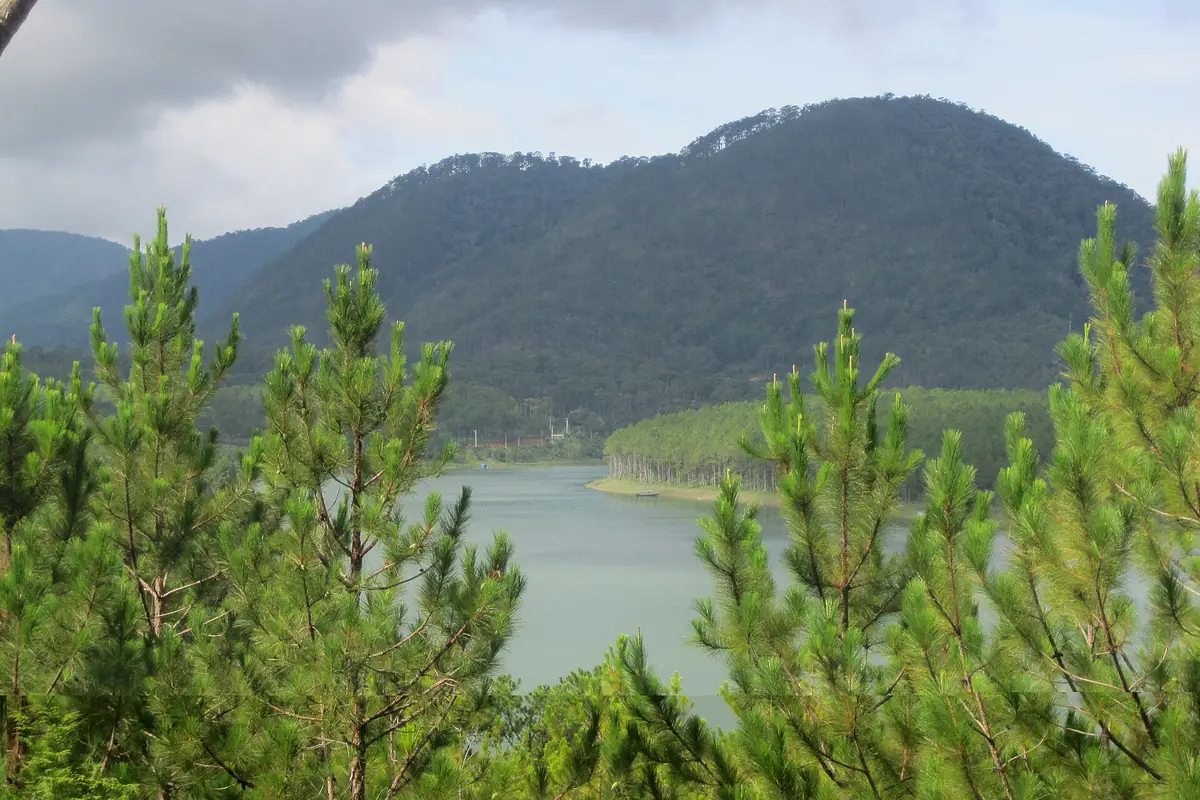
Golden Valley, known locally as Thung Lung Vang, is located along Ankroet Road near Dankia - Suoi Vang Lake.
It is approximately 12-15 km from central Da Lat, depending on your starting point.
This is the area to consider first if you have never visited Da Lat's pink grass hills.
Around Golden Valley, gently sloping hillsides are mixed with pine trees and open grassland.
During a good season, pink grass forms broad patches across the slopes, while green pine forests provide a darker background.
The main advantage is accessibility.
The primary road leading toward Golden Valley is relatively straightforward. You can travel by car or motorbike along Ankroet Road, then locate a grass-covered hillside where public access is permitted.
However, there is an important distinction.
Golden Valley Tourist Area is a ticketed attraction, while some natural pink grass hills are located outside its main grounds.
They may have different entrances and different access rules.
Some photographs published in previous seasons were taken on hillsides near the tourist area rather than inside the paid attraction.
Arriving at Golden Valley's entrance does not guarantee that you will immediately find the exact hillside shown in a photograph.
Before buying a ticket, ask the attraction staff or your local guide where the grass currently looks best.
Golden Valley is particularly suitable for:
- First-time visitors who want pink grass photographs without a complicated forest journey.
- Couples and friends taking portraits or landscape photographs.
- Families with older children who can manage short walks on uneven ground.
- Travelers with only half a day available.
One of the easiest compositions is to stand near the edge of a pink grass patch with pine trees and open sky behind you.
You do not need an entire hillside covered in pink.
A well-colored patch surrounded by a few pine trees can produce a better photograph than a larger field crowded with visitors.
Suoi Vang and the Lonely Pine Tree
Better scenery, more difficult access, about 5 km beyond Golden Valley
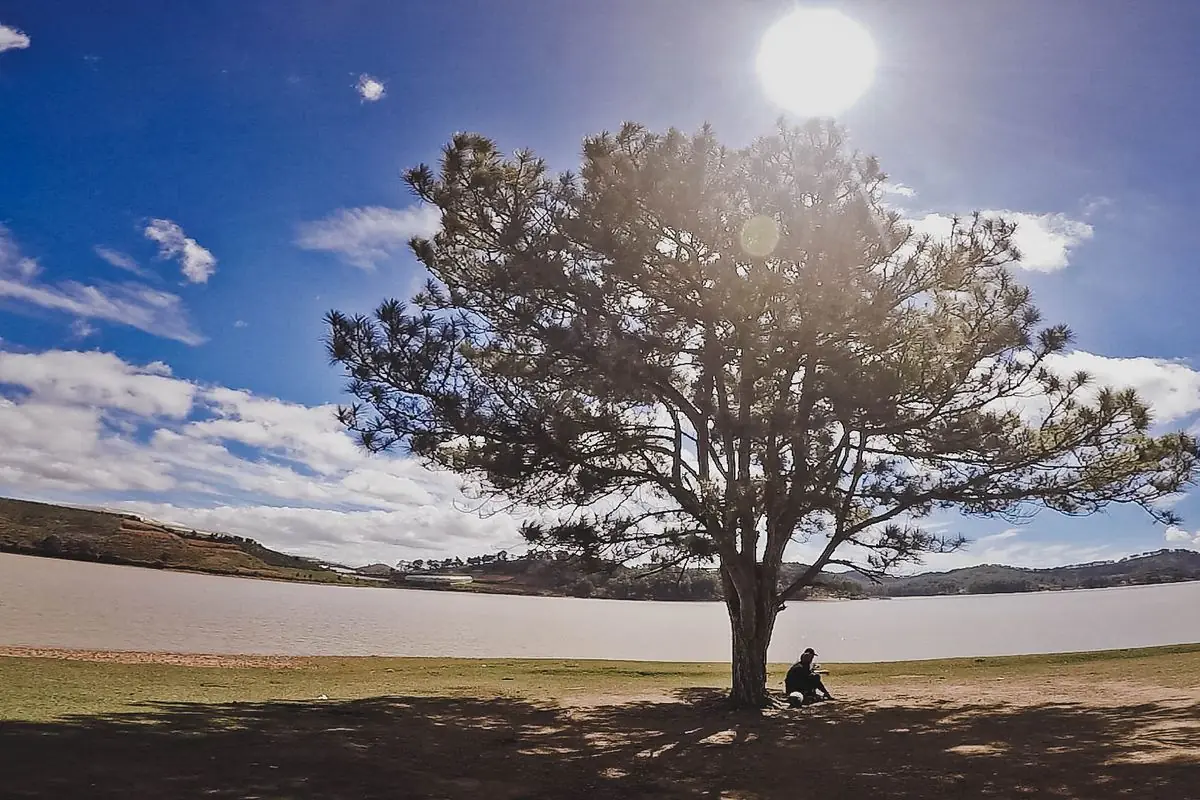
The second area lies near Dankia - Suoi Vang Lake, famous for the Lonely Pine Tree, or Cây Thông Cô Đơn.
The tree stands on an open hillside close to the water, surrounded by mountains and pine forests.
The pink grass area near the Lonely Pine Tree is roughly 5 km beyond Golden Valley. The actual distance to your chosen photography spot depends on the access route.
The scenery here feels more open than Golden Valley.
On a clear morning, you may be able to photograph pink grass in the foreground, the solitary pine tree in the middle distance, and the lake or misty hills behind it.
This is the landscape many travelers have in mind when searching for photographs of Da Lat's pink grass hills.
The difficulty is the final stretch of the journey.
Some routes involve dirt roads, steep slopes, rough surfaces, or muddy sections.
After rain, these roads can become slippery. Low-clearance cars may not be able to continue, and some older approaches involve crossing a stream or arranging alternative transport.
Do not assume that a rental scooter can take you directly to the tree just because the location appears close on Google Maps.
Choose the Lonely Pine Tree area only after confirming the current access route, road conditions, and whether someone familiar with the area can guide you.
Natural access tracks can change from one season to another because of erosion, barriers, or land management restrictions.
This location is better suited to active travelers, landscape photographers, and visitors comfortable walking on uneven ground.
Families with small children or older relatives do not need to make the difficult journey.
The easier hills around Golden Valley can be just as rewarding during peak pink grass season.
Is Masara pink grass hill worth visiting?
Ta Nang area, nearly 80 km from central Da Lat
Masara is another area known for open grasslands that can turn pink during the season.
It lies around the Ta Nang area, nearly 80 km from central Da Lat.
The landscape is different from Golden Valley.
Instead of smaller hills interspersed with pine trees, Masara offers broad, open grasslands with distant mountain views.
It is attractive for landscape photography and for travelers interested in spending time in a less-developed natural setting.
However, Masara is not a quick early-morning detour from Da Lat.
The distance is much greater, and reaching some parts of the area involves challenging terrain.
If you have only two or three days in Da Lat and want to spend one morning photographing pink grass, leave Masara out of the itinerary.
It makes more sense as a separate photography trip arranged with someone who knows the local routes.
How to get to Da Lat's pink grass hills
The easiest starting point to understand is Da Lat Market in the city center.
From there, you head northwest toward Ankroet Road to reach Golden Valley and the wider Suoi Vang area.
Use a specific destination name on your navigation app rather than searching only for "pink grass hill."
Some map pins are created by individual users and may point to the middle of a hillside rather than an accessible parking area.
Loading map...
- Da Lat Market: starting point
- Golden Valley: Ankroet Road, about 12-15 km from the center
- Dankia - Suoi Vang Lake: the lake beside the grass hills
- Lonely Pine Tree: about 5 km beyond Golden Valley, dirt track at the end
Directions to Golden Valley
A commonly used route from central Da Lat follows these roads:
- Step 1
Phan Dinh Phung Street
Start near Da Lat Market and head toward Phan Dinh Phung Street.
- Step 2
Xo Viet Nghe Tinh Street
Continue onto Xo Viet Nghe Tinh Street.
- Step 3
Turn onto Ankroet Road
Travel toward Tung Lam Junction and turn onto Ankroet Road.
- Step 4
Toward Golden Valley
Follow Ankroet Road toward Golden Valley Tourist Area.
- Step 5
Confirm access and parking
Near the attraction, confirm which nearby pink grass slopes can currently be accessed and where you should park.
The distance from central Da Lat is approximately 12-15 km.
Allow at least 30-45 minutes for the main road journey when planning your morning, plus additional time to park and walk to the grass.
This is a planning allowance, not a guaranteed travel time.
Rain, fog, roadworks, or unusually busy traffic can make the trip longer.
Once you arrive, do not automatically follow every path you see beside the tourist area.
Check which paths are open and permitted, especially when visiting before the attraction's official opening time.
If you want sunrise photographs on a natural hillside nearby, you must identify a legal access route in advance.
Do not climb fences or enter a closed tourist attraction before opening hours.
Directions to Suoi Vang and the Lonely Pine Tree
From the Golden Valley direction, continue toward the Suoi Vang area along Ankroet Road.
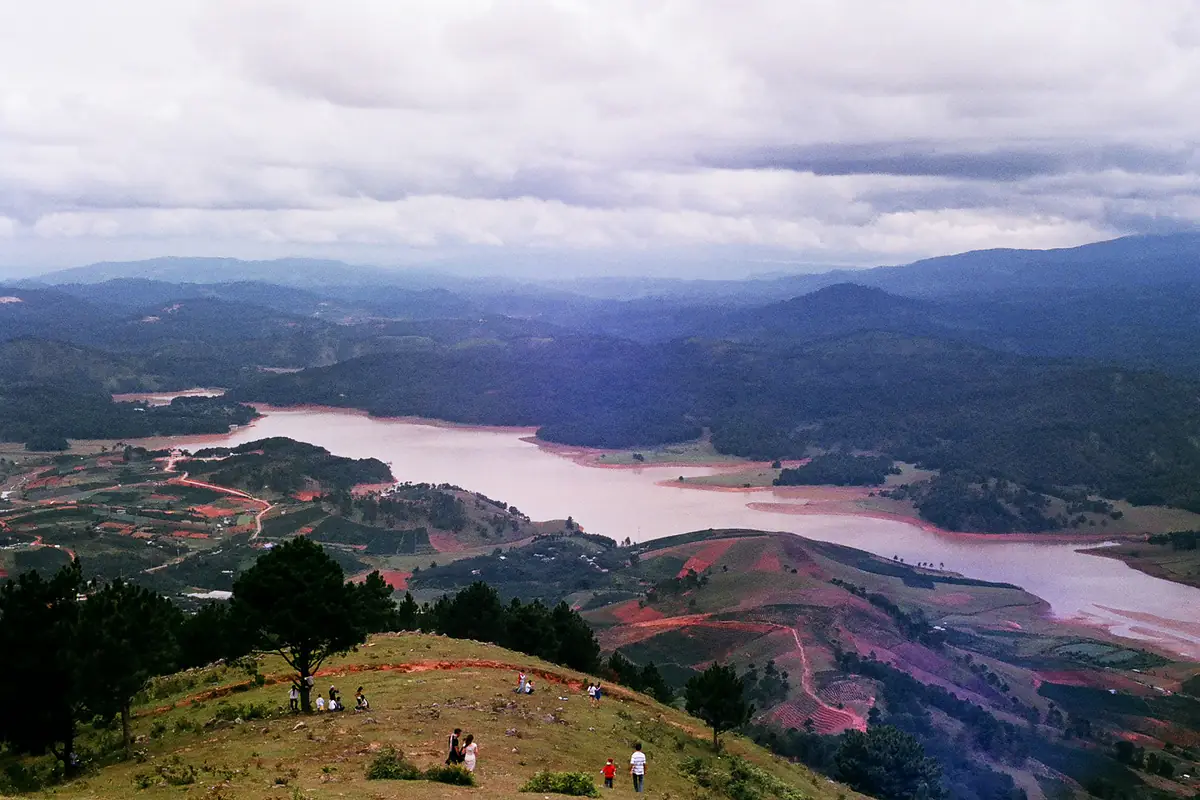
The familiar approach used to pass the Tien Sa Ecotourism area before turning onto dirt tracks leading toward the hills around the Lonely Pine Tree.
However, do not treat that approach as a guarantee that the route is still accessible.
The final tracks may change after heavy rainfall, erosion, construction, or changes in land access.
Before leaving your hotel, find out exactly where vehicles can stop, how far you need to walk, and whether the route involves crossing water.
Some local excursions may arrange additional transport or a crossing near the lake.
Use an identifiable operator with appropriate equipment and safety arrangements, and confirm the pickup point and price before departure.
Should you rent a motorbike or hire a car?
For Golden Valley, a car with a driver is a practical choice, particularly for international visitors or groups carrying photography equipment.
A vehicle can reach the main road area, although it may not reach the actual grass-covered slope.
A motorbike offers more flexibility when stopping along the road.
However, the rider must be comfortable with hills, wet surfaces, and uneven roads, and must hold a valid license for the vehicle.
International travelers should check whether their driving license is legally recognized in Vietnam for the relevant vehicle category.
If you do not have the required license or are unfamiliar with mountain roads, use a car with a driver or arrange a guided trip.
For the Lonely Pine Tree, do not assume that an ordinary rental scooter from central Da Lat is suitable for the entire journey.
You may also arrange a taxi or private car to a suitable drop-off point and continue on foot with local guidance.
Agree on the return pickup location and time beforehand. Remote hills are not necessarily places where you can easily find a ride back to the city.
How much does it cost to visit Da Lat's pink grass hills?
There is no single entrance fee covering all pink grass hills in Da Lat.
The naturally occurring grasslands are not one centrally managed attraction. Some accessible areas may be free to visit, but access depends on land ownership, local restrictions, and available routes.
It is important to separate attraction tickets from parking fees, local transport, and guiding services.
Entrance fees and costs in 2026
| Item | Price | Notes |
|---|---|---|
| Natural pink grass hills with permitted public access | No standard entrance fee | Confirm local access arrangements |
| Golden Valley Tourist Area - adult | VND 70,000 | 2026 ticket price |
| Golden Valley - children 1-1.2 m tall | VND 30,000 | Same 2026 price list |
| Golden Valley - children under 1 m | Free | Same 2026 price list |
| Electric shuttle at Golden Valley | VND 40,000 per person 1.2 m or taller | Separate service |
| Parking, local transfers, or guiding | Varies | Confirm before using the service |
Golden Valley Tourist Area is open from 7:00 AM to 4:30 PM daily.
Visitors purchasing tickets to the tourist area should follow those opening hours.
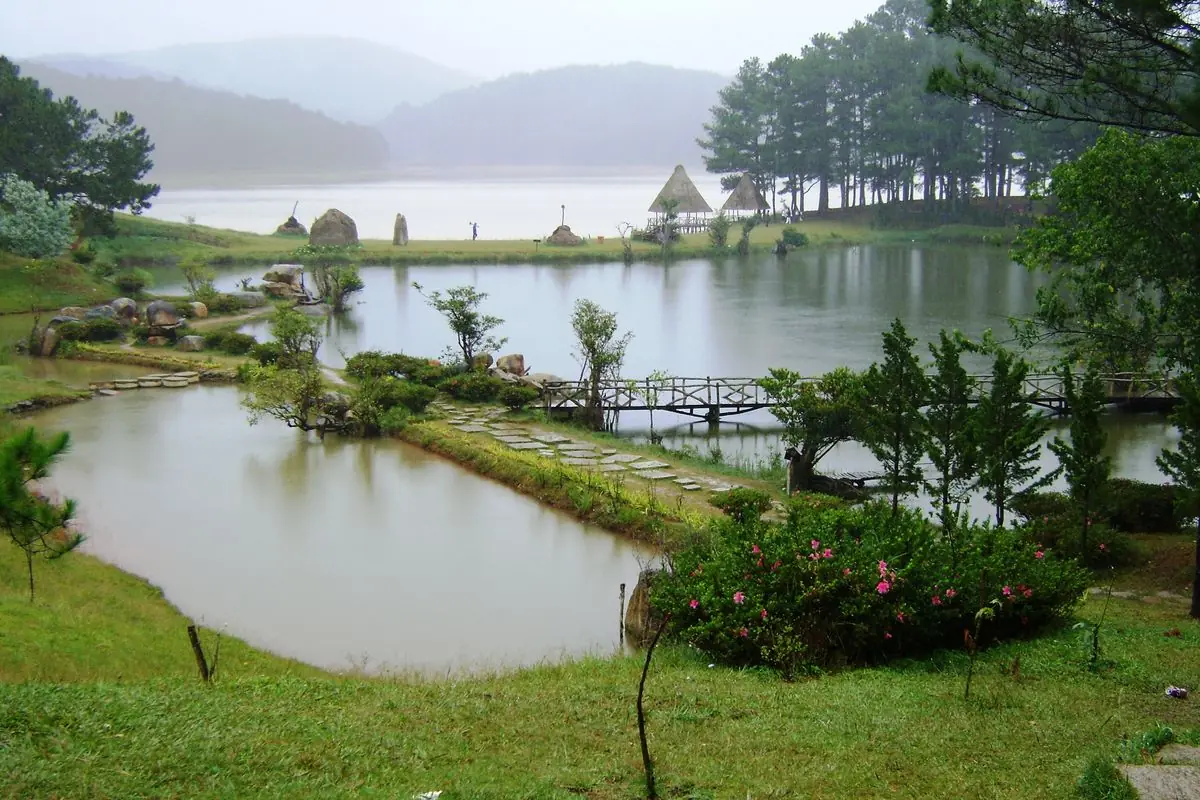
If you want to photograph pink grass at 5:30 AM, you need to identify a natural hillside with a lawful access route outside the ticketed attraction, or arrange access explicitly authorized by the relevant operator.
Another potential cost is parking.
In November 2024, some informal parking areas near pink grass hills charged around VND 5,000-10,000.
That is not an official fee schedule.
Ask about the current charge when you arrive.
For private transport or a local guide, agree on a total price, waiting time, pickup location, and return arrangement before starting.
There is no universal price for every route or group size.
What time should you visit for the best pink grass photos?
The best time is usually 5:30 AM to 7:30 AM.
On a clear morning, photographs can remain attractive until around 8:00 AM, but the dew generally begins disappearing as the sun rises.
The light changes quickly in the early morning.
Arriving a little before your preferred photography time gives you an opportunity to find a composition before the brightest light reaches the hillside.
5:30-6:00 AM: snow grass and morning dew
This is the period to prioritize if you want the silvery appearance of snow grass.
When the air is humid enough, dew settles on the grass heads.
As sunrise approaches, the droplets catch the first light, while the pine forest behind them may still be partly hidden in mist.
The result can be a soft landscape with white, silver, and pale pink tones.
However, the snow grass effect does not happen every morning.
Dry conditions, strong winds, or heavy cloud cover can change the appearance significantly.
If the fog is so thick that you cannot see the track clearly, stay on safe, accessible ground and wait for better visibility.
There is no reason to walk deeper into the hills in darkness merely to arrive a few minutes earlier.
6:00-7:30 AM: stronger pink colors
This is generally the easiest time for most travelers to take photographs.
As sunlight reaches the grass, the dew begins to evaporate and the pink-purple color becomes more noticeable.
Low-angle sunlight also brings out the texture of the fine grass heads.
The darker pine forest can provide contrast without overpowering the pink foreground.
This period works well for both landscape photography and portraits.
For natural color, look for a hillside receiving gentle sunlight rather than harsh direct light.
By late morning, the grass can look paler in photographs because the sunlight comes from higher overhead.
After 4:00 PM: an alternative for travelers who dislike early starts
Late afternoon can also produce attractive photographs, especially on a clear day.
The sunlight is warmer and lower, often turning the grass into shades of peach, pink, and light brown.
This can work particularly well for portraits.
The main disadvantage is that you will miss the morning snow grass effect.
Some slopes also fall into the shadow of nearby pine forests relatively early.
The direction of the hill matters.
Choose an afternoon visit only when you already know the access route, walking distance, and how to return before dark.
The Lonely Pine Tree area is not a good place to begin exploring an unfamiliar dirt track late in the day.
Is it worth visiting on a cloudy day?
Yes, but keep your expectations realistic.
The grass still has color under cloudy skies, although photographs often look less vibrant and have lower contrast.
Light mist can give the landscape a softer appearance.
Dense fog, on the other hand, may hide the pine forest, lake, and distant hills.
After rainfall, the grass may look fresh, but the access roads can remain slippery long after the rain stops.
On difficult routes, safe access matters more than catching a particular lighting condition.
How to photograph Da Lat's pink grass with a phone
You do not need a professional camera to photograph the pink grass hills.
A phone with a decent camera can produce good travel photographs when the light is right.
The key is to show enough grass in the frame.
A close-up of one small clump may reveal the fine pink flower heads, but it will not convey the impression of an entire hillside covered in pink.
Use a lower camera angle
A slightly lower camera position makes the grass in the foreground more prominent.
Try holding your phone around knee height and pointing it gently uphill.
This reduces the amount of bare ground in the frame and makes the grass appear denser.
You do not need to lie on the grass or step through delicate plants.
Stand beside an existing path, on exposed ground, or in a place where visitors are allowed to stop.
For wide landscapes, include some pine trees or a strip of sky.
A photograph containing only pink grass can look flat without a recognizable landmark or contrasting background.
Try gentle backlighting after sunrise
Morning sunlight coming from behind or beside the grass can create a bright outline around the fine flower heads.
Avoid aiming directly into an intense sun.
On a phone, tap your subject's face to set exposure, then lower the brightness slightly if the sky becomes too white.
HDR can help when the image contains both bright sky and dark forest.
However, avoid editing the contrast so heavily that the grass loses its natural color.
Real pink grass is usually softer and less saturated than the intensely pink images sometimes seen on social media.
Use the grass as a background for portraits
For individual portraits, stand near the edge of the grass and leave some distance between yourself and the background.
If your phone has a suitable 2x camera and there is enough light, try using it instead of the ultra-wide lens.
The narrower perspective can make the grass behind you appear denser and more continuous.
For group photographs, use a moderately wide view and keep people relatively close together.
Do not position everyone so far away that their faces become tiny within the landscape.
The open hills and simple background are already strong visual elements.
You do not need elaborate props to create attractive photographs.
Keep editing subtle
The natural color of pink grass is usually a mixture of pink, purple, and brown.
It is not uniformly bright pink.
You can slightly increase exposure, reduce harsh highlights, and add a small amount of vibrance.
Avoid pushing saturation until the grass becomes red or bright purple.
When photographing in mist, preserve some of the natural softness.
Excessive sharpening can make a delicate early-morning scene look artificial.
A half-day pink grass itinerary from central Da Lat
One morning is enough for Golden Valley or the Suoi Vang area.
You do not need to visit both locations, especially if your main goal is portrait photography.
The itinerary below assumes you have already confirmed a natural pink grass hillside that can be legally accessed before sunrise.
- 4:45-5:15 AM
Set off
Leave your accommodation, depending on its location
- 5:30-6:00 AM
Arrive
Arrive, walk to the confirmed spot, and check the light
- 6:00-7:00 AM
Dew and portraits
Photograph dew-covered grass, portraits, and landscapes
- 7:00-7:30 AM
Last shots
Take final photographs as the pink tones become clearer
- 7:30-8:30 AM
Breakfast
Leave the hillside and have breakfast
- After 8:30 AM
Rest of the day
Return to central Da Lat or continue your planned sightseeing
These are suggested planning times, not guaranteed timings for every hillside.
They also do not apply to attractions that remain closed until 7:00 AM.
Calculate your departure time from your actual accommodation.
A hotel close to Da Lat Market is not the same distance from Golden Valley as one near Tuyen Lam Lake or outside the main city.
Do not follow a generic schedule so rigidly that you end up rushing along mountain roads before sunrise.
Only have one morning?
Choose the Golden Valley area.
Find a nearby hillside where access is permitted and where recent photographs confirm that the grass is looking good.
Spend most of your time there.
Do not continue toward the Lonely Pine Tree if the roads are difficult or the weather is poor.
Moving between hills can consume the best photography light, especially when parking, walking, and finding a suitable position take longer than expected.
Have two mornings available?
Use the first morning for an accessible location and keep the second as a weather backup.
Consider the Lonely Pine Tree area on the second morning only if conditions are suitable, the grass is still attractive, and you have confirmed the route.
There is little benefit in squeezing several remote locations into the same sunrise window.
Pink grass photography depends on natural light, unlike sightseeing at attractions with fixed opening hours.
What should you bring to the pink grass hills?
Early mornings in the hills around Da Lat can feel colder than the city center, particularly when the wind is strong and the grass is wet with dew.
Wear a warm jacket during the journey.
Underneath, you can wear whatever outfit you intend to photograph.
Removing the jacket once you reach your chosen spot is more comfortable than standing outside for an hour in thin clothing.
Footwear is especially important.
Dirt tracks, damp grass, and muddy slopes can quickly ruin white sneakers or shoes with slippery soles.
Wear shoes with a good grip that can handle uneven ground.
If you want photographs in fashionable shoes, carry them separately and change only when you have reached a safe, stable area.
Charge your camera and phone the night before.
Moisture can collect on lenses in the early morning, so use an appropriate cleaning cloth instead of wiping them with a dusty sleeve.
What should you wear for pink grass photos?
Long dresses can look beautiful against pink grass, but choose one that is easy to move in and does not drag across wet ground.
Cream, ivory, pale blue, beige, and other neutral colors tend to stand out against the pink-purple grass.
Clothes with too many patterns can compete visually with the grass and pine forest.
A simple sweater, trousers, or jacket also works well.
You do not need a flowing dress to take good photographs here.
For groups, coordinating a general color palette is usually better than wearing identical outfits.
When everyone stands together, the result looks more natural.
Can you bring young children?
Families can visit some of the easier-to-reach areas when the weather is suitable and the access route has been checked.
Avoid difficult mud tracks or stream crossings just to reach a famous photography spot.
The early morning can be cold and damp, with limited opportunities to sit down or take shelter.
Bring warm clothes, drinking water, snacks, and allow enough time to return to your vehicle.
For children who still need a stroller, a managed attraction with established paths during opening hours is more practical than a remote natural hillside.
Why your pink grass photos may not look like the pictures online
Reaching the correct location does not guarantee the same scenery you saw on social media.
The first reason is visiting at the wrong stage of the season.
Early in the season, pink grass may appear in scattered patches. Later, older grass turns brown.
Neither stage looks like the soft, continuous pink carpet seen in photographs taken at the seasonal peak.
The second reason is poor timing during the day.
A hillside can look richly pink at 6:30 AM and much paler at 10:00 AM.
Even on the same hill, slopes facing different directions receive sunlight differently.
The third reason is location confusion.
Many photographs are labeled simply "Da Lat pink grass hills" even though they were taken at Golden Valley, Suoi Vang, Masara, or another grassland.
These places are not all close together.
The fourth reason is outdated photographs.
A photo uploaded this week may have been taken last November.
Its publication date does not prove that the grass currently looks the same.
Heavy color editing makes it even harder to judge real conditions.
The fifth reason is failing to check the access route.
Some travelers reach the correct general area but do not know where to park or which path is open.
Spending another hour trying to find a route can mean missing the best light completely.
To avoid these problems, confirm the exact location with recent photographs, check the weather one or two days before your visit, and understand the final part of the journey before leaving your hotel.
Five steps to plan your pink grass trip
These five steps are useful before committing an early morning to the pink grass hills.
- Step 1
Choose the right part of the season
Prioritize late November through early December.
If your trip falls in early November or late December, look for recent photographs before adding pink grass to your itinerary.
Do not assume that November 20 or December 1 will be the best date every year.
- Step 2
Identify the exact hillside
Save an example photograph showing the type of scenery you want.
Check whether it shows low pink grass or taller pink foxtail grass.
When contacting a driver or guide, send the image and ask for the exact area, the date of the latest photographs, the vehicle drop-off point, and the walking route.
- Step 3
Check the route and transport
Find the main road on your map first.
Then verify the final access section using current information.
Golden Valley is generally the easier option for first-time visitors.
Suoi Vang and the Lonely Pine Tree require more preparation, especially after rainfall.
Do not drive a low-clearance car or an ordinary rental motorbike onto an unfamiliar dirt track without understanding the conditions.
- Step 4
Confirm the costs
Separate natural hillsides from ticketed tourist attractions.
Ask about entrance fees, parking, transfers, and guiding services.
Golden Valley Tourist Area's entrance fee does not apply automatically to every pink grass hillside in the surrounding area.
- Step 5
Choose your photography window and backup plan
Aim for roughly 5:30-7:30 AM when access is permitted and the road and weather conditions are suitable.
If the weather is poor or the route is too slippery, change your plans.
On a multi-day trip to Da Lat, keeping one backup morning is better than relying entirely on the first day.
Should you visit the pink grass hills on a weekend?
Weekends generally bring more visitors to Da Lat, particularly when photographs of pink grass begin circulating widely online.
Popular areas, especially the Lonely Pine Tree, can attract several photography groups at once.
Couples taking wedding photographs, landscape photographers, and independent travelers may all want the same morning light.
The most attractive conditions often last only a short time.
Waiting for other people to leave a particular viewpoint can use up much of that window.
Weekdays may offer more freedom to choose a composition.
However, do not enter a remote or restricted area simply to avoid other visitors.
If a hillside is busy, try a different angle, use pine trees as your background, or photograph from the edge of the established path.
There is no need to walk through the middle of the grass to find an empty section.
The plants grow naturally, and areas damaged by repeated trampling will not recover immediately.
Avoid lighting fires, leaving rubbish, or camping where permission has not been granted.
Areas near pine forests may have specific management and fire safety requirements. Follow local signs and instructions.
How to fit pink grass into your Da Lat itinerary
Pink grass should normally be the first activity of the day, not somewhere you stop after breakfast and several other attractions.
You can spend the night in Da Lat, leave early the following morning, photograph the grass, and return for breakfast and a rest.
This works for a two-day, one-night trip if your transport is properly arranged.
With three days and two nights, choose whichever morning has the better weather forecast.
There is no need to insist on visiting the grass hills on day two rather than day three.
If you have just arrived on an overnight bus and barely slept, do not force yourself to leave again at 4:30 AM simply to catch sunrise.
Fatigue can make both the journey and the photography less enjoyable.
After visiting the pink grass, you can continue to a nearby attraction along the same route or return to central Da Lat.
More distant areas such as Cau Dat, Ta Nung, and Tuyen Lam Lake are better planned as separate routes rather than trying to cross the city repeatedly.
Late November also brings other seasonal scenery to Da Lat.
You can combine the pink grass with flower seasons, local events, and other sightseeing on the remaining days.
But there is no reason to turn a short pink grass photography trip into a rushed journey between distant attractions.
Final recommendation: Golden Valley or the Lonely Pine Tree?
For your first visit, especially if you only have one morning or are unfamiliar with dirt roads, choose the pink grass hills around Golden Valley and confirm a nearby accessible spot before leaving. Choose the Lonely Pine Tree area instead if the lake and more remote mountain scenery are your priority, and you have a knowledgeable guide and a safe, verified route.
FAQ
What month is best for seeing pink grass in Da Lat?
Late November to early December is usually the best period. The grass may begin appearing in late October and last until late December, but the exact timing changes each year. Check recent photographs of your chosen hillside a few days before visiting.
Where are the pink grass hills in Da Lat?
The two most popular areas are around Golden Valley and Dankia - Suoi Vang Lake near the Lonely Pine Tree, approximately 12-20 km from central Da Lat depending on the exact location. A common route from the city follows Phan Dinh Phung Street, Xo Viet Nghe Tinh Street, and Ankroet Road. The hills do not share a single official entrance.
Is there an entrance fee for Da Lat's pink grass hills?
There is no standard entrance fee for all natural pink grass hills, and some accessible locations may be free. Golden Valley Tourist Area charges a separate entrance fee of VND 70,000 for adults and VND 30,000 for children measuring 1-1.2 m tall in 2026. Parking and local transport may cost extra.
What time of day is best for pink grass photography?
Between 5:30 AM and 7:30 AM is generally best, particularly when there is morning dew and gentle sunlight. Late afternoon after 4:00 PM can also be attractive, although the snow grass effect will be gone. Early-morning visits require a legally accessible route; Golden Valley Tourist Area itself opens at 7:00 AM.
Can I ride a motorbike to the Lonely Pine Tree pink grass hills?
Only if you have the appropriate driving license, are experienced on mountain roads, and have checked the current route. The final dirt tracks can be steep, rough, and slippery after rain. For first-time visitors or international travelers unfamiliar with the area, a car with a driver combined with local guidance is usually the more manageable choice.